

On a September day that was replete with sunshine, we voyaged to Versailles, the decadent Baroque palace of France’s roi soleil (sun king). As Shawn and I wandered among the palace’s 250 gardened acres and peered through windows into the gilded interiors — just as a subject might have done 300 years ago — I was reminded of history lessons about the French Revolution.



Wanting to escape Paris’ stuffy climate in the seventeenth-century, Louis XIV summoned architects to spiff up and greatly expand his father’s hunting lodge and grounds. The King’s planners drew up extensive expansion plans that commenced in 1661, resulting in one of the world’s largest palaces. More than 30,000 laborers are said to have participated in the building projects!

In 1678, Louis XIV had begun moving his court to Versailles. By 1682, nearly 20,000 noblemen, servants and flatterers had moved into Versailles resulting in the court’s official establishment there. With the seat of government then outside Paris, and the nobility leading debauched lifestyles at Versailles, so the seeds of the French Revolution were born.

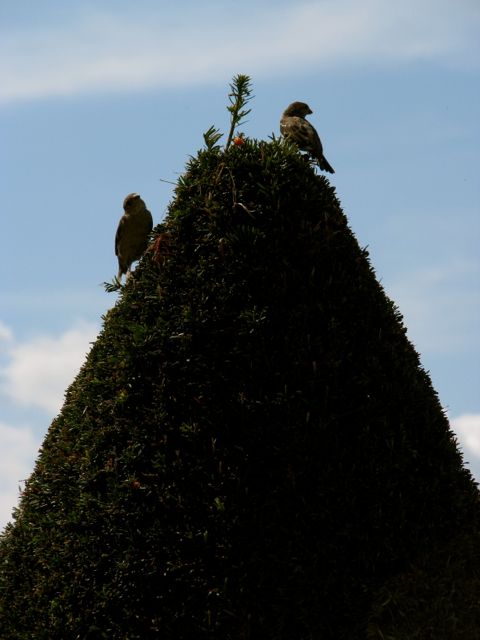

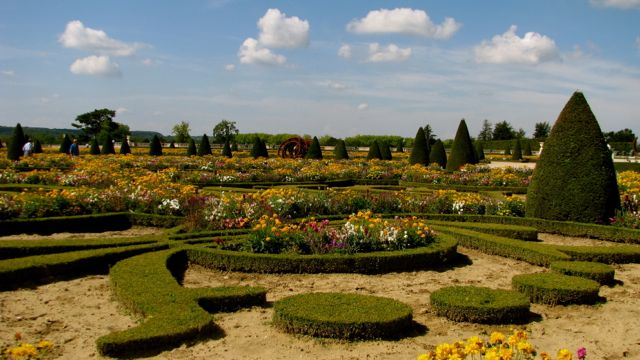
Despite the blazing sun, and ornamental gardens that lack shading and protective canopies, we spent several hours promenading through Versailles’ grounds, which actually form one of Europe’s largest parks. Amazingly, forests were once imported to ornament Versailles’ gardens, the focal point of which is the mile-long Grand Canal.

The flowerbeds and hedges were coiffed immaculately. Versailles’ chief landscape architect, André Le Nôtre’s quotation about the palace’s view into the delicate gardens seemed timely: “Flowers can only be walked on by the eyes.”
In Louis XIV’s time, it was not possible to run all the fountains at once, so when Louis strolled through the grounds, the fountain-tenders turned on the fountains in advance of his footsteps and then turned them off behind him.


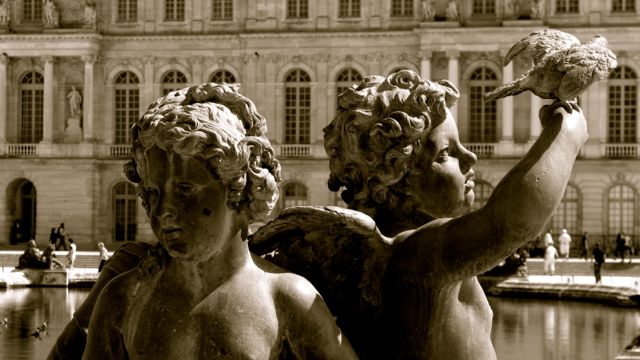
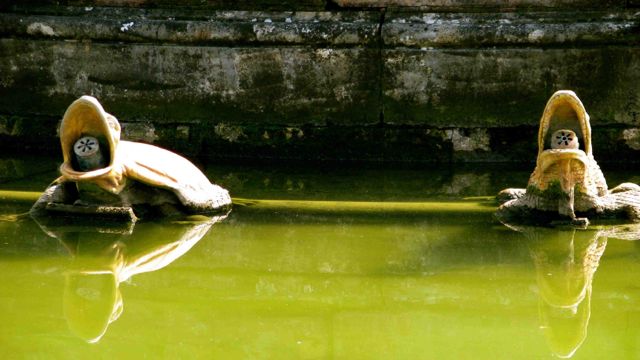
The gardens’ more than 600 fountains and statues were installed between 1661-1668. I most enjoyed the cherub statues as well as the creative manner in which fountainheads were camouflaged as cat-tail plants or as if they were coming out of turtles’ mouths.



Our readings about the palace’s posh interiors didn’t persuade us to venture into the treasure box-like rooms. Nevertheless, one guidebook statistic about the over-the-top décor stuck with me: Versailles’ paintings, if laid end to end, would equal more than 7 miles (11 km.) of canvas!


Where in the World?
Planning Pointers:
- The Palace of Versailles is located about 15 miles (24 km.) southwest of Paris. We traveled there by car. However, you can travel from Paris to Versailles by train.
- When we visited on a Friday, we were disappointed to discover that the fountains were not running. Nevertheless, we were pleased that there was no entrance fee, as a result. The palace’s official website details when the fountains are running, as well as Versailles ticket prices.
Photography & text © Tricia A. Mitchell. All rights reserved.


Join the conversation.