

As our minibus chugged through the Albanian countryside during a 6-hour trip, my husband and I inadvertently created a new car game to pass the time: Who could first spot a bunker as a new one appeared in the ever-changing scenery?
With nearly 700,000 bunkers still dotting this southeastern European nation’s landscape, the game didn’t prove challenging. We saw a man leading a donkey past a mammoth-sized bunker, and then small ones clustered at the tops of hills. We even saw another pair nestled beside a home.

Though we were very curious about the concrete mushroom-like structures, our fellow passengers didn’t seem to give them much attention. For Albanians, it seems, they’re a ubiquitous part of the country’s scenery, a reminder of an unpleasant chapter of the country’s history.


Albania’s former dictator, Enver Hoxha, was bonkers for bunkers. Paranoid that his former Communist allies or NATO enemies would invade Albania, he instituted the bunkerization program. These UFO-lookalikes were erected in semi-rural areas, near apartment complexes, on beaches, in playgrounds, and even in cemeteries.
Between 1967-1985, it’s estimated that one bunker was built for every four Albanian citizens. Hoxha’s isolationist regime has been compared to North Korea’s. Hoxha died in 1985, Communism ended in 1991, and the bunkers were never used for their intended purpose.
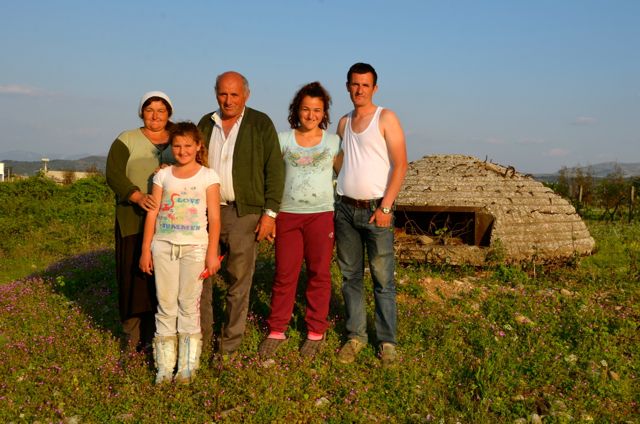
Our Albanian host for the week, 68 year-old, Zef Kodra, estimates that he built 200 of these bunkers. One afternoon, Zef took us out to see one bunker structure that’s just a three-minute walk from his family’s home in the northern Albanian city of Shköder.
Zef’s bubbly personality is evident as we stroll through his semi-rural neighborhood to “his” bunker. We pass locals who are curious about the foreign visitors he is escorting, and he exudes an air of pride, mentioning the Albanian word bunkari multiple times, while gesturing to the field out in the distance where the bunker sits.

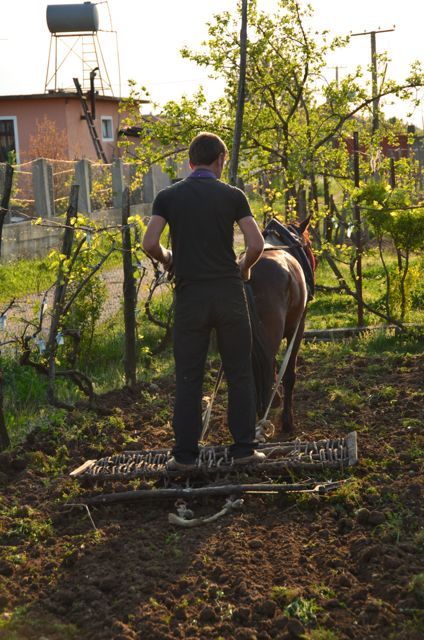
On our way, there is a man directing a horse-drawn cart on the concrete road, and another tilling his front yard using a stand-behind horse-drawn plow. The man appears to be riding on a rattan or wooden platform. As we pass the home, the farmer’s wife and young children enthusiastically wave at us, encouraging us to take a photograph of the father. When he rides by us on the plow, he nods and smiles, while ordering the horse to keep pulling. The work looks challenging, not only for the animal, but also for the man.



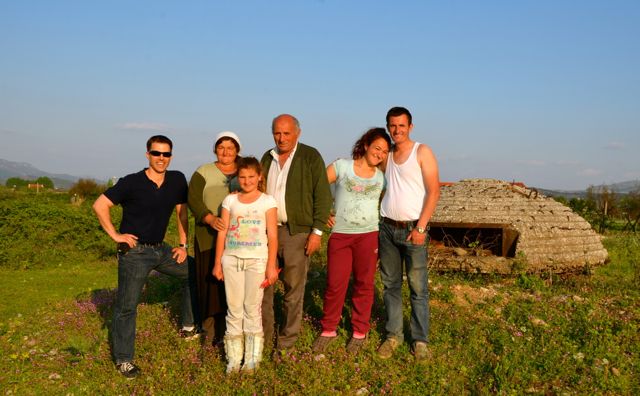
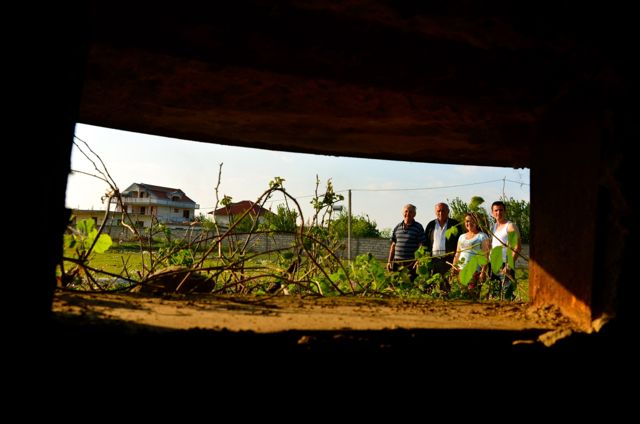
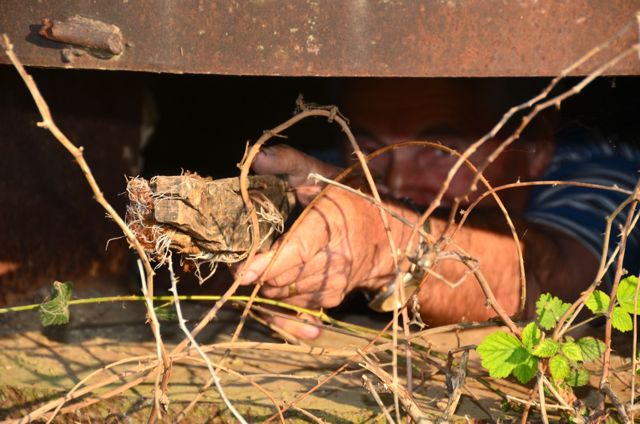
When we reach the bunker, we find that its sniper window is overgrown with a raspberry-like bush. Zef finds a piece of wood, which he uses to tear away the brush. By now, a family of five has emerged from their neighboring home, curious what we’re up to. They smile, giggle, and pose for several pictures in front of the bunker. They ask where we’re from.

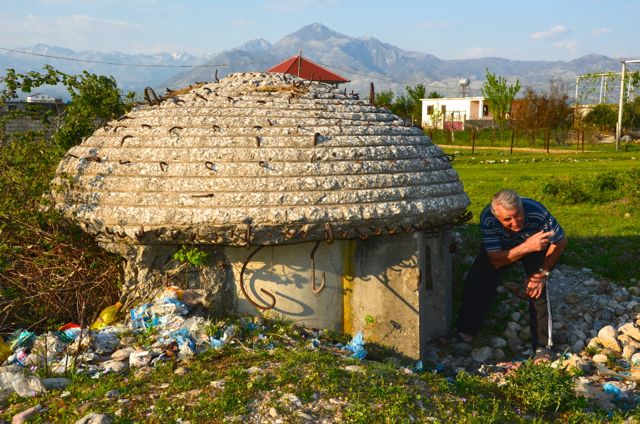
Ever the prankster, Zef climbs inside the bunker, propping the rifle-lookalike piece of wood through the sniper window, pretending to take shots. When he emerges, he makes gestures towards the bunker that suggest that he’s miming a smashing motion with an imaginary sledgehammer.


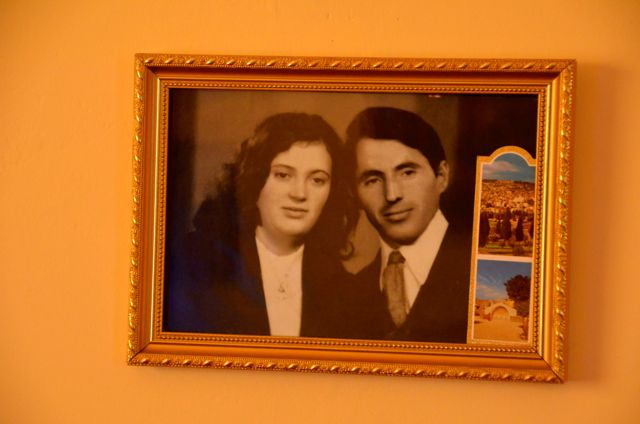
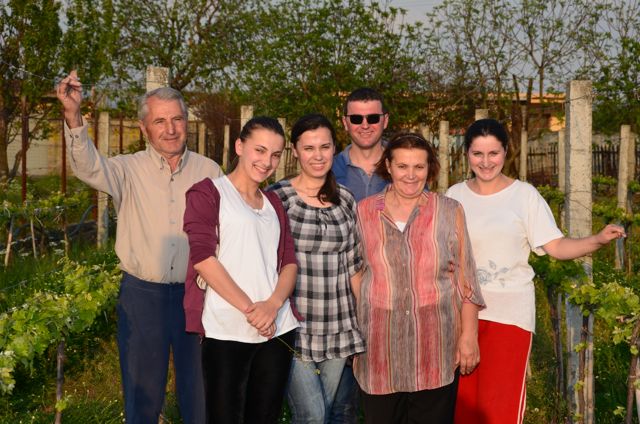
With his son, Florian, acting as translator later that evening, Zef tells us more about his bunker-building years. We sit in the family’s new living room, which they’d just built to expand their guesthouse business. A vintage portrait of Zef and his wife, Age, hangs on the wall. In his younger years, Zef resembles the American actor Gregory Peck, I think.
Two times during our interview, the power cuts out. Despite these temporary inconveniences, Zef keeps talking, laughing, and describing his experiences.
“I built bunkers under the Communist system of Enver Hoxha between 1965-1985,” Zef says.
“I once worked on a farm, but one day, the farm’s director told me and the other workers that we must go work in another area. Then we were told to begin building bunkers.”
“It took approximately one week to build one bunker, and there were generally two sizes,” Zef explains.
“We used lots of material to build a bunker – there were two types of metal, concrete, and mountain stones. I worked 8 to 9 hours per day, and earned about €2 per month.”
“The dictator, Enver Hoxha was handsome, but he had a criminial spirit. He put fear into the people of Albania. Albania itself was in jail. We were told that “the enemy is coming” and that we “must mobilize, because the Mother Party is calling.’ ”
“The main gangsters were the USA and western Europe. We were ordered not to read American literature because we were told that it would be bad for our health.”
Zef and Florian explained that Albanian citizens needed a passport to visit another Albanian city. International travel was, of course, out of the question. Religion was also banned.
Ironically, one year Hoxha visited a cafeteria in the vicinity of Shköder, where he sampled the wine that Zef had made himself.

We were curious what Zef thought about all the North American, Western European, and Australian guests that frequent his business today, so we asked him if he remembers the first American he ever met. It turns out that he met an Albanian-American immigrant in 1993.
“The government taught us to hate the US, but still we thought America had good freedom and human rights,” Zef says. “Of course, we had to keep our thoughts to ourselves. There was no political dissent.”

Having read recent articles that discussed Albania’s uncertainty about what to do with the plethora of bunkers, we asked Zef his thoughts.
“Destroy them with explosives, collect the scrap metal and sell it. At least then I could get some money for all the work I did to build them,” Zef says.
But Zef does not dwell on the past.
“After a long time of darkness, I am now living the best part of my life. Now, I am in the light.”
His brother, Tony, who spent several years living in the United States, talks about the period of bunkerization in a more somber fashion.
“So much money was spent on them,” he says. “Houses and roads could’ve been built with those resources.”
Given Albania’s dilapidated roadways and status as one of Europe’s poorest countries, Tony’s assessment is fitting. The bunker building undertaking in Albania reportedly required three times as much concrete as was used to build France’s Maginot Line.
Another source claims that it costs approximately €800 to destroy just one bunker.
Florian mentions that some creative Albanians in other cities have turned the bunkers into guesthouses or cafés. We’ve also read that they’ve been repurposed into wine cellars, restaurants, and a tattoo parlor. They’re also said to shelter animals, the homeless, and young Albanians as they share amorous moments.

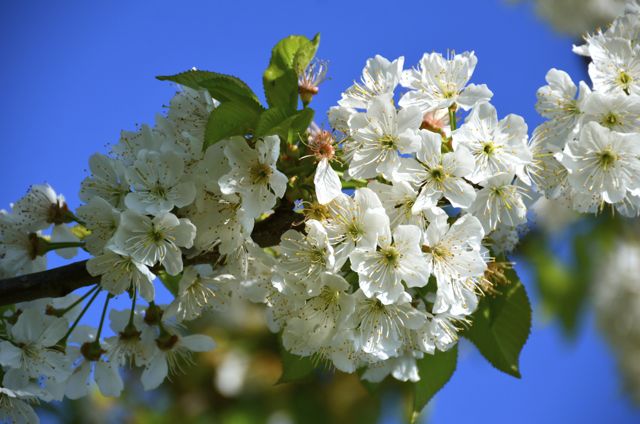
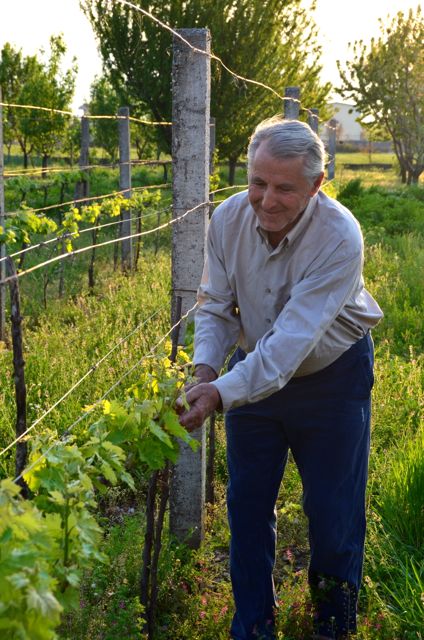
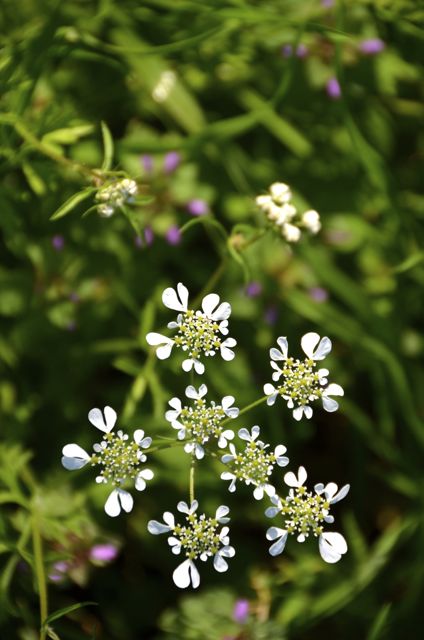
The next evening, as we stroll through the family’s vineyard that Zef cultivates, we look upon the spring blooms framed by white-capped mountains, and Albania’s future seems bright.
We’re honored to have met Zef. We’re also happy that he’s had the opportunity to exchange bunker-building for wine-making — and the chance to nurture the family’s ever-growing guesthouse business.
Don’t miss Shawn’s video below, which gives you a better picture of the beautiful Albanian landscape, and the warm reception we received there.
What do you think would be a good use for Albania’s bunkers? Should they be destroyed or repurposed?
Video of this Experience:
Where in the World?
Planning Pointers:
- The city of Shkodër, where Zef and his family live, is located in northwestern Albania, about 110 kilometers (65 miles) from Kotor, Montenegro. We stayed overnight in the town of Ulcinj, Montenegro before crossing the border into Albania. We traveled by bus.
- During our week spent in Shkodër, Shawn and I stayed at Florian’s Guesthouse (affiliate link), an authentic homestay managed by Zef’s son, Florian, and his family. Spending time there allowed us to get a feel for what life is like in a semi-rural, residential Albanian neighborhood. (The homestay is located in the outskirts of Shkodër, about 30 minutes away on foot, but you can borrow a bicycle from the guesthouse to make the journey quicker.) Florian’s mother, Age, and sister, Emanuela, made hearty, traditional meals by scratch, incorporating heaps of fresh vegetables from the family’s garden. The ladies were eager to demonstrate how to make Albanian dishes like Byrek, and Emanuela even made me homemade, gluten-free cornbread, something that paired quite well with the vegetable soup. Father Zef treated us to his homemade wine, lovingly made from grapes grown across the street from the family home. And aunts, uncles, and cousins stopped by, sharing photo albums and wedding tales with us. Fellow guests from the Netherlands, Poland, and England also helped make our stay there enjoyable. As an update from our 2013 visit, we’ve since heard that Florian has opened an additional hostel in Shkodër’s city center.
Photography & text © Tricia A. Mitchell. All Rights Reserved. The video was made by my husband, Shawn.


Leave a reply to Tina Schell Cancel reply