
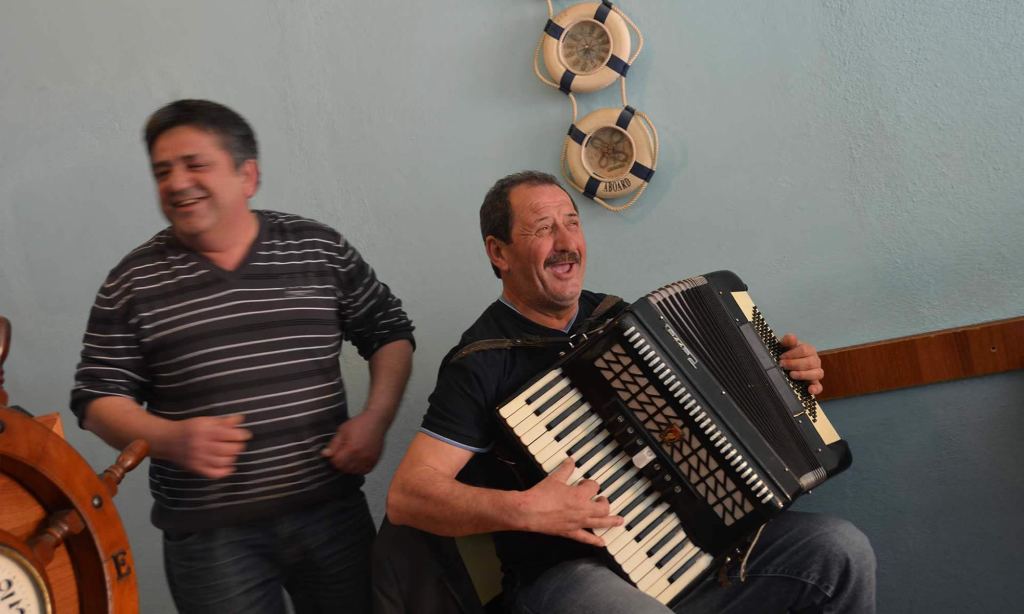
The moment we stepped into the tiny Albanian bar bearing mint-green walls, I regretted having not been more studious when learning Italian several years earlier. The five gentlemen inside the Shkodër establishment spoke Albanian of course, but between the two of us, Shawn and I only knew about five Albanian words.
The seven of us quickly defaulted to Italian. When that didn’t go so well, we realized we really only needed to use the universal language to communicate.
Music that is.

“Music is the universal language of mankind.”
Henry Wadsworth Longfellow

The warm sound of an accordion is what lured us into the bar, after all. Then came the contagious laughter of the men inside and the promise of an authentic experience, in a country not yet on the tourist radar.
The owner, Nikola, pulled out two chilled cans of B52, an energy drink that would have us buzzing for hours to come. He set them on our table, and made it known that this was his treat. There was no way that he was going to let us pay.

Luigi’s music had everyone in the nautical-themed establishment doing toe tapping, with Luigi’s black, pointy shoe leading the way. The men sang. Shawn and I didn’t know the lyrics, but still we hummed and we swayed along.
The expressive looks on Luigi’s face were priceless. During more passionate measures of the music, he looked as if he were about to cry. But then there came a brilliant, merry crescendo, and his face sported a wide-eyed grin.
I believe that music has the power to bring happiness into anyone’s life, but I suspect that during Albania’s brutal chapter under dictator Enver Hoxha, it was one of the only pleasures that citizens could savor. I imagined Luigi during those decades, belting out a tune on the same accordion.

Two older gentlemen, smartly dressed in sport coats and button-up shirts, sat at Luigi’s table. One of them was a violinist. That fellow only stayed for a few songs, then bid his friends goodbye, pedaling off on his little bike. I wondered for how many decades he’d had this same Saturday ritual?

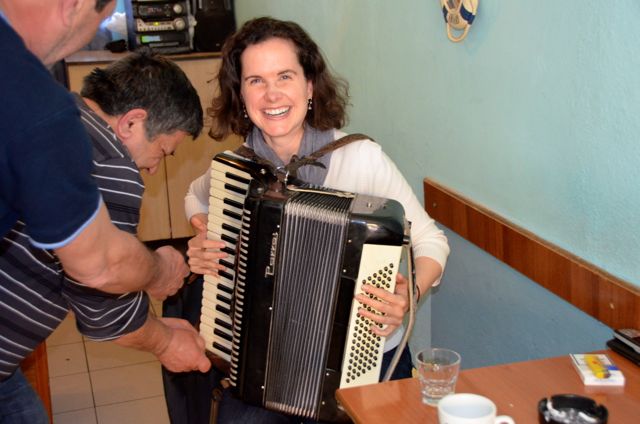
Long appreciative of the charm an accordionist’s music adds to Europe’s Old World ambience, I’d always wanted to tickle the ivories of an accordion. I asked Luigi if I could play a tune. He obliged, helping me put the accordion over my head. He even offered his muscle power by pumping the accordion’s bellows.
I got a diplomatic response from my international audience when I played Scott Joplin’s ragtime tune, The Entertainer. Americans probably recognize this song from the film, the Sting, or as one often belted out of ice cream trucks. However, for the Southeastern Europeans, it seemed to be an unknown jingle.
When I played the Italian classic, La Donna è Mobile, the reaction was instantly enthusiastic. The men were swaying and singing. I couldn’t keep from laughing.
Without Luigi, I wouldn’t have been able to play the accordion at all though, because I couldn’t muster up the coordination or the muscle to pump the instrument’s bellows.
And so it was that an Albanian man chivalrously pumped the bellows on the left, while an American woman played its more keyboard-like side on the right. Forget about high profile meetings between world leaders; this was citizen diplomacy at work.


Feeling sufficiently energized by now, thanks to the lively music and the caffeine and sugar swimming in our veins, Shawn and I decided it was time to walk off some calories on Shkoder’s streets.
Ever the generous host, Nikola didn’t let us go so easily. He walked us down the street to his son-in-law’s brand new seafood restaurant, insisting on treating us to yet another drink.

When we tried to pick up the tab, Nikola playfully said, “No, it’s my turn. When I come to California to see you, then it’s your turn.”
Where in the World?
Planning Pointers:
- The city of Shkodër is located in northwestern Albania, about 110 kilometers (65 miles) from Kotor, Montenegro. Shawn and I first stayed overnight in the town of Ulcinj, Montenegro before crossing the border into Albania. We traveled by bus.
- During our week spent in Shkodër, we stayed at Florian’s Guesthouse (affiliate link), an authentic homestay managed by Florian and his family. Spending time there allowed us to get a feel for what life is like in a semi-rural, residential Albanian neighborhood. (The homestay is located in the outskirts of Shkodër, about 30 minutes away on foot, but you can borrow a bicycle from the guesthouse to make the journey quicker.) Florian’s mother, Age, and sister, Emanuela, made hearty, traditional meals from scratch, incorporating heaps of fresh vegetables from the family’s garden. The ladies were eager to demonstrate how to make Albanian dishes like Byrek, and Emanuela even made me homemade, gluten-free cornbread, something that paired quite well with the vegetable soup. Father Zef treated us to his homemade wine, lovingly made from grapes grown across the street from the family home. He also showed off one of the bunkers he’d built, about a three-minute walk from the family’s property. And aunts, uncles, and cousins stopped by, sharing photo albums and wedding tales with us. Fellow guests from the Netherlands, Poland, and England also helped make our stay there enjoyable. As an update from our 2013 visit, we’ve since heard that Florian has opened an additional hostel in Shkodër’s city center.
Photography & text © Tricia A. Mitchell. All Rights Reserved.


Leave a reply to Ludwig Cancel reply