
Believed to be one of the oldest prehistoric underground temples in the world, the Ħal Saflieni Hypogeum is a mysterious and impressive engineering marvel crafted by Malta’s “Temple Builders.”
Little is known about the sophisticated Temple Builders and why they eventually vanished from the island, leaving only their temples behind. Incredibly, some of their structures predate Stonehenge and the Great Pyramid at Giza.
Archaeologists think Malta’s Hypogeum was carved out of living rock as far back as 3600 BCE, and originally used as a sanctuary, then as a necropolis. The remains of approximately 7,000 people were found there.
By the time the Hypogeum was officially rediscovered in 1902, four homes had already been built on top of it. It’s said that real estate developers kept an even earlier discovery quiet so that they could continue constructing homes. The four modern structures have since been demolished, but the site is now engulfed by twentieth-century townhouses. With its present nondescript exterior, you would never guess that a prehistoric treasure like the Hypogeum dwells below ground.
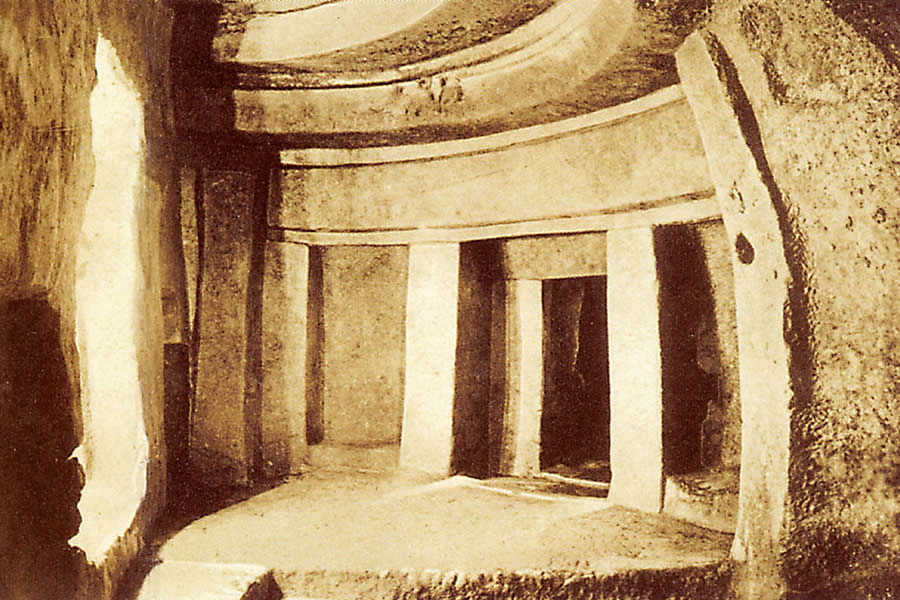
The Hypogeum is built on three levels, with the oldest at ground level. What’s especially incredible about the structure is that it has survived earthquakes.
Aesthetically, it’s also impressive that the individuals who sculpted it employed techniques that made it look like architecture, using simple tools to carve the rock.
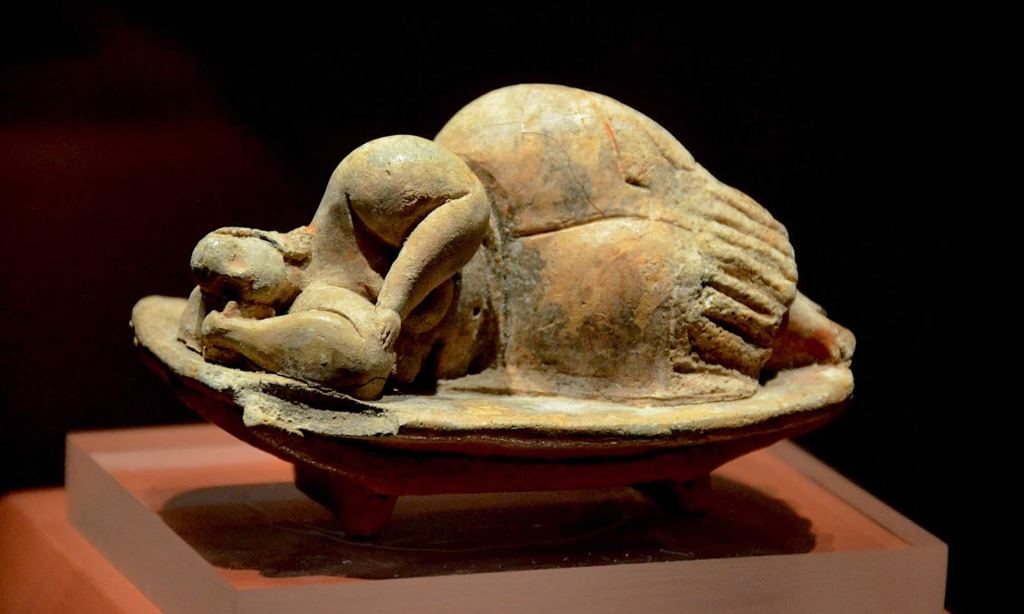
Archaeologists found human remains within the Hypogeum, as well as pottery, amulets, beads, and the “Sleeping Lady” statue. Made of clay, this tiny statue depicts a reclined woman, perhaps symbolizing eternal rest. Today, the statue is in Malta’s National Archaeology Museum in the city of Valletta.
As we descended into the musty site, water droplets fell from the rock ceiling, which shimmered with moisture. Jammed next to the other visitors, I stepped carefully so I didn’t slip on the path. The air was damp and cool. I shuddered to think how foul the smell must have been millennia earlier when the chambers were filled with decaying corpses.
Occasionally, our female guide pointed out the Hypogeum’s highlights. At other moments, the audioguide prompted us, with a primordial beat in the background. I thought it was fitting that the musician who had created the audioguide’s haunting soundtrack had actually composed and recorded it inside the temple using stones, pottery, and a frame drum as instruments. Apparently wanting to be inspired by the Hypogeum’s surroundings, he spent a great amount of time underground there.
On some of the walls, you could still make out ornamental swirls of red ocher, a natural pigment likely originating from nearby Sicily. Since red ocher has been found elsewhere on Temple People artifacts, it’s thought to be a spiritual flourish, perhaps symbolizing blood or life.
No one actually crooned inside the Hypogeum’s oracle chamber during our tour.
However, our guide explained that specialists had actually discovered that if a man were to call into the abyss, his booming voice would resonate eerily through the temple.
Apparently, this doesn’t work for female voices.
It’s unknown if the resonating effect was deliberate, and if it might have had a spiritual purpose. Perhaps someday we’ll know why, but for now, it’s fascinating to ponder such mysteries of the Hypogeum.



Where in the World?
Planning Pointers:
- The Hypogeum is located in the town of Paola, 7 km (about 4 miles) south of the capital city of Valletta.
- The Hypogeum is a UNESCO World Heritage site. Because of the Hypogeum’s fragile nature, a minimal number of visitors are allowed inside each day. Due to the limited number of tickets available, it’s a good idea to buy tickets well in advance. You can buy tickets from the site’s caretaker, Heritage Malta. The Heritage Malta website details Hypogeum ticket prices and opening hours, as well as where you can buy Hypogeum tickets online, directly.
- As of 2023, tickets are €35 for adults, €20 for seniors, €20 for students, and 15€ for children.
- As we prepared to descend into the Hypogeum, a Heritage Malta employee collected all the purses, cameras, and backpacks of the people on the tour, and stowed them into a locked cabinet near the check-in desk. We were able to reclaim items left behind once we came back upstairs.
- In order to protect the site, photography is not allowed inside, so some of the images I’ve shared here are in the public domain.
- Note that it’s dark and damp inside the Hypogeum, and rather cramped — not surprising since this site is nearly 5,000 years old! As a result, you’ll want to wear appropriate footwear to avoid slipping.
- To get to the town of Paola, where the Hypogeum is located, we traveled by bus from Valletta. We used this Journey Planner and Google Maps to plot our route. Keep in mind that short distances can be deceiving when it comes to travel times on Malta. The island is densely populated, and during rush hour it can take an hour just to travel a few kilometers.
- If you want a sneak peek of the Hypogeum, or don’t know if you’ll have time to visit, Google Arts & Culture offers a virtual tour of the Hypogeum.
- If you’re interested in prehistoric sites, also consider visiting some of the other fascinating megalithic structures built by Malta’s “Temple Builders,” such as:
- Ggantija Archaeological Park (Gozo)
- Ħaġar Qim and Mnajdra Archaeological Park (Malta)
- Ħal Tarxien Prehistoric Complex (Malta)
- Ta’ Ħaġrat Megalithic Site (Malta)
- Tas-Silġ Archaeological Complex (Malta)
- Skorba Prehistoric Site (Malta)
- Kordin III Megalithic Site (Malta)
- Borġ in-Nadur Prehistoric Complex (Malta)
- Would you like more ideas as you plan your trip to Malta? This page contains an index of all my posts from Malta.
Photography & text © Tricia A. Mitchell (with public domain exceptions noted). All Rights Reserved.


Leave a reply to Amanda Afield Cancel reply