
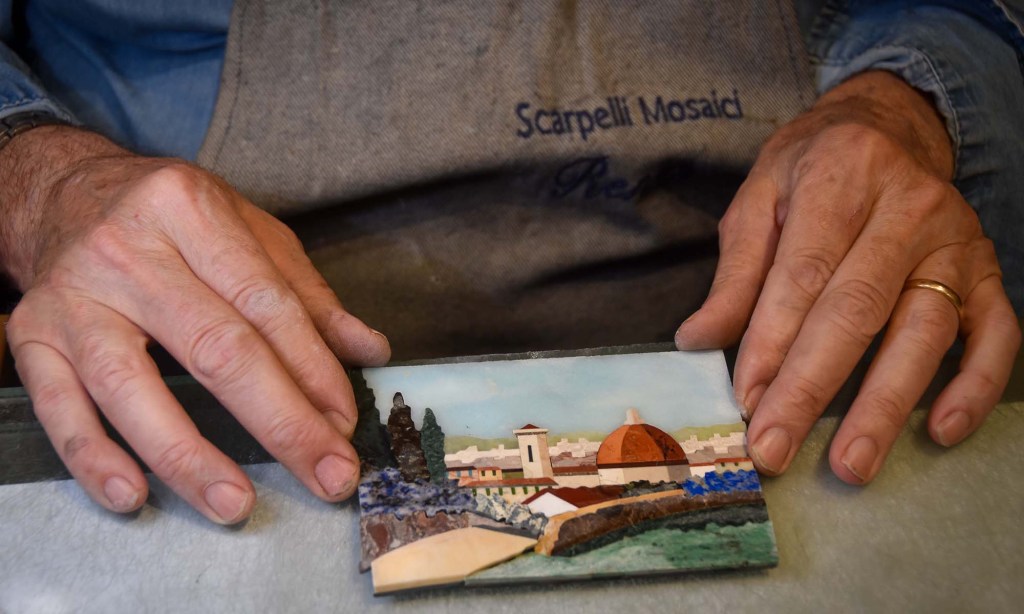
The arts have long flourished in Florence — the so-called “cradle of the Renaissance.” Hundreds of years ago, there were tens of thousands of artisans in the city, each dedicated to everything from leather goods and hand-decorated paper to jewelry making.
Over time, the number of workshops has declined. Nevertheless, Florence still has a sizable amount of artisans and craftspeople, including several master mosaicists who specialize in Florentine marquetry — also sometimes called pietra dura or Florentine mosaics.
Skip Ahead:
What is Florentine Marquetry?
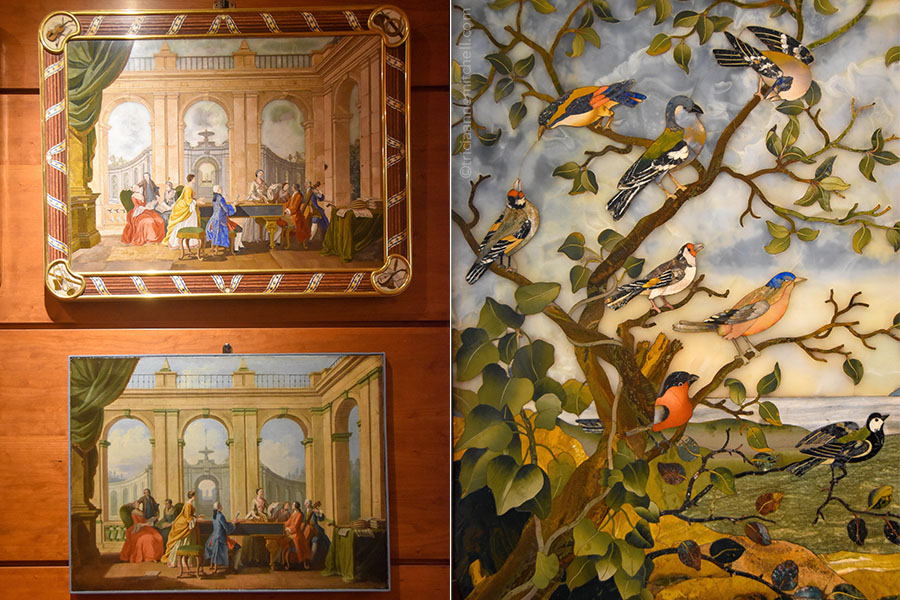
Florentine marquetry in semi-precious stones (Italian: Commesso Fiorentino in pietre dure) is a type of mosaic. However, Florentine marquetry differs from the ancient Greek, Roman, or Byzantine mosaics you might have seen in pictures or in museums.
Both types of art are formed by assembling individual pieces or tiles (tesserae) to create a complete picture. With ancient mosaics, the individual pieces tend to be somewhat uniform in size and shape. You can see the spaces between the tiles, and grout is used to join them together.
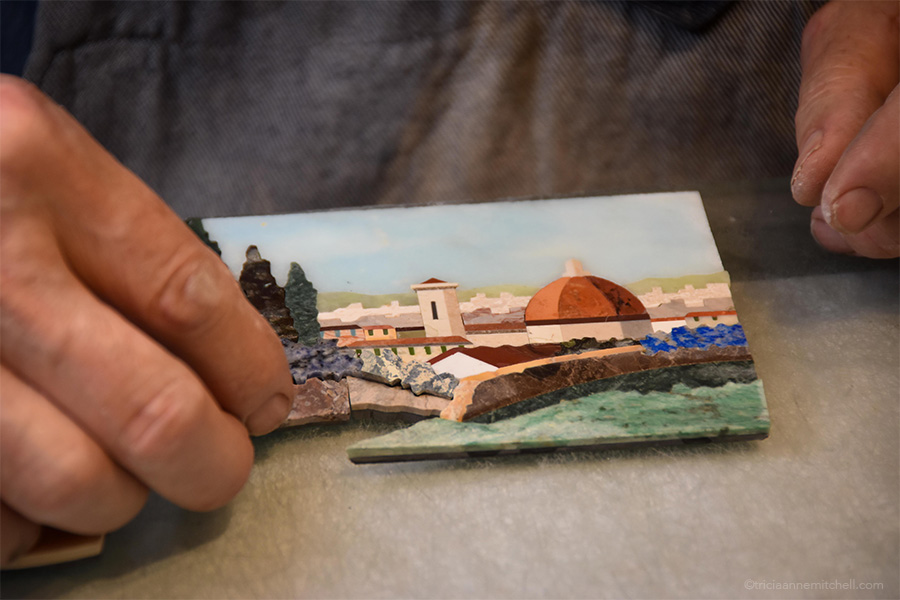
Florentine marquetry, in contrast, is a decorative inlay technique in which stone pieces of varying sizes and shapes are used. And since they’re so finely assembled, the joints appear virtually invisible.
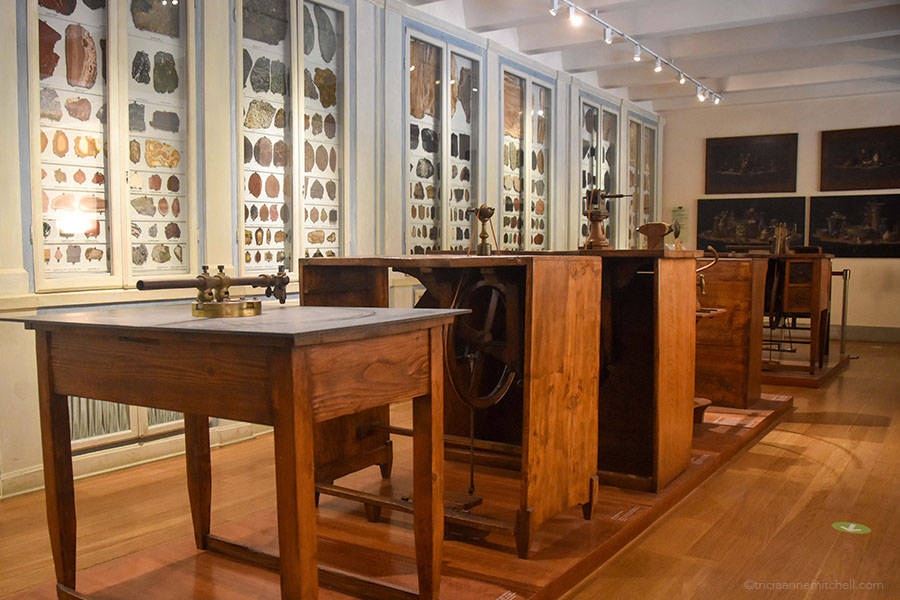
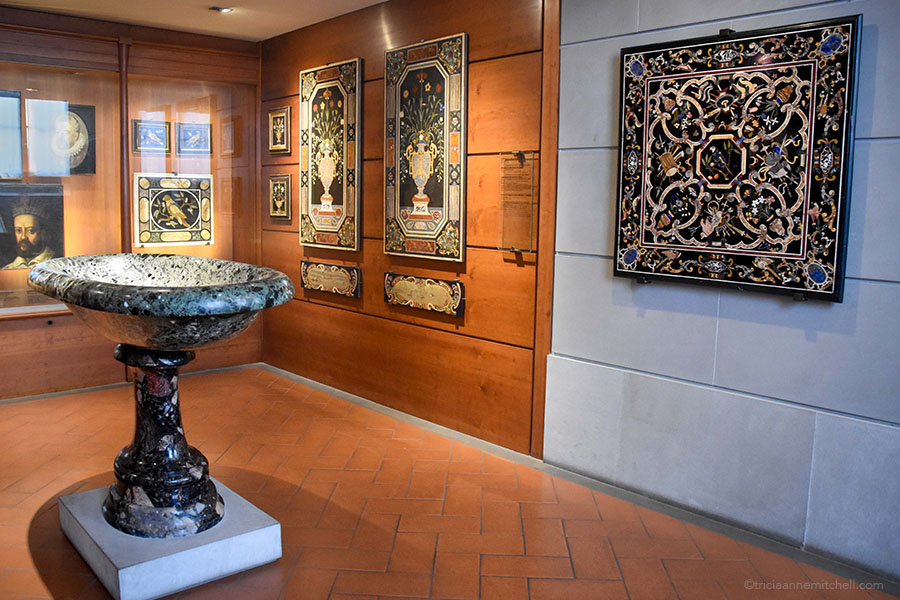
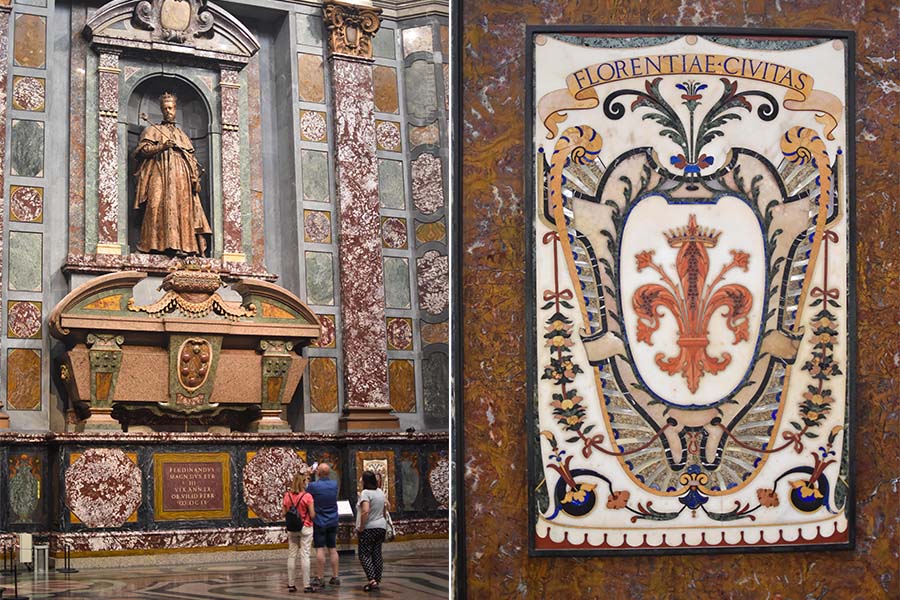
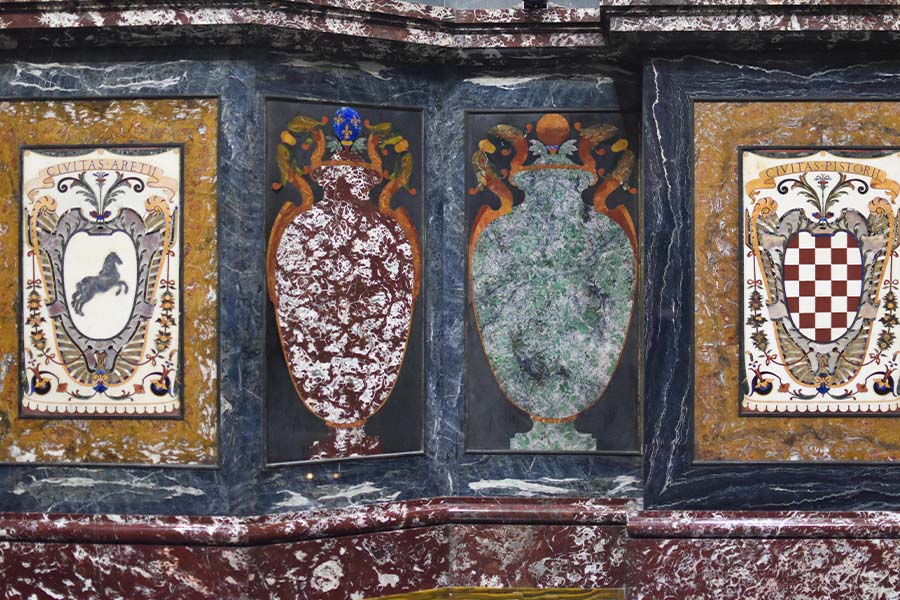
In 1588, the influential Medici family established a workshop dedicated to stone pieces of art made via the Florentine marquetry technique. For a time, this workshop was located inside the Uffizi (which housed government offices long before it became the world-famous art gallery it is today). Mosaicists at this Florentine marquetry workshop produced the grandiose works that you can still see inside the Medici Chapels, for example. These master artisans also crafted furniture, reproductions of famous paintings, and gifts for European leaders. Eventually, the workshop moved into another building and evolved into a world-renowned conservation center, as well as a museum. Today, it’s known as the Opificio delle Pietre Dure (Semi-Precious Stones Workshop & Museum). It’s a museum I highly recommend!
Between the 16th and 19th centuries, Florence became the exclusive hub for the production of art objects made via the stone marquetry technique. Eventually, the technique came to be known as Commesso Fiorentino. (The word commesso is the past participle of the Italian word commettere, which means “to put together.” So you could also translate it as a composition. Fiorentino means Florentine.) Soon, monarchs throughout Europe wanted to emulate this decorative art. Workshops similar to the one started by the Medici were also established by the Habsburgs in Prague, and by Louis XIV in France.
Florence’s stone marquetry might have even influenced members of the Mughal Dynasty in what is now India. The Taj Mahal is a brilliant example of how 17th-century century artists in India reinterpreted this art form and made it their own. (When I went to the Taj Mahal and visited Agra more than a decade ago, I stopped by a few inlaid-stone shops to marvel at their handcrafted tables and jewelry boxes crafted via the technique, which is called Parchin Kari. At the time, I didn’t know the art’s origins.)
Watch a Video of This Experience
A Travel Rebirth in the Cradle of the Renaissance
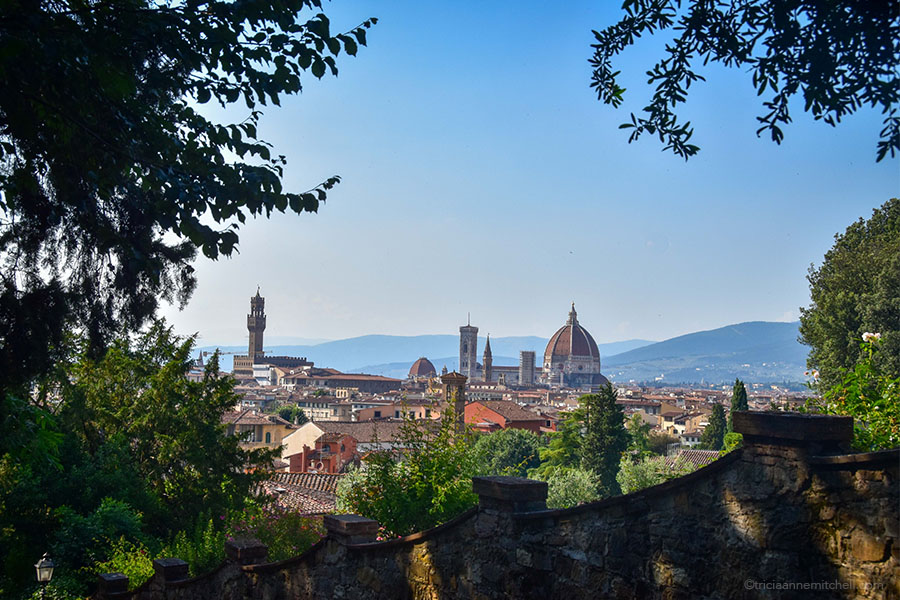
Last summer, Shawn and I were fortunate to spend one fantastic month in Florence, Italy’s artistic and cultural powerhouse. For the previous 14 months, we’d been taking pandemic precautions in a lovely part of coastal Croatia, where we’d unexpectedly gotten “stuck” when the Covid pandemic began.
Eventually, we learned that we wouldn’t be eligible to receive our Covid vaccinations in Croatia. So, we reluctantly boarded an overnight ferry, crossed the Adriatic Sea, and traveled to Italy to get our vaccines at an American Air Force base. It was complicated traveling to Italy during a pandemic, but we’ll always be grateful to the service members there for taking care of us.
Once we were fully vaccinated, we headed to Florence. There, we had a travel rebirth of sorts — albeit prudently — in the birthplace of the Renaissance. For four weeks, we visited Florence’s celebrated museums and gardens. We also decided to learn more about some of Florence’s artistic traditions, including its magnificent stone artwork.
Reflecting on my childhood, I can now see why I was drawn to learn more about Florence’s stone masterpieces. When I was growing up, I loved stones and rocks! I spent hours exploring the woods behind my home and even found some fossil samples. As a kid, rather amusingly, I was convinced those fossils contained samples of dinosaur skin or eggs. I also made a few visits to a local shop, where there were highly polished stone samples for sale. I’m grateful that my parents helped satisfy my curiosity by taking me to that shop — as well as to our local university — to identify my fossils and tiny stones. I still have a small box of them.
In recent years, I’ve gone on to observe apprentices sculpting dazzling white limestone at the Stonemasonry School on the Croatian island of Brač. However, this was the first time I’ve watched artisans working with puzzle-sized pieces to create this type of stone mosaic art.
Where to See Semi-Precious Stonework and Florentine Marquetry (Commesso Fiorentino) in Florence
- Semi-Precious Stones Workshop & Museum (Opificio delle Pietre Dure & Museo) Note that if you buy a ticket to the Uffizi, you can use the same ticket to enter the Semi-Precious Stones Museum for free. See the details here.
- Medici Chapels (Cappelle Medicee)
- Pitti Palace (Palazzo Pitti)
- Tribuna, in the Uffizi Gallery (Le Gallerie degli Uffizi)
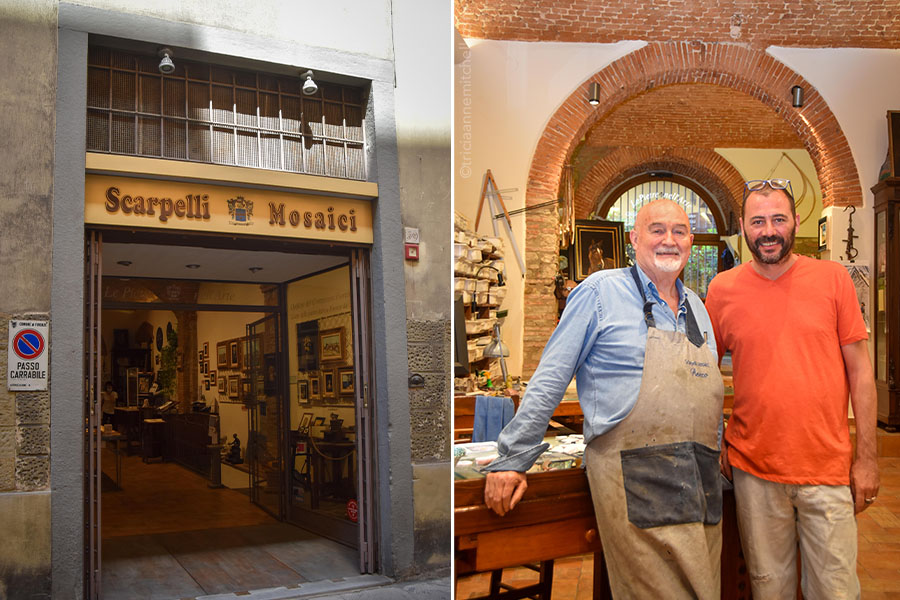
- Private workshops (botteghe) — There are several in Florence, but we visited Scarpelli Mosaici (more details about our visit to this marvelous workshop are below).




A Visit to Scarpelli Mosaici Boutique & Workshop
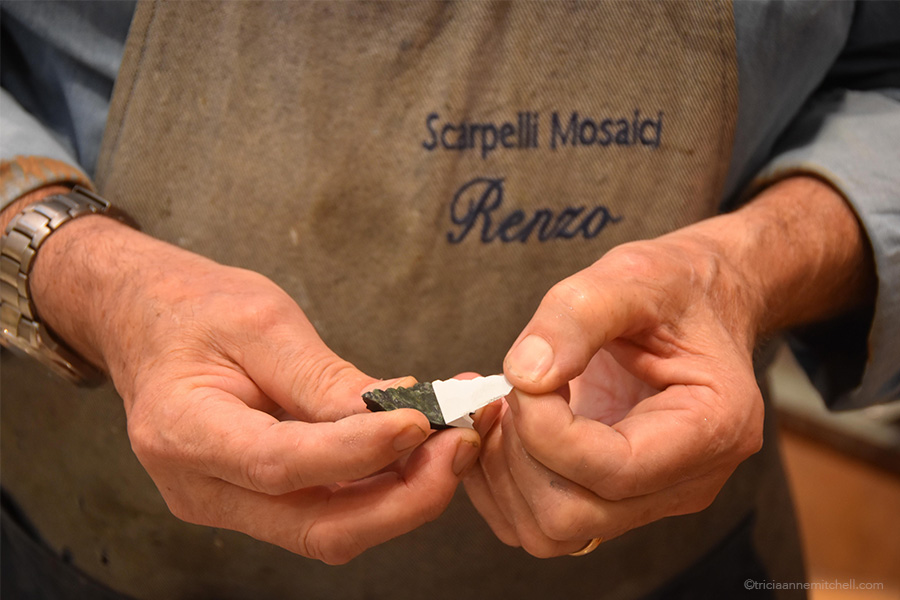
Scarpelli Mosaici is a family-run workshop (bottega) and boutique where master artisans Renzo and Leonardo Scarpelli make, showcase, and sell their Florentine marquetry masterpieces. This father-and-son duo is supported by Renzo’s wife, Gabriella (a jewelry artist herself), and daughter Catia (who is in charge of the business and marketing strategies). A handful of other talented mosaicists and shop assistants also round out this friendly, tight-knit team.
The effect achieved via Florentine marquetry has been likened to “painting with stones,” something Catia Scarpelli alluded to during our summertime visit to the family’s workshop.
“You have to ‘paint’ with a material that’s one of the hardest there is while also achieving softness and movement with the stones,” Catia explained.
Because of its everlasting nature, a 15th-century painter named Domenico Ghirlandaio described Commesso Fiorentino as “painting for eternity” (pittura per l’eternità).
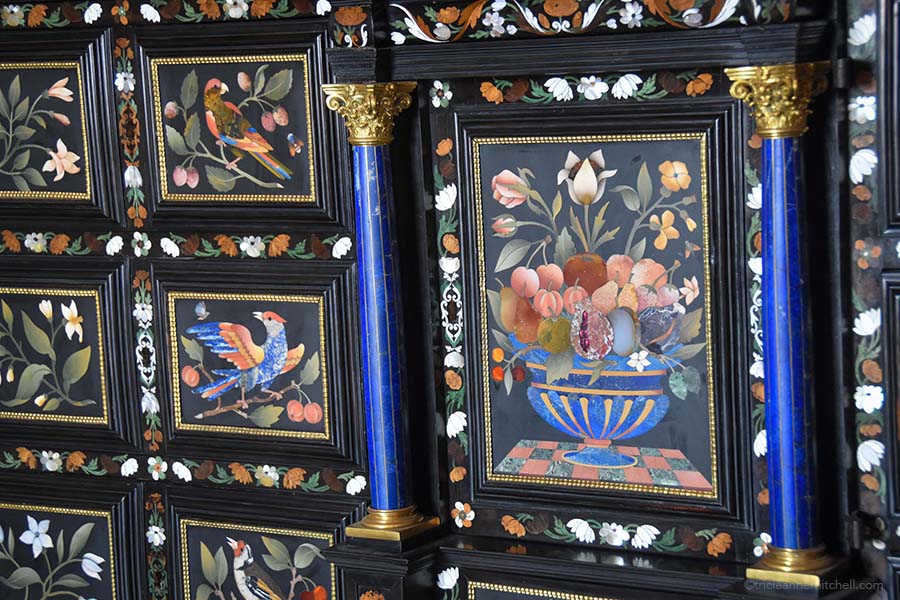
The Scarpellis make a variety of handmade luxury items. With their paintings, subjects include Florentine and Tuscan landscapes, seascapes, flowers, still lifes, animals and children, portraits, and contemporary pieces inspired by the cosmos. They also craft jewelry and extraordinary table tops, which often feature a black background that is adorned with flowers, birds, and perhaps even pomegranates. Some of these works have taken months — even many years — to produce.
Collectors from six continents have purchased their work, and Renzo and Leonardo have even collaborated with iconic brands like Dolce & Gabbana to make a clutch bag.
“Self-criticism helps us to grow artistically and a bit of humility is always needed.”
– Renzo Scarpelli

How Florentine Marquetry is Made, Step by Step
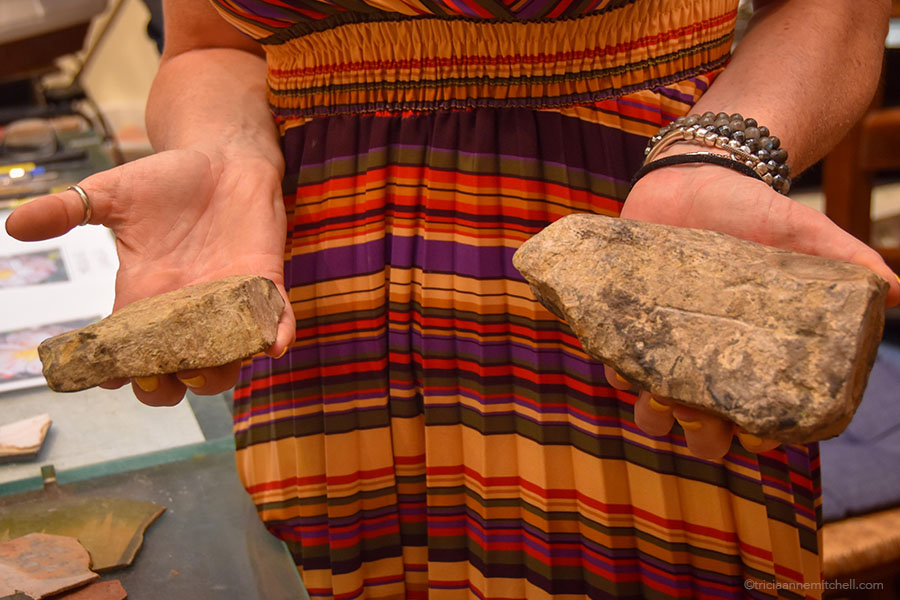
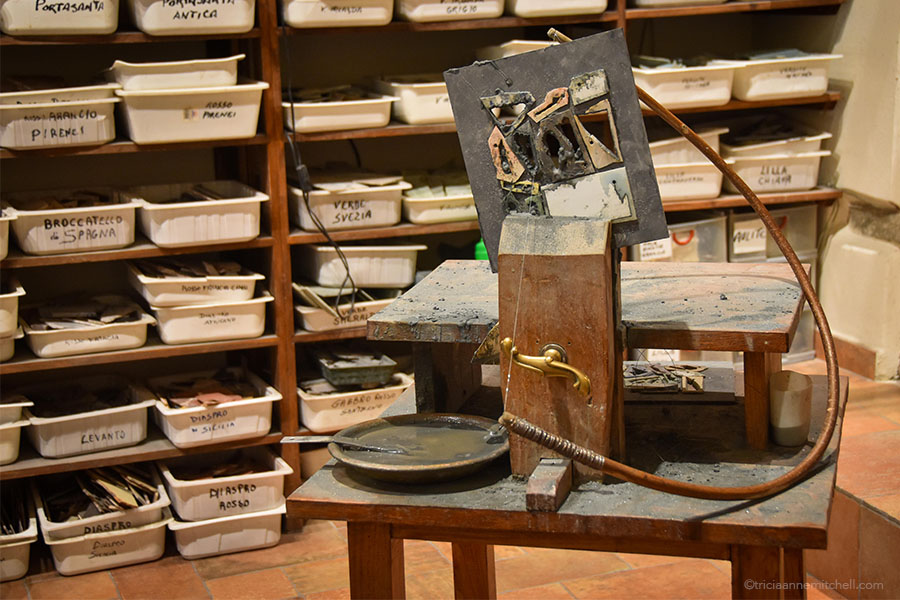
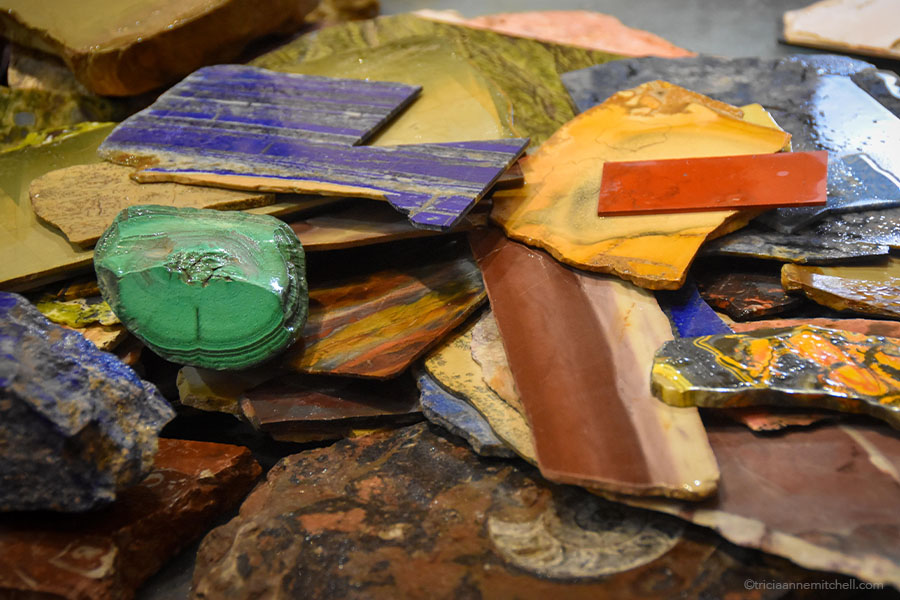
- Sourcing the stones: Master mosaicists like Renzo and Leonardo head to the Tuscan countryside to collect stones that are appropriate for a project. In nature, the quality stones they’re seeking can look deceptively plain — like nondescript rocks. For this reason, it can take years for a master to develop an eagle eye for just the right stone specimens. When a mosaicist can’t find a stone locally, they supplement their supply by purchasing stones like lapis lazuli, malachite, and turquoise from specialists abroad. The Scarpellis prefer to personally go to shows so that they can meet the importers and ensure the stones are just the right color and tone. Eventually, the stones are sawed into thin “slices” that are 3 millimeters (about 1/8 of an inch) thick.
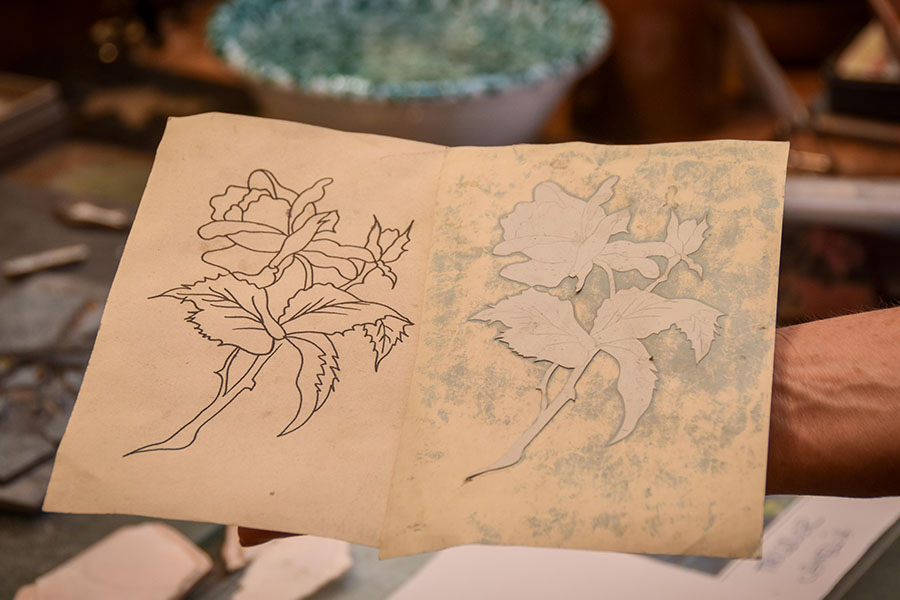
- Sketching out the artwork: The mosaicists draw the artwork on a kind of sticky paper. From there, they cut out the drawing’s individual shapes and attach these “cartoons” to the section of the stone that has just the right variegation to make the artwork come alive.
- Selecting the stone — macchiatura: During the macchiatura (coloring) phase, the mosaicist chooses which stones to use for every individual piece of the composition. To achieve a brilliant chromatic effect with the finished work, he takes into account the desired colors, his experience, and personal tastes.
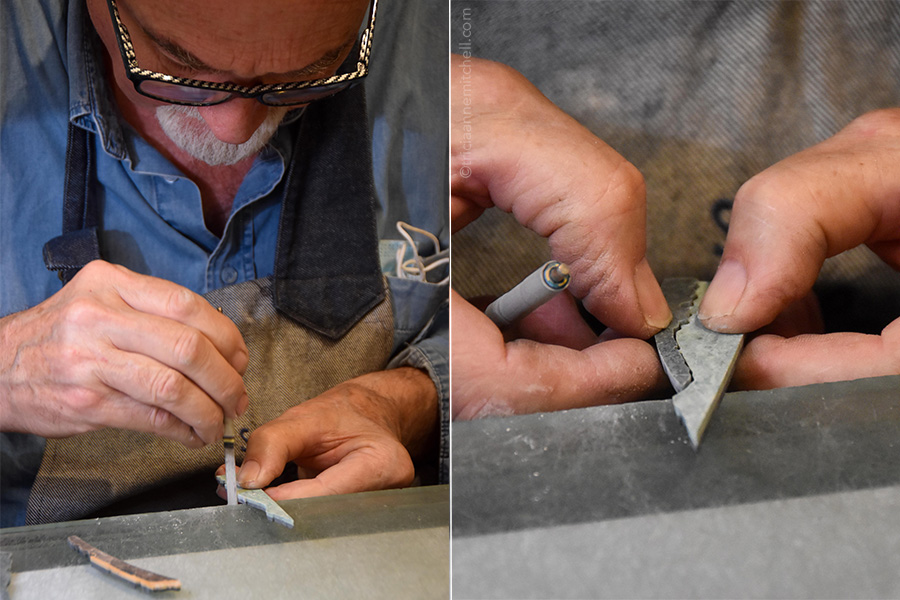
- Cutting the stone and filing it: The semi-precious stone is glued to a slate board, which offers more structural support. Then, using a wooden bow saw that’s outfitted with a piece of iron wire, the mosaicists meticulously cut out the various shapes into puzzle-like pieces (tessera). Later, the mosaicist uses a diamond file to smooth the fragments’ edges to ensure there will be a fit so perfect that the joints are essentially invisible.
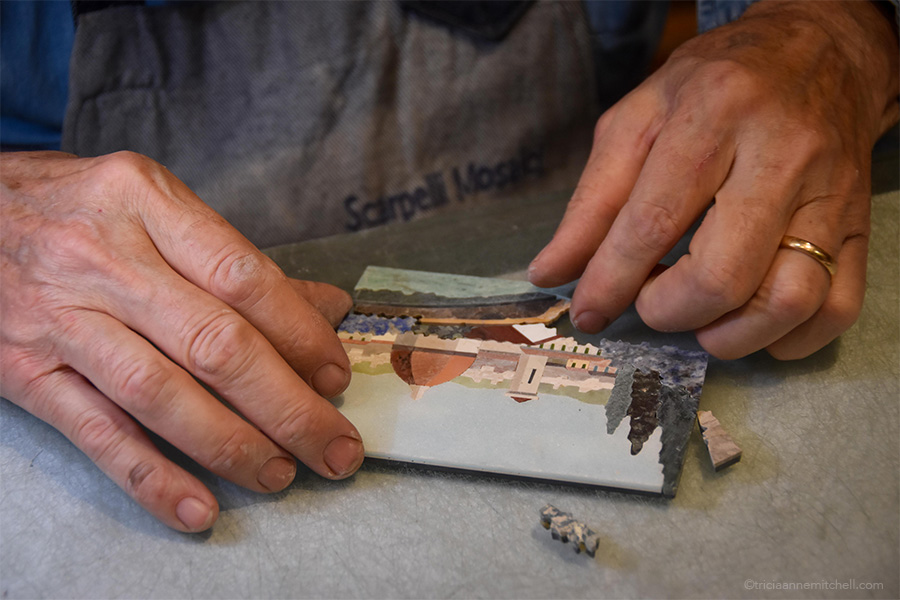
- Assembling and gluing the pieces together: The mosaicists painstakingly assemble the stone pieces to create the composition they sketched out earlier in the process. Then, using a traditional glue recipe that’s made with beeswax and pine resin, they glue the pieces together. Later, the Scarpellis apply a synthetic adhesive (mastic gum) that’s even more robust since it doesn’t deteriorate.
- Smoothing and polishing: The mosaicists smooth and polish the work to accentuate the stones’ brilliant natural characteristics.












https://www.instagram.com/p/B9J7LqNF_dA/?utm_source=ig_web_copy_link
Further Resources:
- Commesso Fiorentino, an article with photos and video on the Google Arts & Culture website.
- Commesso, a brief entry on Wikipedia.
- Gemstones in the Era of the Taj Mahal and the Mughals, an article on the website of GIA (Gemological Institute of America), a nonprofit organization.
- Opificio delle Pietre Dure, website for the Workshop of Semi-Precious Stones. Based in Florence, it’s a public institute that’s part of the Italian Ministry for Cultural Heritage.
- Historic Centre of Florence, Florence’s World Heritage List description on UNESCO’s website.
- Homo Faber Guide, The Scarpellis are included in the Homo Faber Guide, which is produced by the Michelangelo Foundation, a non-profit organization. Since 2018, the foundation has organized Homo Faber, an international exhibition in Venice that promotes fine craftsmanship.
- Noi Scarpelli, Una Storia a Firenze, a 400+ page book about the Scarpelli family’s story and the art of Commesso Fiorentino. Written in both English and Italian, the book features extraordinary images of the Scarpellis and their team creating Florentine marquetry masterpieces. If you visit the family’s workshop, ask if you can peruse a copy of this fabulous book.
- The Pietra Dura Maker: “Everyone Else in Florence Was Looking at the Paintings, But I Was Looking at the Pietra-Dura Floor,” an interview in Country Life Magazine featuring the UK’s only pietra dura artist.
- Pietre Dure: The Art of Semi-Precious Stonework, a 2006 book by Anna Maria Giusti. You can borrow it for free at Archive.org (a non-profit digital library).
- The Role of the Workshop in Italian Renaissance Art, an entry discussing the importance of the workshop (bottega) on the Khan Academy website.
- Scarpelli Mosaici: The Art of “Commesso Fiorentino,” an article on the Fondazione Cologni dei Mestieri d’Arte website. The Cologni Foundation for the Métiers d’Art is a private non profit organization based in Milan.
Where in the World?
Planning Pointers:
How to Visit Scarpelli Mosaici:
The Scarpelli Mosaici workshop is located in a fabulous 16th-century building with red-brick vaulted ceilings. The shop is about halfway between two of Florence’s most celebrated sights — the Galleria dell’Accademia (home to Michelangelo’s statue of David), and the Duomo. This central location makes it convenient to visit and observe the Scarpelli masters at work as they keep this marvelous Florentine tradition alive.
Visiting is free, and no appointment is required. If you stop by, someone in the shop will be happy to explain the technique and share the family’s story.
To arrange a private tour, please contact the shop in advance. The Scarpellis even offer art and wine tasting experiences.
- Scarpelli Mosaici Address: Via Ricasoli 59/r, Florence
- Telephone: +39 055 21 25 87
- Social Media: Facebook | Instagram
- Website: Scarpelli Mosaici
Hotels and Accommodation in Florence:
Florence has long been a popular travel destination, so you’ll find a wide variety of accommodation options. From boutique hotels to apartments with all the conveniences you’d find at home, Florence has it all.
Below, I’ve rounded up a few distinctive accommodation options. Please note that some affiliate links follow.
Accommodation with Incredible Views:
- Granduomo Charming Accomodation – Located just across the street from Florence’s magnificent Duomo, these stylish apartments are housed in a Florentine residence dating back to the 18th century. Each features hardwood floors and exquisite Italian furnishings.
- Piazza Signoria 1 Apartment – Just footsteps away from the Palazzo Vecchio, this 55-square-meter (180-square-foot) apartment features air conditioning, a comfortable bedroom, a fully equipped kitchen, and a private bathroom with all the essentials. What’s more, it even has extraordinary views of one of Florence’s most famous squares, the Piazza Signoria.
- Attico in Piazza Santa Croce – The Attico in Piazza Santa Croce is a cozy penthouse apartment offering stunning views of the Basilica of Santa Croce, where famous historical figures like Galileo, Michelangelo, and Machiavelli are buried. The apartment features two bedrooms, a living room, a well-equipped kitchen, and a bathroom. Its classic antiques and vintage-tiled floors create a warm and authentic atmosphere, while the balcony provides a perfect spot to enjoy the panoramic views.
Luxurious Properties:
- Palazzo Niccolini al Duomo Residenza D’Epoca – This refined property is located just steps away from the Duomo Cathedral. The rooms are beautifully decorated, with some featuring ornate ceilings and frescoes, and even fireplaces. Some rooms offer breathtaking vistas of the Duomo. Guests can enjoy a delicious buffet breakfast each morning.
- Borgia di Firenze – This elegant apartment is located on the second floor of Santa Trinita Palace. The Borgia di Firenze offers traditional Florentine decor, including stunning frescoes and modern comforts like an elevator, free Wi-Fi, and air conditioning. The apartment is ideally situated within walking distance of numerous attractions, and it’s just 600 meters (just over one-third of a mile) from the Santa Maria Novella train station.
- Dante States Apartments – Nestled in a 600-year-old building, the Dante States Apartments offer classic-style accommodations in the heart of Florence. Enjoy free high-speed Wi-Fi, handsome wood-beamed ceilings, and well-equipped kitchens in these lovely apartments. Explore Florence’s top attractions on foot, with Firenze Santa Maria Novella Train Station just a 15-minute walk away.
Cozy Apartments:
- Aleri – The Aleri is a cozy 1-bedroom apartment in a historic building, just a short walk from the Santa Maria Novella Train Station. With 50 square meters of living space (about 535 square teet), the apartment features traditional decor, including wooden beamed ceilings and a 4-poster bed. Despite its historic charm, the Aleri offers modern amenities such as Wi-Fi, satellite TV, and a well-equipped kitchen.
- Giotto – Shawn and I spent one month in this apartment, which is located in the San Frediano neighborhood, about a 20-minute walk from the Uffizi Gallery and the Santa Maria Novella Train Station. The apartment has a living room/kitchen, bedroom, and bathroom and it offers a lovely mix of old and new. The interior was recently renovated and has a new washing machine, dishwasher, refrigerator, and two air conditioners. Like most Italian apartments, the Giotto also has an espresso maker, in this case, a Bialetti Venus moka. We loved the sleek design and functionality so much that we later bought one. Since we had a fair amount of luggage with us, we liked that the apartment had lots of storage space. What’s more, the ceilings above our bedroom and the kitchen were a work of art themselves! They were painted in the early-20th century. After a long day of sightseeing in the sweltering June and July heat, we loved coming “home,” lying in bed, and looking at the scenes of birds and nature above our bedroom. The apartment overlooks a courtyard that doubles as a small parking lot for the other residents. Since we weren’t facing the street (with all the scooters whizzing by), the apartment was blissfully quiet. We also enjoyed chatting with the apartment’s thoughtful and helpful owners, Paola and Roberto. (2025 update: It appears that the Giotto is no longer being offered as a short-term rental. However, the hosts do have other short-term apartments for rent in the same complex.)
Bed & Breakfasts:
- Canto degli Arancini – The Canto degli Arancini is a delightful bed and breakfast located in the Santa Croce district of Florence. It has a modern interior and offers various room types, including doubles, suites, and family suites. The hotel features an elevator and air-conditioned rooms. There’s also a buffet breakfast with gluten-free options.
- Dimora Bandinelli – The Dimora Bandinelli is a charming bed and breakfast offering double and triple rooms adorned with beautiful 19th-century frescoes. Guests can enjoy a buffet breakfast featuring fresh, seasonal products, including gluten-free options. The bed and breakfast is conveniently located within walking distance of Florence’s old town center. For a leisurely stroll, guests can enjoy a 15-minute walk along the riverbank to reach the heart of Florence. Alternatively, the tram stop is just 50 meters (165 feet) away, offering a quick seven-minute ride to the city center.
Spas:
- B&B Mr. My Resort – The B&B Mr My Resort is conveniently located just a short walk from the Accademia Gallery, home to Michelangelo’s iconic David statue. This charming bed and breakfast offers a private wellness center with a Turkish bath and a hot tub for guests to enjoy. Some rooms feature views of the peaceful internal garden, while others showcase historic charm with features like stone walls, old frescoes, and exposed wooden beams.
Pet-Friendly Lodging:
- Riva Lofts Florence – The Riva Lofts apartment complex is located near the Cascine Park and overlooks the Arno River. Featuring an outdoor swimming pool surrounded by gardens, Riva Lofts offers a luxurious and relaxing stay. Some studios feature private terraces with lovely views of the complex’s gardens. The Riva Lofts offers a buffet breakfast featuring homemade cakes, Tuscan cheese and ham, and even gluten-free options. You can enjoy breakfast on the terrace overlooking the swimming pool or in the comfortable dining area. Riva Lofts is located near the Sansovino tram stop, providing easy access to Santa Maria Novella Railway Station. Free bicycles are available for exploring the city, and pets are allowed.
- Relais Piazza Signoria – The Relais Piazza Signoria offers a variety of accommodation options, including studios, suites, and apenthouses with wonderful views. Conveniently located on the corner of Piazza Signoria in Florence you can reach the Uffizi Gallery and Palazzo Vecchio on foot within a few minutes. The apartments offer modern amenities such as kitchenettes, LCD TVs, and air conditioning, along with an elevator for easy access. Pets are welcome.
Looking for more Italy trip-planning inspiration?
From seeing how Parmigiano-Reggiano cheese is made in Modena to visiting Leonardo da Vinci’s Vineyard in Milan, see all of my posts from Italy.
Save to Pinterest
Photography & text © Tricia A. Mitchell. All Rights Reserved.


Leave a reply to Zlática Kraljevic Cancel reply