Last Updated:

Spilimbergo: Italy’s Enchanting “City of Mosaics”

Posted by

·

, ,

Spilimbergo, a charming medieval town nestled in the Friuli Venezia Giulia region of Italy, offers a lovely blend of art, history, and natural beauty. With its well-preserved historic center, world-famous mosaic school, and picturesque surroundings, Spilimbergo makes for a delightful day trip when you’re visiting Venice or the Friuli Venezia Guilia region.

What are the highlights of this tiny town you wonder? Lovely frescoed buildings (don’t miss the Spilimbergo Castle and its Palazzo Dapinto!), mountain views, and mosaics galore—both indoors and outdoors. As you stroll the town’s streets and see mosaics adorning buildings, parking lots, and even tree trunks, you’ll understand why Italians have dubbed Spilimbergo the città del mosaico (city of mosaics).

The Mosaic School

Since 1922, Spilimbergo has played host to a renowned mosaic school, the Scuola Mosaicisti del Friuli. Graduates have gone on to create mosaics in prominent cities around the world, including the opera house in Paris, the Library of Congress in Washington, D.C., and the Ground Zero subway station in New York City.

When Shawn and I visited Spilimbergo a few summers ago, the Mosaic School wasn’t offering any in-depth tours because of the pandemic. Nevertheless, we were wowed by the mosaic sculptures in front of the building, as well as the panels hanging in the entryway. The creations ranged from classical art to a contemporary mosaic of a QR code posted outside, designed to direct visitors to the school’s website. Someday, we look forward to returning so we can watch the students in the workshops creating mosaics.

Spilimbergo’s Other Must-See Landmarks:

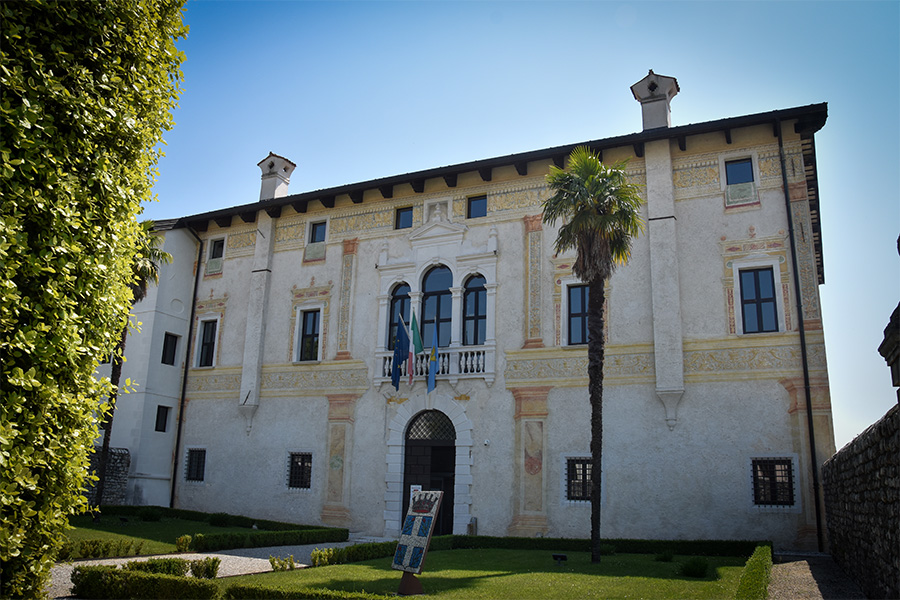
The frescoed exterior of Spilimbergo's Palazzo Spilimbergo di Sopra (Town Hall) on a sunny day.
The Palazzo Spilimbergo di Sopra, which dates back to the 14th century, now houses Spilimbergo’s Town Hall. Throughout the centuries, it’s been a residence for counts, a silkworm farm, and an army shelter. (Having learned about the silk-making process in Cambodia, I found it fascinating to imagine silk being produced here.)
The frescoed exterior of Spilimbergo's Palazzo Spilimbergo di Sopra (Town Hall) on a sunny day. A mountain silhouette is visible in the distance.
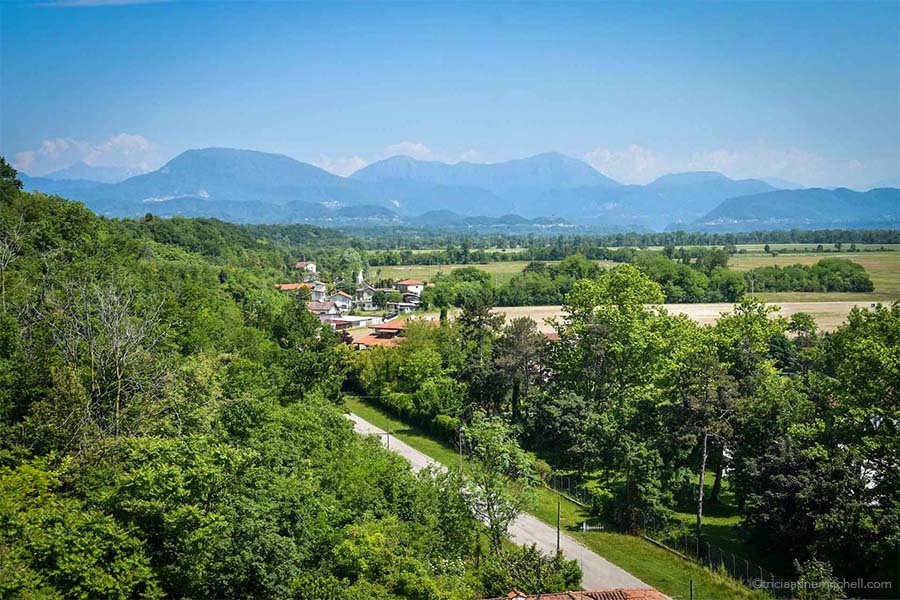
Mountain silhouettes, with Spilimbergo’s Town Hall in the foreground
Mountain views as seen from Spilimbergo's Town Hall, the Palazzo Spilimbergo di Sopra.
The view from the Palazzo Spilimbergo di Sopra.
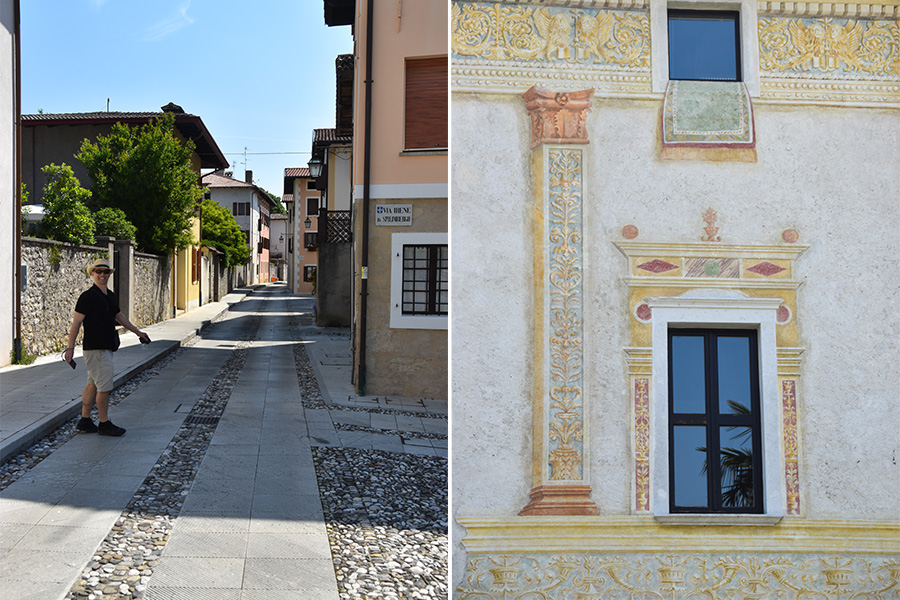
On the left, a man crosses a street in the tiny town of Spilimbergo, Italy. On the right, frescoes adorn the community's town hall building, depicting a column and an ornate rug being aired out.
Left: Shawn, enjoying our mini adventure. We made a day-trip from the pretty town of Pordenone, where we based ourselves for about one month. Right: Convincing trompe-l’œil frescoes make it look as though a Persian rug is being aired outside the upper window.
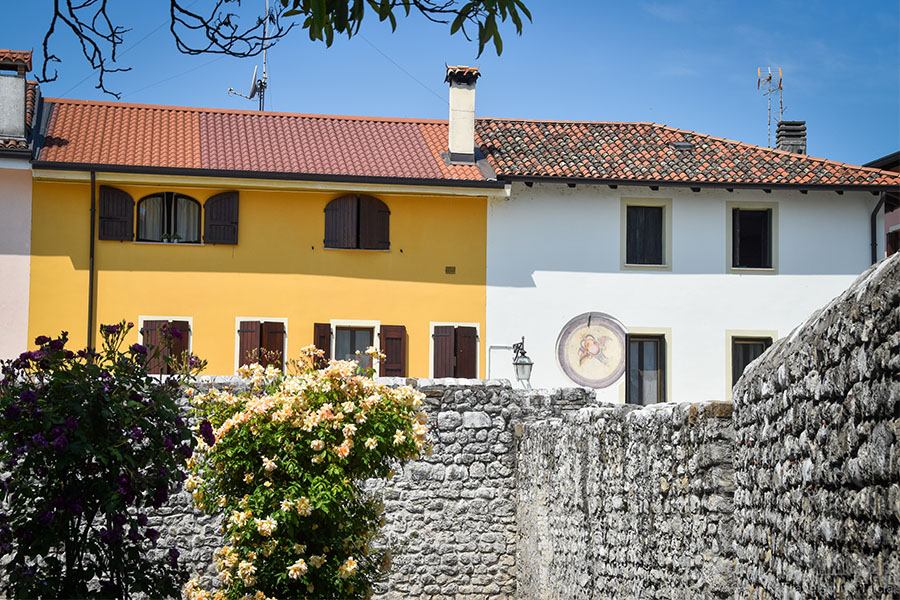
Two adjoining homes in Spilimbergo, one yellow-orange, the other white. Both buildings have terracotta tiles and stone walls.
Homes in Spilimbergo.
A woman rides a bike through Spilimbergo's streets.
An ornate red building in Spilimbergo.
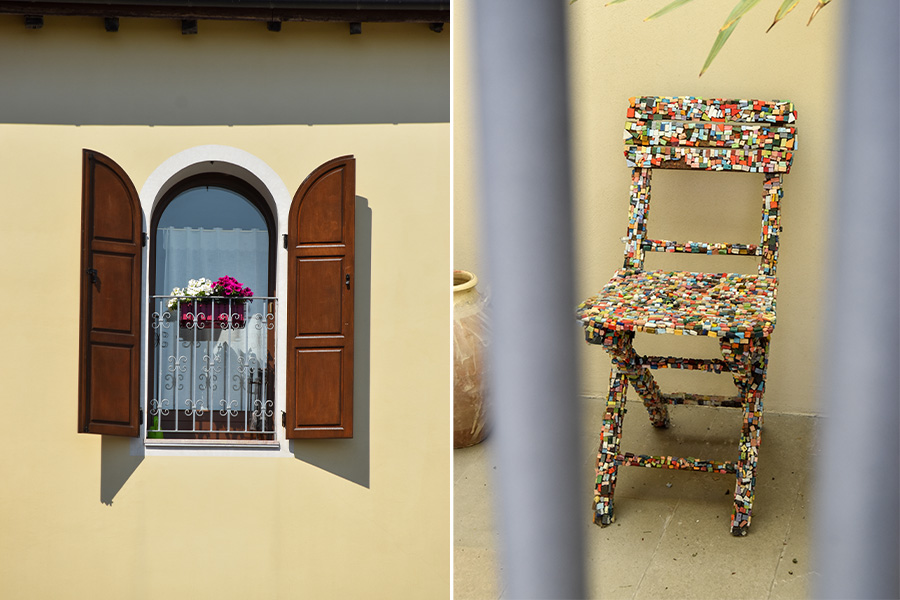
On the left, a yellow house features a flowerbox filled with purple and white flowers and wooden shutters. On the right, a folding chair is decorated with multicolored mosaic tiles.
Left: Flowerboxes studded with flowers are a common sight in Spilimbergo. Right: A fold-out chair bedecked with mosaic tiles.
A fresco depicting the winged lion of St Mark decorates a Spilimbergo building.
A fresco depicting the winged lion of St Mark.
On the left, Spilimbergo's Eastern Tower is visible with its clock tower. On the right, a cobblestone street lined with white buildings, some of which are decorated with frescoed paintings.
Left: Spilimbergo’s Eastern Tower dates back to the early 1300s. Right: Frescoed buildings and cobblestone lanes add charm to the town.
A close-up of the clocktower of Spilimbergo's Eastern Tower.
The weathered clocktower on the Eastern Tower.
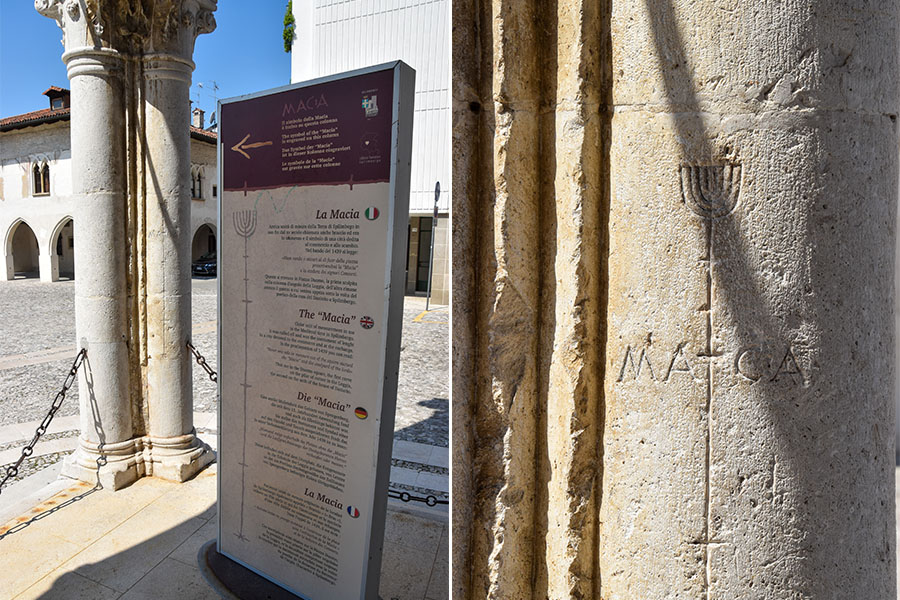
On Spilimbergo's Municipal Loggia, the "macia" symbol is carved into a column, along with the word "MACIA."
In Spilimbergo’s Municipal Loggia, this antique unit of measurement — the macia — is carved into a column. Centuries ago, it was used to measure cloth.
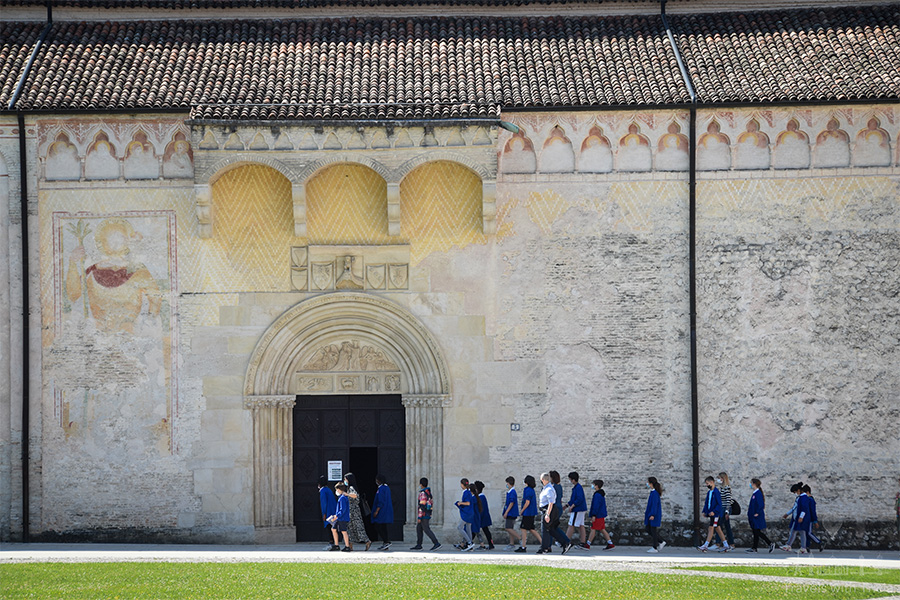
A line of schoolchildren enters the large doorway of the Duomo di Santa Maria Maggiore Cathedral in Spilimbergo.
Schoolchildren visit Spilimbergo’s 13th-century cathedral, the Duomo di Santa Maria Maggiore.
Trees line the street of Spilimbergo. Mosaic bands wrap around the trunks like belts.
Spilimbergo is a like an open-air mosaic museum, with the tiny tiles adorning conventional and unexpected places. Here, bands of mosaics embrace the trunks of trees.
Red roses against a stone wall.
Close-up of a mosaic decorating a parking lot in Spilimbergo. There is a floral motif, with golden, blue, red, and green tiles.
Mosaics can be found throughout Spilimbergo, such as this colorful panel near a parking lot.
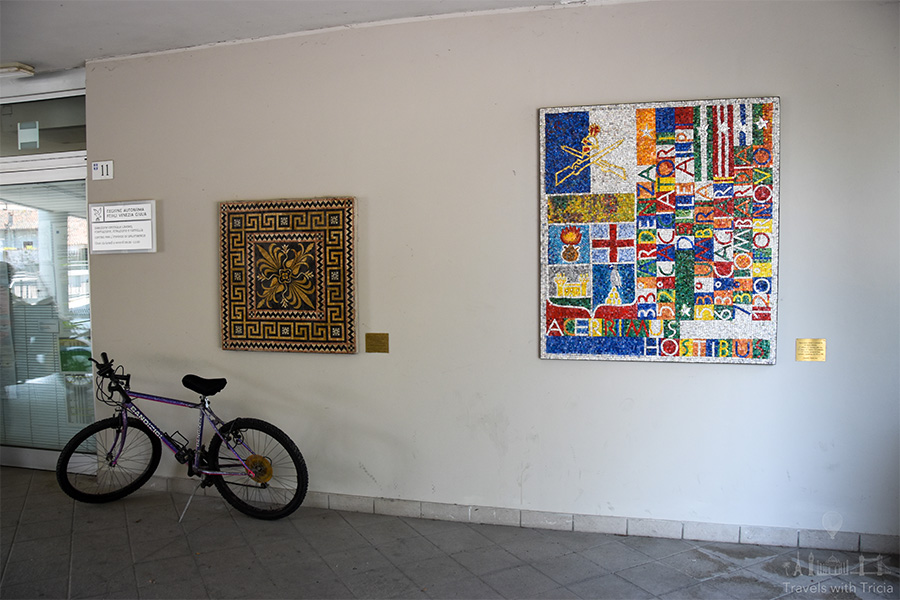
A bike is parked next to the entrance of a government building in Spilimbergo. Two mosaics hang on the wall.
Mosaics decorate the exterior of a government building.
Two crests, crafted out of mosaics, are displayed outside. The mosaic on the left reads, "5 Legione Brigate G. di F. Spilimbergo" and features a golden eagle. The mosaic on the right features a black and red crown with four blue squares and red tulip-like flowers underneath.
Detail of the ornate façade of the Palazzo Dipinto, inside the Spilimbergo Castle (Castello di Spilimbergo) complex. This fresco shows a woman dressed in a green and purple robe wearing a crown. She is holding a mirror and book in her hand and there is one small window in the facade and one stone balcony.
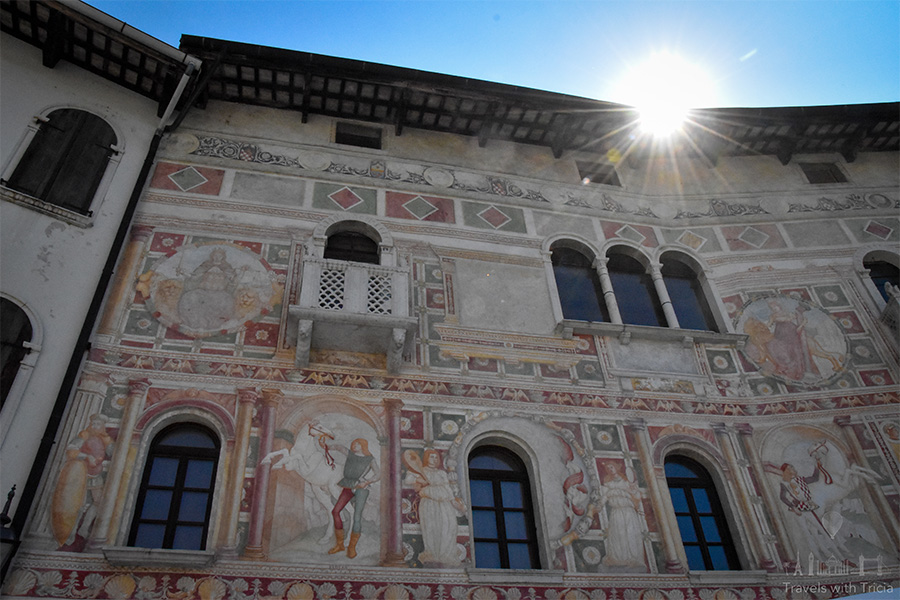
Detail of the ornate façade of the Palazzo Dipinto, inside the Spilimbergo Castle (Castello di Spilimbergo) complex. The castello’s appearance has evolved over the centuries due to earthquakes, fires, and expansion projects.
Detail of the ornate façade of the Palazzo Dipinto. In these frescoes, a woman wearing a crown is flanked by two lions. A stone balcony is visible to the right.
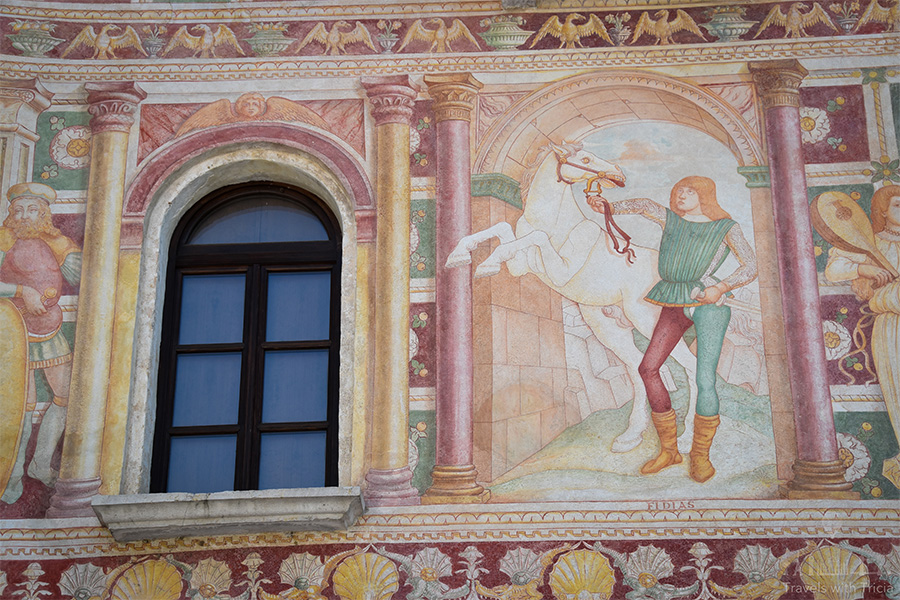
It is believed that artist Andrea Bellunello painted these frescoes in the 15th century.
Detail of the ornate façade of the Palazzo Dipinto. There is a fresco depicting a man holding the reins of a white horse.
Detail of the ornate façade of the Palazzo Dipinto, inside the Spilimbergo Castle (Castello di Spilimbergo) complex. There is a blue sky and sunburst overhead.
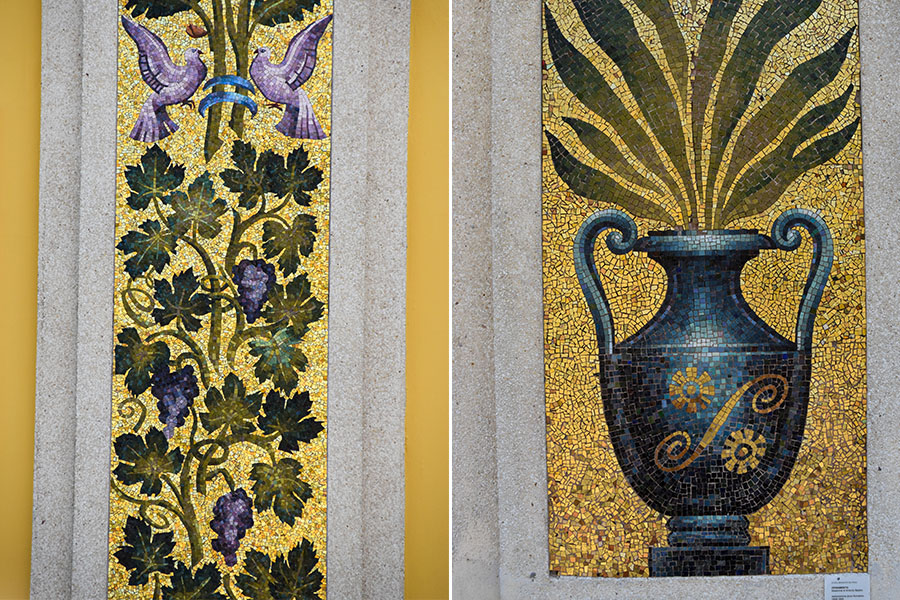
The exterior of Spilimbergo's Mosaic School. There are 3 flags displayed outside and the exterior of the yellow building is decorated with mosaics depicting urns, grapes, leaves, and purple doves.
Spilimbergo’s Mosaic School (Scuola Mosaicisti del Friuli).
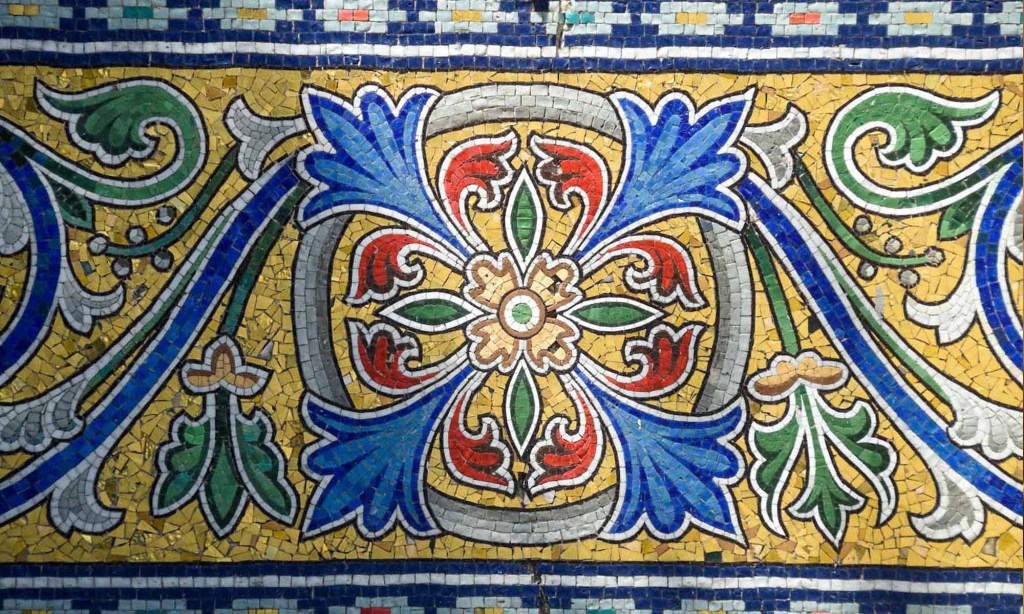
The intricate detail of the Mosaic School’s exterior. The urn on the right dates from 1939-1940. The work is based on a design by Antonio Baldini, who was a director, teacher, and painter at the Spilimbergo Institute.
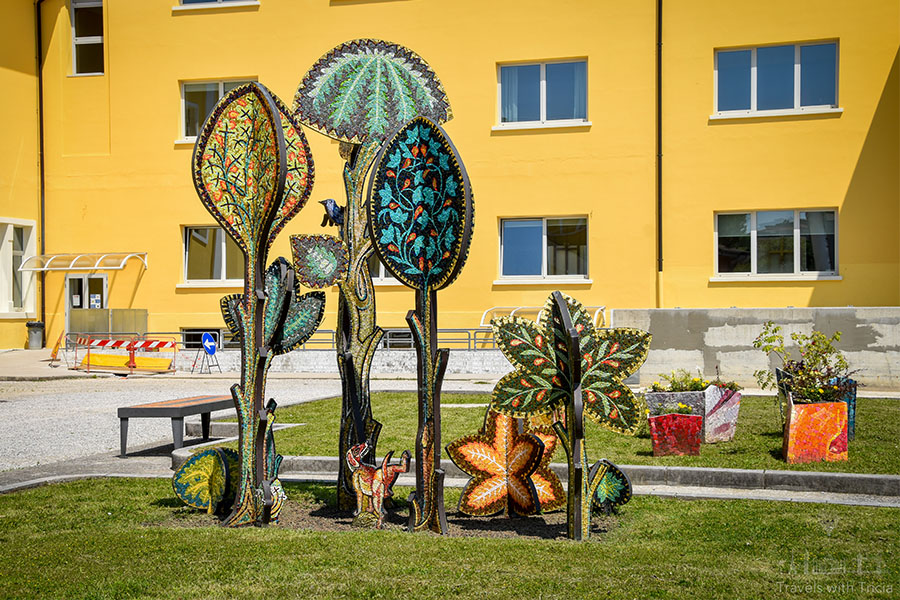
The exterior of Spilimbergo's Mosaic School. Three-dimensional sculptures resembling flowers stand on the lawn. They are decorated with multicolored mosaics.
Mosaics adorn these lawn ornaments on the grounds of the Mosaic School.
The modern entrance to Spilimbergo's Mosaic School. Above the doorway is an overhang with the words "Scuola Mosaicisti del Friuli" written on it. A mosaic QR code panel hangs on the concrete wall.
A mosaic-style QR code on the wall of the Mosaic School. Note the colorful walkway, too!
A mosaic hammer and multicolored mosaic fragments on display inside the entryway of the school.
A mosaic hammer and mosaic fragments on display inside the entryway of the school.
A contemporary mosaic with colorful polka dots on display.
Polka dots take center stage in this playful mosaic.

Where in the World?

Planning Pointers:

Photography & text © Tricia A. Mitchell. All Rights Reserved.

Tricia A. Mitchell Avatar

About the author

Hi! My name is Tricia Mitchell. I delight in telling stories about my slow travels through more than 65 countries. Some of my highlights have included sharing meals with locals in Armenia, Cambodia, and Tunisia; sipping sparkling wine with French cousins in Alsace; milking goats in a sleepy Bulgarian village; and training with a Japanese mine-clearance team in Laos. My husband, Shawn, and I are based in France’s Loire Valley.

Leave a reply to Tricia A. Mitchell Cancel reply

This site uses Akismet to reduce spam. Learn how your comment data is processed.

16 responses to “Spilimbergo: Italy’s Enchanting “City of Mosaics””

  1. Darlene Avatar

    This place looks amazing. I love mosaics. Thanks for the wonderful pictures.

    1. Tricia A. Mitchell Avatar

      Hi Darlene, indeed, Spilimbergo sure has character, largely because of all of the artisans’ efforts! We can’t wait to get back someday so we can see the Mosaic School students at work.

  2. Pamela McCaster Avatar
    Pamela McCaster

    Beautiful!!

    1. Tricia A. Mitchell Avatar

      Hi Pam, the town and the mosaics are certainly special. We didn’t make it to (somewhat close) Venice during this trip, but I always think of that as your and Aubrey’s city. Sending a hug your way!

  3. Anna Avatar

    A beautiful place I hadn’t heard of! I love mosaics!

    1. Tricia A. Mitchell Avatar

      Hi Anna, I also hadn’t heard of Spilimbergo until more recently. Once we arrived in the Friuli Venezia Guilia region, I was also surprised to learn about what they can grow there — including saffron! I’d love to see the saffron crocus flowers getting harvested next time we visit the region. So much natural and human-made beauty to appreciate!

      1. Anna Avatar

        So much to discover in Italy, so little time!

  4. the eternal traveller Avatar

    What a pretty place, with so much to see. I love mosaics and always wonder how long it took to place all those tiny pieces to the creator’s satisfaction.

    1. Tricia A. Mitchell Avatar

      Hi Carol, you’re right — it’s undoubtedly so much work to get just the right color, shape, and size for the tiles. In addition to appreciating these more contemporary creations, I also love seeing Ancient Roman and Greek mosaics — especially when you can see them gracing their original locations.

      1. the eternal traveller Avatar

        Yes, that’s a special experience.

  5. Bama Avatar

    How beautiful! I’m particularly fascinated by the blue vase mosaics for the realistic appearance — those light-colored tiles give the entire artwork a 3D touch. Impressive!

    1. Tricia A. Mitchell Avatar

      Hi Bama! I agree — it’s amazing how artists can achieve a 3D perspective with ceramic, glass, stone, etc. This urn dates back to the 1930s, but on the façade there was another urn from the early 2000s. Though it has a different color scheme, the 3D effect is there. Impressive indeed!

  6. marvellousnightmare Avatar
    marvellousnightmare

    “The intricate detail of the Mosaic School’s exterior”
    I’m at a loss for words – so beautiful, delicate, and elegant! The city is wonderful too :)
    Thank you so much for sharing this!

    1. Tricia A. Mitchell Avatar

      Hi there, it is inspiring what beautiful things can be created when people work towards a common project or goal. If you’re curious, here are some more of their extraordinary mosaics: https://scuolamosaicistifriuli.infoteca.it/LYT.aspx?Code=SMDF&IDLYT=972&ST=SQL&SQL=ID_AList=8550&M1LYT=Collaborazioni+con+gli+artisti&ORDERBY=N5+Desc

  7. Michel CAMBOULIVES Avatar
    Michel CAMBOULIVES

    Thanks a lot !
    I love mosaïcs.
    Plenty of them on the floors of my Art Deco house.

    1. Tricia A. Mitchell Avatar

      Bonjour Michel, et je vous en prie. I’m glad you enjoyed this look at Spilimbergo’s mosaics. And how lovely it must be to have mosaics adorning your own home. Do your mosaic floors date back to the Art Deco period, or are they reproductions?