
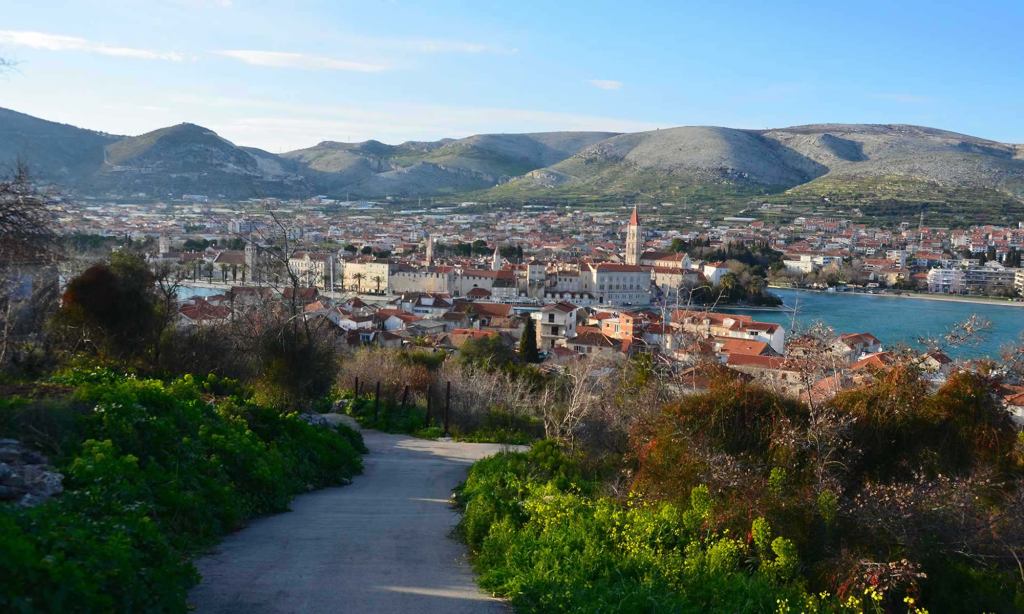
Trogir was our Croatian home away from home for two memorable months. This picturesque old town has a fascinating history that goes back more than 2,300 years — in fact, it’s actually situated on an island!
During our first weeks in Trogir, we preferred to soak up the town’s details bit by bit, leaving much to imagination. However, when the opportunity presented itself to go on a walking tour with Natalija, a new friend and certified tour guide, we decided it was time we properly unravel the mysteries of the ancient town.
Meeting Our Guide, Natalija
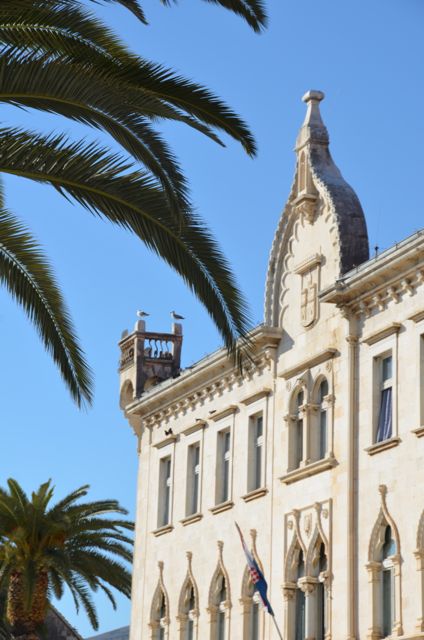
We started our walking tour at the spot where we’d originally met Natalija – Trogir’s Petar Berislavić School, a handsome, century-old building with a commanding location on the Adriatic. When we’d gone there to make arrangements to visit an English class earlier in the month, Natalija (who works as the school’s legal advisor; she is a lawyer schooled in Split), helped translate. Our visit to the 6th grade class would turn out to be a fun diversion: we chatted about the students’ current lessons (their teacher kept reminding us that we could only speak to the kids in the present tense, as it’s the only one they’d yet learned), and their extracurricular passions. One boy was an up-and-coming water polo player, another was an avid basketball fan. The female students professed a love for studying, not sports. As we left the classroom, impressed by the young students’ fine grasp of English and feeling their contagious energy, we concluded that these Croatian youth weren’t very different from their peers we’d met in classes in Southeast Asia and India just a year earlier.
An Overview of Trogir’s History
Standing in front of the school on the day of our walking tour, we saw familiar student faces peeking out of the open windows; several students waved at us in a hearty fashion, sending us off on our way with Natalija.
Natalija started out by explaining Trogir’s etymology. Trogir was founded by Greek colonists in the 3rd century BC; they called the port Tragurion, similar to the Greek word Tragos meaning ‘male goat.’ After the Greeks, the Romans and Venetians would put their stamp on Trogir’s history, followed by Habsburg Empire rule and French troops. Trogir and Croatia as a whole would eventually become part of the Kingdom of Yugoslavia, and the Socialist Republic of Yugoslavia. The town was also occupied by the Italians during WWII, incurring some bombing damage. Croatia finally gained its independence in 1991 and Trogir was listed as a UNESCO World Heritage Site in 1997.

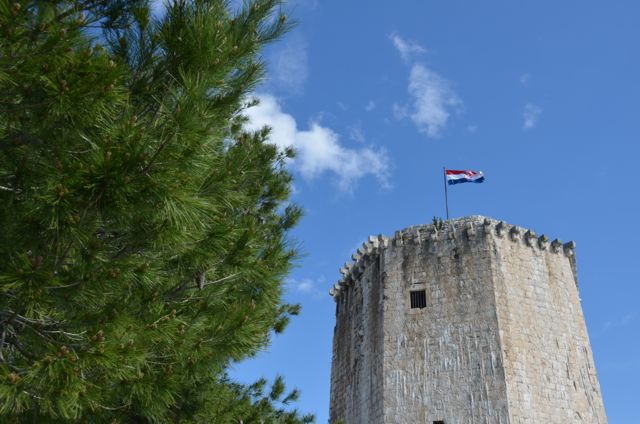
Nearby, the elementary school is the mid-15th-century Kamerlengo Fortress. Natalija drew our attention to the fortress’ tower, and what remains of a decorative frieze of the Winged Lion of Saint Mark. If you’ve been to Venice, or any spots once under the Venetian Republic’s rule, it’d be a familiar sight, except this one was largely destroyed after the fall of Venice in 1797. Natalija told us that we’d see the town’s only surviving winged lion in a few moments.

Next, we strolled to a suburb of Trogir called Pašike, which Natalija explained was once the district of the city’s poorer people. Trogir’s adjacent historic quarter, on the other hand, is where the noble people called home, behind entryways adorned with elaborate coats of arms. Natalija explained that noble ladies would often come to the wall bordering Pašike, so that they could escape the stuffy air, and dark, high walls of Trogir, where it was difficult to soak up the sunshine.
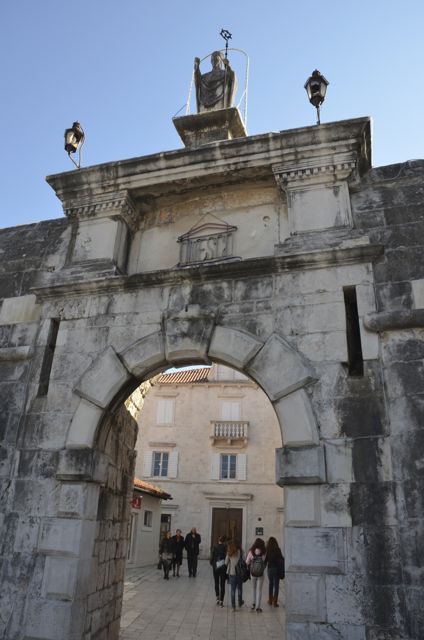
Entering through Trogir’s north gate, Natalija called our attention to the statue of Trogir’s town protector, St Ivan Orsini. Just a few footsteps inside is the Garagnin-Fanfogna Palace, the building that now houses the City Museum.

The family that once lived here was very powerful – so powerful that they could pardon someone awaiting execution by simply putting a white sheet on this balcony,” Natalija explained.
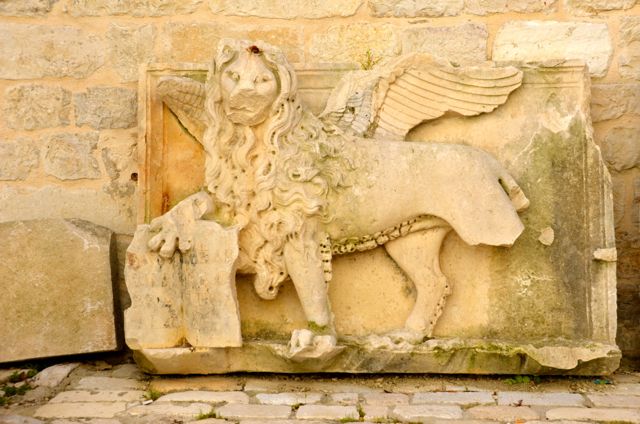
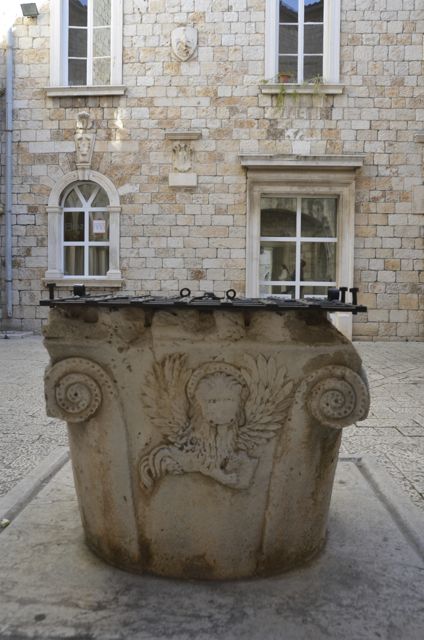
Back in the palace’s courtyard was a haphazard collection of limestone olive oil millstones, and the city’s only Winged Lion of Saint Mark frieze that was not damaged after the 370+ years of Venetian rule came to an end. Natalija drew our attention to the open book at the lion’s feet, explaining that it’s widely believed that an open book indicates a period of relative peace, whereas a closed one symbolizes times of war.


Nearing Trogir’s main square, Trg Ivana Pavla II, named after Pope John Paul II, we stopped at the Cipiko Palace, which was once home to the Cipiko family’s well-known writers, artists and historians. The large rooster replica in the entryway, Natalija explained, was seized from a Turkish ship by a Cipiko family member during a pivotal 15h-century battle. High up on the building’s front façade are beautiful windows that would be equally at home overlooking Venice’s canals.


An Italian Connection
If you’re thinking that some of these names sound a bit Italian, you’re correct. During medieval times, Latin was spoken here. Even today, Natalija explained, many Dalmatian families still have Italian surnames. She compared the Dalmatian temperament to that of the Italian people (playful and less rigid than northern Croatians, who are said to have been influenced by the Austro-Hungarians).

The most prominent monument on the square and in Trogir is the St. Lawrence Church/St. Lovro Cathedral. It has a celebrated entryway, carved by the master Trogir sculptor, Radovan.

Natalija explained some of the symbolism behind Radovan’s work. Adam and Eve are represented, and the lamb represents good, the dragon symbolizes evil). She also shared an interesting art history tidbit about the column and sculpture just in front of the church.
“This statue is of Jesus,” she explained, “and many tour guides will walk past it without saying anything because it is a bit scandalous and only a year or so old.”
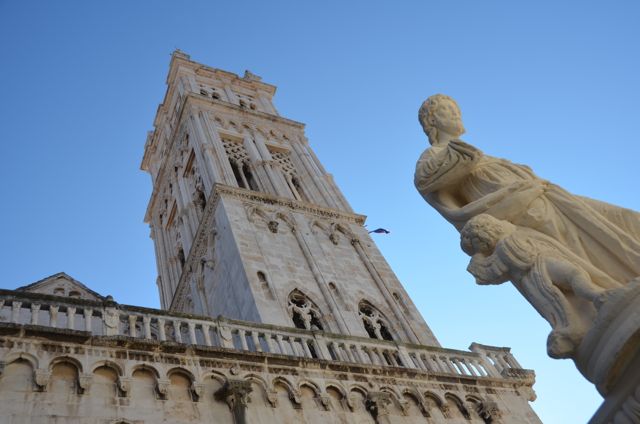
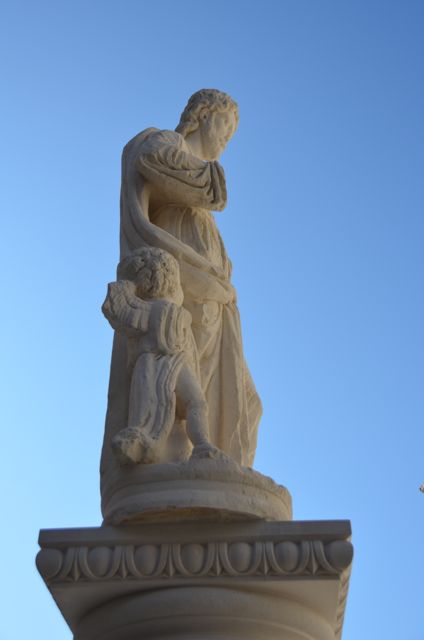
Natalija elaborated, explaining that the city leaders and the church did not agree about whether or not to recognize St. John’s Day as a local holiday. Church leaders were upset when the patron saint’s day wasn’t recognized, so they erected the sculpture. I found this funny since I’d photographed the sculpture just days before — certain it was as old as the church. Natalija joked that someday it may be removed since putting it there could be seen as questionable given Trogir’s UNESCO World Heritage status.
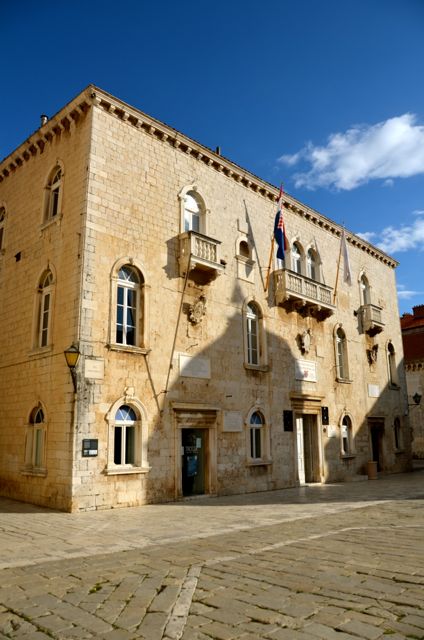


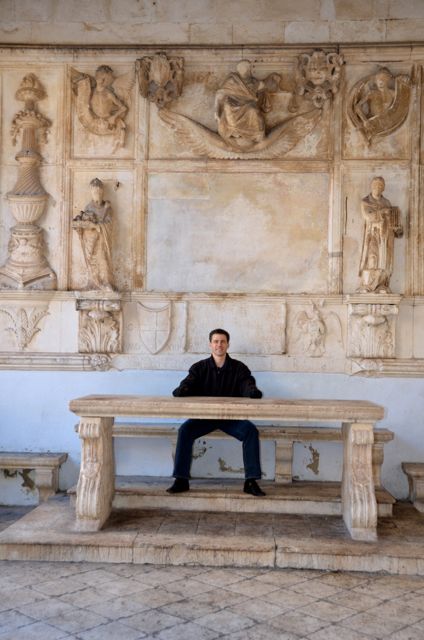
Other prominent buildings on the square are Former Duke’s Palace/City Hall, the town’s Clock Tower and Loggia, which was formerly a courthouse of sorts. Natalija showed us chains that once held the accused wrists during the trial, and explained that executions were carried out in the main square.



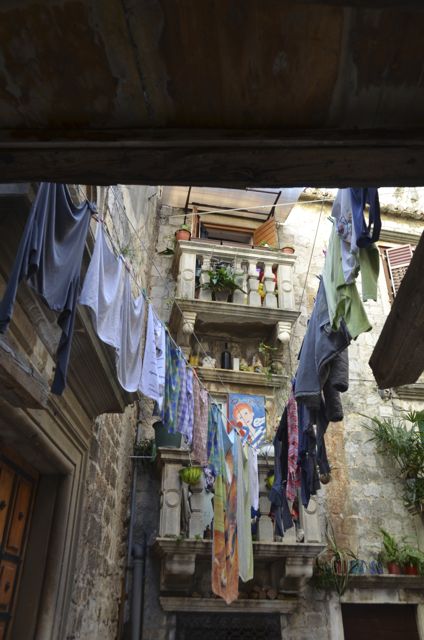
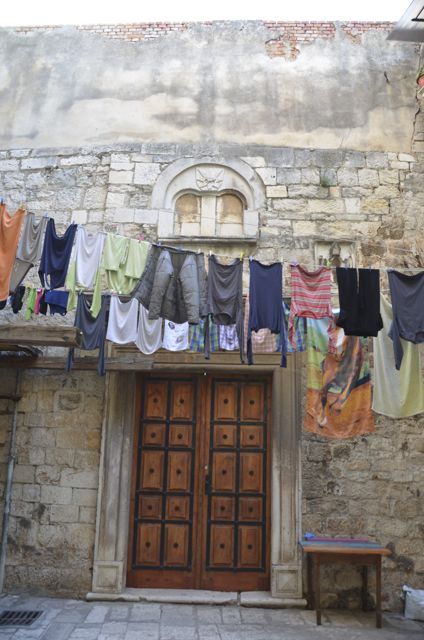
Next, we wound through a charming courtyard, where multiple potted plants lined the stairways, and laundry lines criss-crossed overhead, before exiting through the town’s south portal, which amazingly still wears 15th century wooden doors (complete with intimidating iron adornments).


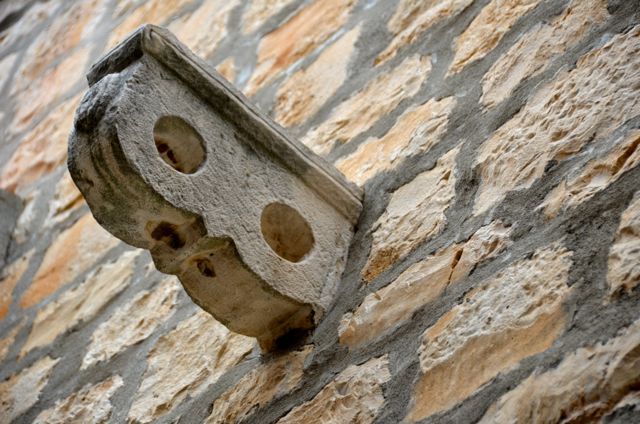
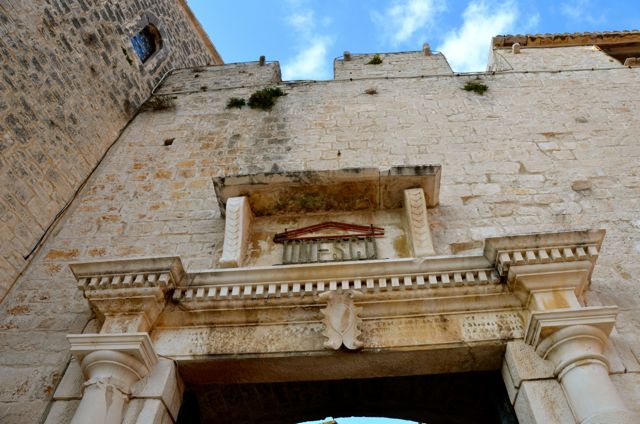

“After 1100 PM, people were not allowed to come into the town,” Natalija explained, so this Small Loggia (or Mala Loza) was a shelter for them while they waited for morning.” The loggia later evolved into a fish market, and today houses souvenirs during Trogir’s busy tourist months.

Having looped back to the elementary school, our tour had come full circle. We were thrilled to finally have acquired a greater appreciation of Trogir, thanks to Natalija sharing her afternoon with us. When we mentioned to Natalija that we’d likely be exploring nearby Split in the coming days, she tempted us with more intriguing historical tidbits about Diocletian’s Palace and beyond. She’s a true fountain of knowledge.
Where in the World?
Planning Pointers:
- If you’re coming to Trogir or the Split area, and would like to arrange a private or small group walking tour, do consider getting in touch with our guide Natalija. Her English is fantastic, and as a lawyer, she offers an interesting perspective on the area’s culture and history. You can reach Natalija at: natalija.nov[at]gmail.com .
- If you’re a Dr. Who fan, check out the Trogir locations where the Dr. Who episodes were filmed in 2009.
- Visit my Croatia page for more trip tips, plus an index of all my posts about Croatia.
Accommodation in the Split Area:
Shawn and I have spent a total of five winters and one summer in and around the city of Split, using it as a base to explore Croatia’s popular Central Dalmatia region. We’ve made it a habit to create new memories by staying in a different property each year. Over the years, we’ve had long-term stays in Split, Trogir, Solin, and Makarska. We would happily revisit all of the following apartments. (Please note that some are affiliate links.)
- Kaleta Apartments (Split) – These lovely apartments are located within Diocletian’s Palace (well, technically just a few meters from the Iron Gate). Our elegant studio apartment, called the “Diocletian’s Suite,” had lots of character — including Roman brickwork embedded into the wall. We had overhead views of life on Split’s Old Town streets, and we enjoyed chatting with the friendly owners, Novica and Negri. We spent about 2.5 months here.
- Guesthouse F (Split) – This cozy studio apartment is located in Split’s Varoš neighborhood, just a few minutes’ walk from Diocletian’s Palace. With its quirky narrow streets and stone homes decorated with hunter-green shutters and flower boxes, Varoš is charming. One of Guesthouse F’s apartments was originally a horseshoe maker’s workshop, owned by Anja’s grandfather. Shawn and I dubbed it the “horseshoe cottage.” Aside from our central location, we loved having a tiny terrace. We also appreciated the kindness of our hosts, Anja and Miro. In total, we spent about 2 months here.
- Viola Apartment (Split) – We spent roughly 3 months in this wonderful 2-bedroom apartment, which is also in the Varoš neighborhood of Split. The apartment also has a lovely sun porch and garden. It is in an old stone home, but the interior has recently been remodeled. We were in a perfect location for accessing Diocletian’s Palace and Marjan Forest Park, too. On foot, it takes about six minutes to reach Split’s most famous lookout point near the Caffe Bar Vidilica. The owner, Ljubica, lives upstairs. She is easygoing and helpful.
- Apartments Mirkec (Trogir) – We spent 7 wonderful weeks in this studio apartment, which is located in the heart of the town of Trogir. The apartment had good Wifi and a kitchen with all the basics. It was also perfectly situated in the heart of Trogir’s gorgeous Old Town, just a minute’s walk from the seaside walkway, the Riva. Trogir’s bus station was about a 5-minute walk from the Apartments Mirkec, making day trips using mass transportation easy. Note: As of 2025, I think this apartment has permanently closed. However, the owner’s popular restaurant (Pizzeria Mirkec), which is located underneath the apartment, is still cooking up delicious pizzas in their wood-fired pizza oven.
- Apartments Vesna (Makarska) – This 1-bedroom apartment was our home for about 12 months. The apartment is on the top floor and features skylights. A small balcony on the back of the apartment overlooks Makarska’s harbor — the views of Makarska’s dramatic mountains are wonderful! It takes about 8 minutes to reach Makarska’s bus station on foot. In a matter of minutes, you can also walk to Makarska’s Riva (seaside promenade), several grocery stores, restaurants, and cafés. The owners, Mise and Anna, are exceptionally friendly and helpful.
Photography & text © Tricia A. Mitchell. All Rights Reserved.


Leave a reply to moderndayruth Cancel reply