

Modena cheese maker Carlo has been making Parmigiano-Reggiano for more than 50 years. Still, the farmer-turned-cheesemaker does not tire of the prized Italian cheese.
“I always have Parmigiano-Reggiano in my mouth [when not at work]. I constantly keep eating it,” he joked, as we toured the Hombre Organic Cheese Farm in Italy’s Emilia-Romagna region, just outside of Modena.
The opportunity to learn about another Modena prized delicacy, traditional balsamic vinegar, would be our next stop.
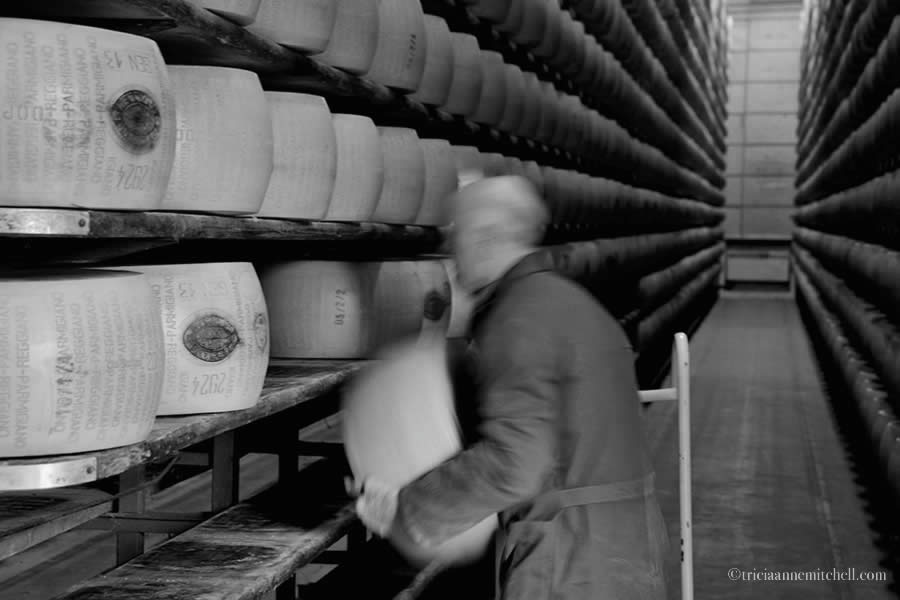
As Carlo inspected and cleaned a wheel of cheese weighing approximately 38 kilograms (80+ pounds), he mentioned that his other culinary weaknesses were spaghetti and bread. He said that as he’s gotten older, he’s had to cut back from eating as much as 1 kilo (or 2.2 pounds) of bread a day!
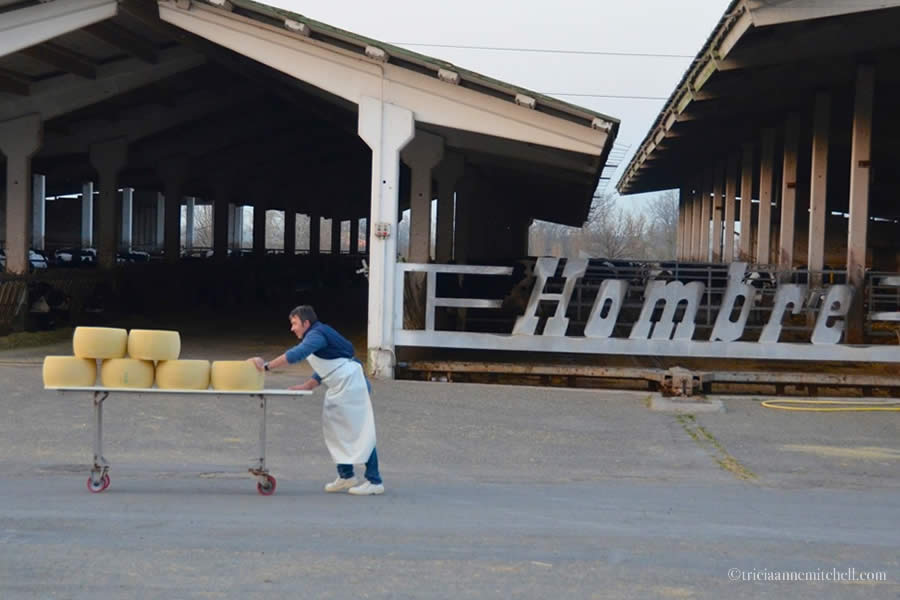
Carol then loaded up a dolly with several massive wheels and walked into the nearby storage room to place them on a shelf for aging.
Our guide, Elena, chimed in: “After 24 months of aging, the cheese’s flavor is rather mild. Even if it’s aged 40 months, the flavor is not too sharp or overpowering. There’s a belief that the American market wants sharp flavor, but the Italians prefer the flavor not so sharp,” Elena added.
Next, Shawn and I toured the grounds, where we saw some of the pampered Fresian cows that produce the milk for the cheese.
“Hombre’s cows are well taken care of. One can’t push production – the cows must be allowed rest time. They listen to classical music in the milking room, and no humans are allowed there to help ensure the cows do not become stressed,” said Elena.
Before we went into the farm’s shop for a tasting session, we explored the gallery of classic automobiles collected by the farm’s late owner. Masseratis, Mercedes, and Cadillacs were on display, shimmering in the late afternoon sunlight of the golden hour.
Inside the tasting room, the mouthwatering morsels awakened the turophile in both Shawn and me. We regretted not having a large piece of luggage in which to carry home a wheel of the cheese. And neither one of us felt ashamed about taking the last piece on the plate, known in Italian as the vergogna, or ‘The Shame.’
“Hombre’s cows are well taken care of. One can’t push production – the cows must be allowed rest time. They listen to classical music in the milking room, and no humans are allowed there to help ensure the cows do not become stressed.”
– Elena
Once we had bid farewell to the cheese paradise that is Hombre, we were whisked off to the Società Agricola Acetomodena, to meet the traditional balsamic vinegar producer whose family has been making this so-called ‘black gold’ for more than 100 years.
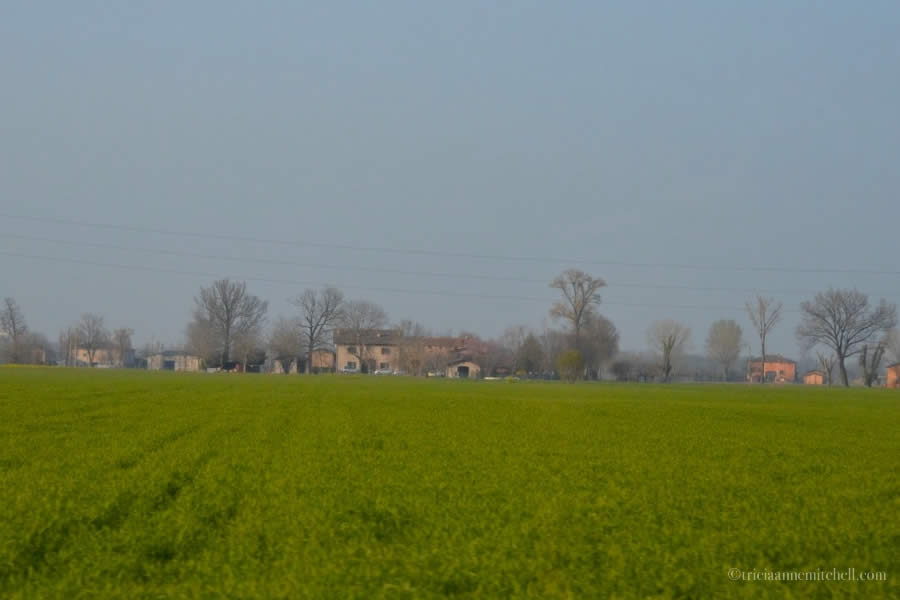
As we rode through Emilia-Romagna’s spring-green countryside, Elena shared some tidbits about the culture surrounding the region’s esteemed product.
“It’s customary for balsamic vinegar-producing friends to give vinegar to their family members and friends for Christmas. And we put it on frittatas, pumpkin and potato soup, salads, boiled potatoes, risotto, even strawberries or gelato,” she added.
We assumed that the producer’s acetaia would be housed in a centuries-old building; however, much to our surprise, the Società Agricola Acetomodena structure was streamlined and modern. Inside was a panoramic tasting room that overlooked the rows of Lambrusco and Trebbiano grapes harvested for the vinegar’s production. Bubbly owner Patrizia Marchi, along with employee Gary, greeted us and explained the process.
“Once the grapes are harvested, they are pressed and cooked into a must, or a juice,” they explained. “After a long period of fermentation and aging in a series of barrels known as a battery, the liquid becomes balsamic vinegar of Modena.”
Like Matrioshka nesting dolls, the battery consists of barrels that decrease in size. The must starts out in the largest barrels and graduates to the smaller ones.
Having heard that a battery is started to commemorate the birth of a son, we asked Patty if her family had followed this tradition. With a warm smile, she guided us over to a series of barrels near the sleek glass partition, indicating that they were her son’s.
To attain DOP certification, the vinegar must age for at least 12 years.
To be declared Extravecchio, literally ‘extra old’ – at least 25 years.
During the process, the vinegar is regularly tested and must be approved by official tasters. It can only be designated Aceto Balsamico Tradizionale di Modena DOP if it has gone through this rigorous process. It’s then bottled in a uniform bottle called a cruet, which is numbered with a seal.
On an antique horse-stall door-turned-tabletop, we sampled from several bottles, ranging from the more humble condiment to the ‘grandfather’ bottle that had been aged for 25 years. It had no bite, and it was especially smooth.
“Life centers around the table here,” Gary said. “Every family has balsamic vinegar on their table.”
The next afternoon, when we were back at our hotel, Shawn and I enjoyed a treat of plump strawberries dotted with balsamic vinegar from the Società Agricola Acetomodena. Upon tasting it, we could see why every family is passionate about their balsamic vinegar. The ‘black gold’ took our plate of divine strawberries to a new level.










Our Video of This Experience:
Where in the World?
Further Resources:
- Italy’s Practically Perfect Food (BBC Travel)
Planning Pointers:
- The Hombre Organic Cheese Farm is located at Via Corletto sud, 320, 41100 Modena, Italy.
- The Società Agricola Acetomodena‘s address is Stabilimento in Strada Borelle 120, 41126, Modena, Italy.
- While in Modena, we spent 3 nights at the elegant, historic, and centrally-located Hotel Canalgrande (affiliate link). One of our favorite memories from Modena, in fact, was sitting out on our hotel room balcony just before sunset, looking out over Modena’s rooftops, while enjoying goodies that we’d procured at the Albinelli Market earlier in the day.
- Peruse the Emilia-Romagna Tourist Board website for more details about this region’s rich offerings. Also, they’ve just recently released a free e-book that chronicles Emilia-Romagna’s Art Cities. I wish it’d been published when we were in the region, yet it’s since presented even more excuses to return to this stunning part of Italy.
- If you’d also like to “eat, feel and live local in Italy” as we did in Modena, check out the BlogVille project website.
- Need more inspiration? This link contains an index of all my posts from Italy.
Disclosure & Thanks:
Our Modena visit was supported by the Emilia-Romagna Tourist Board, to which we extend thanks.
An extra special thank you to Nick and Francesca for coordinating all the details and making us feel so welcome in Emilia-Romagna. For these excursions, we also wish to say Grazie mille to our guide, Elena, for giving us much insight into local culture.
Photography & text © Tricia A. Mitchell. All Rights Reserved. The video was created by my husband, Shawn.




Leave a reply to The House Mouse Cancel reply