Last Updated:

Blown Away by Orange, France: An Afternoon Admiring the Roman Theater and Triumphal Arch

Posted by

·

, ,

I’d read about Provence’s unforgiving mistral wind. Now, I was battling it in the Ancient Roman Theater in Orange, France.

The sky was a clear, brilliant blue on this autumn day, but frigid gusts grew stronger the higher I climbed. Struggling to maintain my footing, I tried to channel lessons learned from years of doing balance poses on a yoga mat. I could taste a grit in my mouth, the dust of limestone ground down over the millennia.

When the wind got to be too much, I sat upon the chilly concrete seats and admired the splendor of my surroundings. The 2,000-year-old theater’s spectacular backdrop wall soaked up the day’s last hours of sunlight. Weathered columns and niches were still bathed in a golden light, but a statue of Roman Emperor Augustus had already fallen into shadows.

I’ve read that the mistral wind might make its appearance in Provence about 100 days a year! Realizing how much my hair had been tousled by the mistral in a few minutes’ time, I imagined how this fierce wind had impacted performers the last few thousand years. What props have succumbed to the strong gusts? And what did Roman performance-goers wear to protect themselves from the mistral’s inevitable chilling effect?

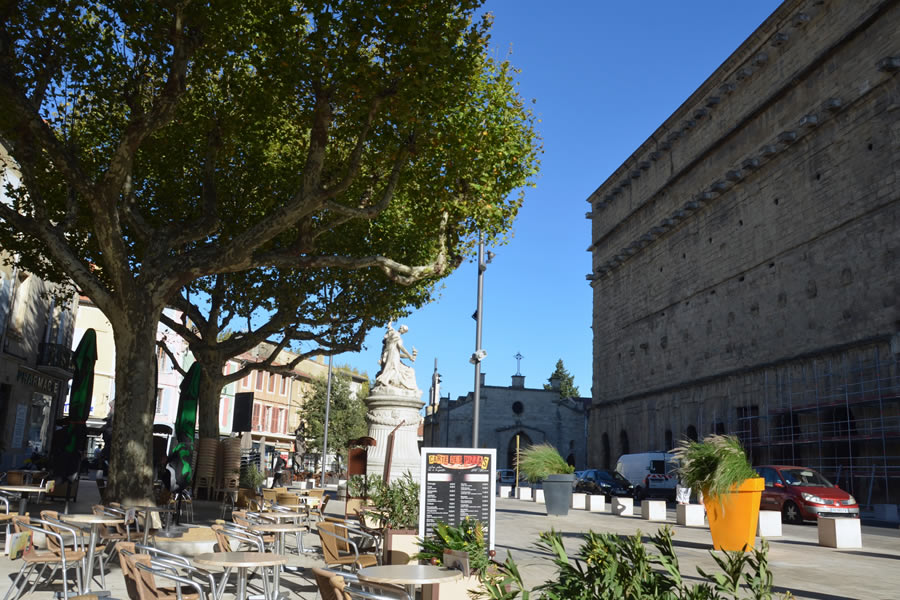
Realizing that we didn’t have enough outerwear to stay warm, Shawn, his parents, and I headed to a café just across from the theater. We wrapped our hands around hot cups of coffee, and looked at the theater’s exterior from our sheltered spot.

Once we’d gotten our second wind, we again braved the elements to visit the city’s triumphal arch, which was built around the same time as the theater.

As the branches of the nearby trees tossed in the wind, I marveled at how the arch’s carvings could look so intact despite being exposed to centuries of the mistral’s abuse.

A Bit About Roman Orange (Arausio)

Originally known as Arausio, Orange’s Roman chapter began in about 35 BCE, when a military colony was established there.

Like Rome, Orange had temples, baths, an arena, a theater, and an arch. Today, only Orange’s theater and arch survive. The theater is said to be one of Europe’s best preserved. (If you want to dive deeper into the theater’s history, the Orange Tourism Board’s website details Orange’s history from prehistoric to modern times.

Both the theater and Orange’s triumphal arch are UNESCO World Heritage Sites.

Recognized for its fine architecture long before the 1981 UNESCO inscription, Louis XIV supposedly declared the theater’s backdrop wall as “the most beautiful wall” in his kingdom.

A streetscape in Orange, France, and a pink building with blue shutters.
Left: Our first glimpse of the Roman Theatre (French: Théâtre antique d’Orange) at the corner of this streetscape. Right: Buildings painted in traditional Provençal hues.
The exterior of Orange's Roman Theatre Antique, covered in scaffolding.
The Roman Theater’s massive exterior wall, partially covered in scaffolding. This 17th-century drawing gives an idea of how this structure dwarfed some of Orange’s other buildings.
Cafe tables sit across from the Roman Theater in Orange, France.
This café interior offered me, Shawn, and his parents shelter from Orange’s wind, after we toured the theater.
A car is visible through the arch of Orange's Theatre Antique.
Old meets new: peering through a theater arch, onto a well-traveled street.
The interior of Orange, France's Theatre Antique, or Roman theater.
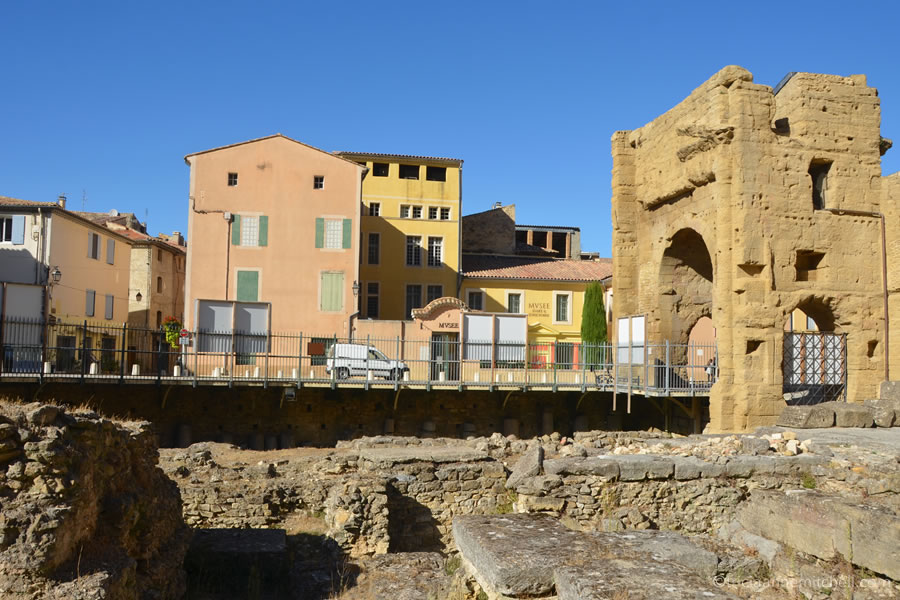
When you first enter the theater complex, you’ll happen upon these ruins. Archaeologists have debated whether they’re the remains of a temple — even a circus. Today, it’s believed that the area was dedicated to the worship of Emperor Augustus.
Ruined Roman architecture inside the Theatre Antique of Orange, France.
Fragments of entablature
View of an Orange, France street scene through the fenced-in Roman Theater interior.
The ruins of the temple, contrasted with a contemporary street scene.
The stage of Orange, France's Roman Theatre Antique.
The Roman Theater’s spectacular backdrop wall. A statue of Emperor Augustus is the focal point, and originally the wall would’ve been adorned with marble.
Detail of the Roman columns at the Theatre Antique in Orange, France
Weathered columns.
A woman sits in the numbered seats of Orange's Roman Theatre in Orange, France. On the left are Roman columns.
Left: Columns adorn the backdrop wall. Right: Modern, concrete seating. For a time, the structure was transformed into a prison, even a housing area. It wasn’t until the 19th century that the theater returned to being a venue for hosting opera and theatrical performances.
The staircase and Emperor Augustus statue at the Roman Theater in Orange, France.
Left: A view of the stage. Right: Augustus’ weathered likeness.
A woman walks across the stage at Orange's Theatre Antique in France.
A woman walks across the stage.
The worn stairs of Orange's Theatre Antique (left) and views of the city of Orange, France (right).
Left: Stairs worn by time and the feet of countless theater-goers. Right: A crumbling theater wall frames the distant Alps.
Visitors at Orange's Theatre Antique in France.
Left: Shawn and his mom. Right: Me, trying to escape the relentless mistral wind.
The concrete, steep, numbered seats inside the Theatre Antique in Orange, France.
The theater has seating for about 9,000 spectators.
The statue of Roman Emperor Augustus at Orange's Theatre Antique in Orange, France.

Tourists take photos from the seating area in France's Theatre Antique in Orange.
The theater’s seating area is built into a hill. The next time we visit, I’d love to climb up to this green overlook for a bird’s eye view.
The exterior of colorful, shuttered homes in the city of Orange, France.
Colorful buildings line one of Orange’s main streets.
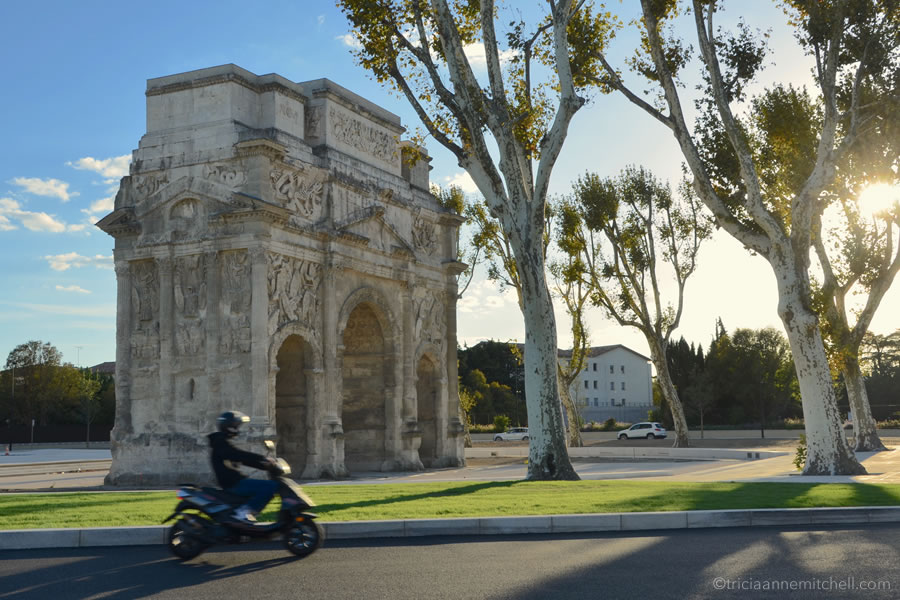
A person on a motorbike speeds past the Triumphal Arch of Orange, France.
A motorbike speeds past Orange’s Triumphal Arch, not long before sunset. The arch, which dates back to the 1st century CE, was constructed by a Roman legion of veterans.
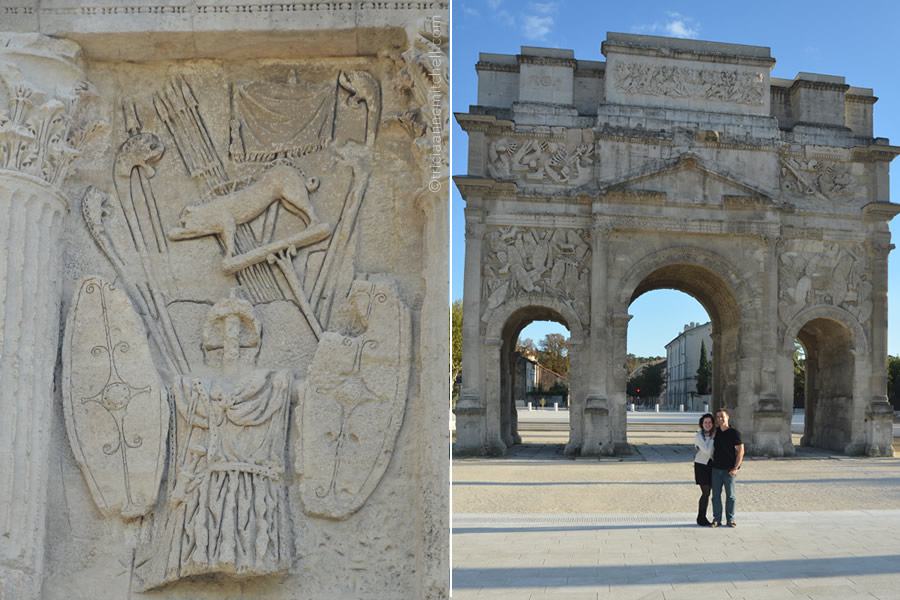
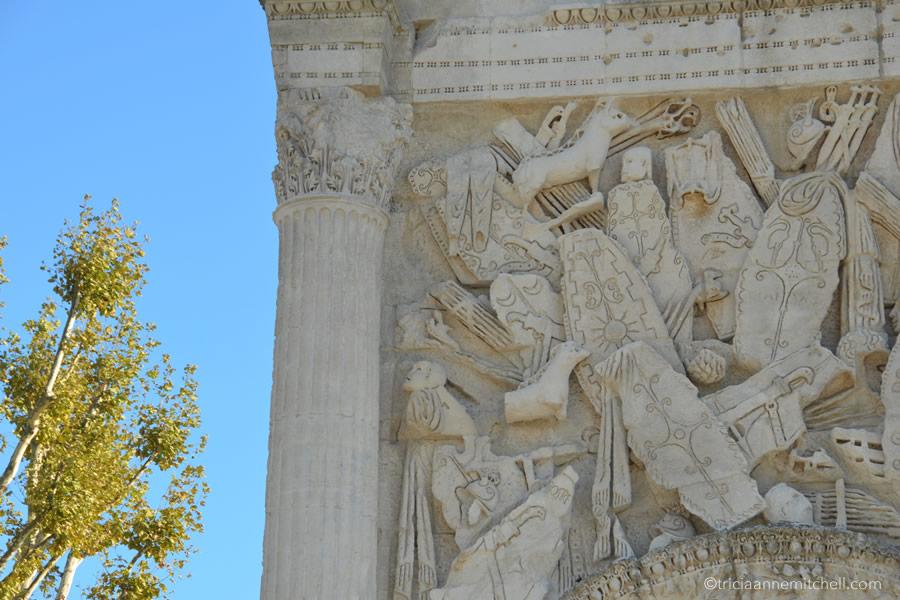
A close-up of the architectural detail of the Triumphal Arch of Orange, France
Left: One of the panel’s details. Right: Shawn and me huddle together to stay warm.
The Triumphal Arch of Orange, France, framed by a tree's foliage.
A plane tree wearing autumn leaves frames the arch.
A close-up of the architecture of the Roman Arch in Orange, France.
The arch’s well-preserved reliefs depict military themes: shields, naval symbols, and standards.
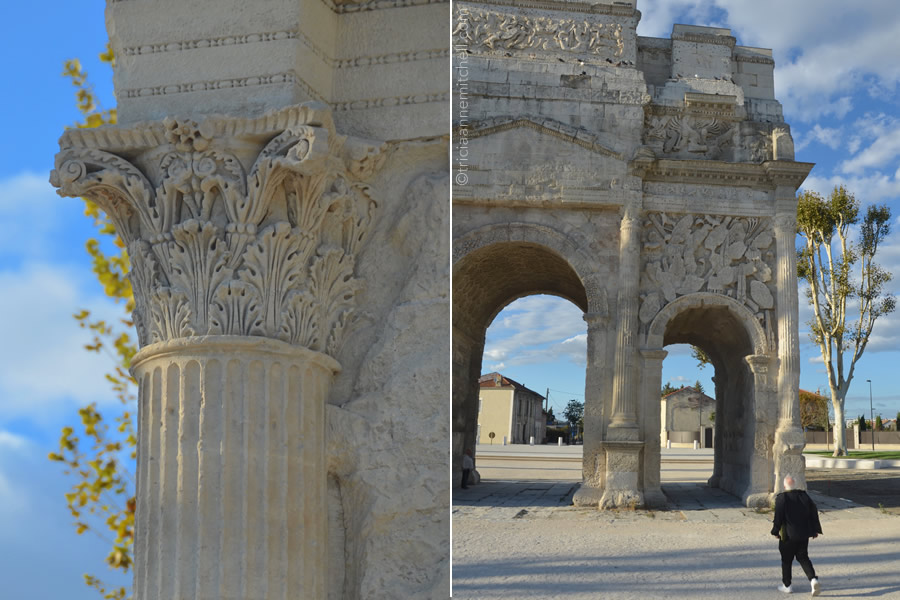
A Roman's column's detail of the Triumphal Arch of Orange, France
Left: A Corinthian-style column. Right: Shawn’s father admires the architecture.
Looking upward toward the ceiling of the Triumphal Arch, in Orange, France.
The arch’s ceiling reminds me of the one inside Jupiter’s Temple in Split, Croatia.
A close-up of the architecture of the Triumphal Arch in Orange, France.

Shawn’s Video:

Where in the World?

Planning Pointers:

  • Orange is located in France’s Provence-Alpes-Côte d’Azur region, about 115 km (70 miles) northwest of Marseille. Here is a map of Orange, on the Orange Office of Tourism website.
  • The Roman Theater (French: Théâtre antique d’Orange) is open for visits and the venue hosts performances, too. We did independent tours, and were given information-packed audioguides. See the Roman Theater’s official website for opening hours, prices, and upcoming events.
  • There is no cost to access Orange’s Triumphal Arch.
  • Here are more resources:
  • Do you need more inspiration as you plan your trip to France? My France guide contains an index of all my posts from France.

Photography & text © Tricia A. Mitchell. All Rights Reserved. My husband, Shawn, created the video.

Tricia A. Mitchell Avatar

About the author

Hi! My name is Tricia Mitchell. I delight in telling stories about my slow travels through more than 65 countries. Some of my highlights have included sharing meals with locals in Armenia, Cambodia, and Tunisia; sipping sparkling wine with French cousins in Alsace; milking goats in a sleepy Bulgarian village; and training with a Japanese mine-clearance team in Laos. My husband, Shawn, and I are based in France’s Loire Valley.

Leave a reply to the eternal traveller Cancel reply

This site uses Akismet to reduce spam. Learn how your comment data is processed.

22 responses to “Blown Away by Orange, France: An Afternoon Admiring the Roman Theater and Triumphal Arch”

  1. Darlene Avatar

    So great to see you here! This place looks amazing, in spite of the cold wind. We have had some windy days here too. (but not very cold) Glad to see you are still travelling to interesting places. Happy New Year!!

    1. Tricia A. Mitchell Avatar

      Hi Darlene, it’s great to be back sharing some stories. Thanks for the nice welcome! What is the cold, northerly wind in Spain called? Having spent some time in a few different countries, I’m finding it fascinating hearing the locals’ comments about how particular winds impact their mood and physical health. Do you hear similar accounts in Spain?

      And have you been to Segovia to see the aqueduct there? It looks pretty incredible!

  2. restlessjo Avatar

    What an interesting site, Tricia :) :) The days of the good old headscarf and Sophia Loren are called to mind.

    1. Tricia A. Mitchell Avatar

      I like that, Jo. I’ll have to remember a Sophia-esque accessory the next time we’re in mistral country! :)

  3. corneliaweberphotography Avatar

    Thank you Tricia and Shawn for your beautiful post, History is just amazing going back to BC.

    1. Tricia A. Mitchell Avatar

      Thank you, Cornelia! As for Ancient Roman history, Germany has some interesting sites too. Have you been to Trier? I’d love to get back there with Shawn and see the the Porta Nigra again.

  4. Bespoke Traveler Avatar

    Though I did not enjoy the mistral winds in Provence either, I do so love the quality of that light. It glows golden and seems to have a life of its own. Every time I have visited this region of France, I have thought to myself, “I understand why artists flocked here!” You’ve captured that light beautifully in your photos.

    1. Tricia A. Mitchell Avatar

      Hi Atreyee, those master painters were no doubt drawn to Provence’s glorious light, but probably had to hold onto their canvases tightly. :)

      This was my first time visiting the area west of Marseille. We stayed 3 weeks, dividing our time between home bases near Carcassonne and Nîmes. Since you have visited this region more than once, can you share any of your favorite towns or places? We hope to return soon, and feel as though we only scratched the surface.

      1. Bespoke Traveler Avatar

        I too feel as if I have only scratched the surface of Provence, Tricia! In the Vaucluse my favorite towns are Gordes, Vaison-la-Romaine, and Mazan.

        Gordes is 38 kilometers east of Avignon. It’s got Roman ruins, but also a beautiful Cistercian abbey called Sénanque. Vaison-la-Romaine is the place to see tons of Roman ruins right next to medieval quarters — like stepping into the pages of a history book. Mazan had some amazing Merovingian sarcophagi in its cemetery. I remember Roussillon to be picturesque too due to its position on top of ochre hills. Don’t remember any Roman ruins there, but the town is awash in shades of the pigment and, if you’re a Samuel Beckett (the playwright) fan, is the town where he hid while aiding the Resistance during WWII.

        I have a few favorites in the Var and Alpes-Maritimes departments of Provence as well. If you want more information on any of those or the towns I mentioned in the Vaucluse I’m happy to provide it, but I didn’t want this reply to be too long.

      2. Tricia A. Mitchell Avatar

        Belated thanks for these recommendations, Atreyee. There are so many layers of history in that area! I’ve made note of your tips and especially like the sound of Gordes and those ochre hills.

        We do hope to return to this part of France soon, but don’t have a specific date. Perhaps when we have set plans, I’ll touch base again.

      3. Bespoke Traveler Avatar

        Absolutely! Happy to help with any tidbits at my disposal.

  5. the eternal traveller Avatar

    What a fantastic sight and so well-preserved. I love visiting Roman sites and seeing the detailed work in the structures. I think it was worth facing that freezing wind to see this, Tricia. Happy 2018.

    1. Tricia A. Mitchell Avatar

      Hi Carol, it’s good to hear from you! You’re right that the state of preservation makes it remarkable. I also love that performances are still held there, keeping the spirit of the site alive. The acoustics are supposed to be great, but Orange’s stone seats seem pretty unforgiving. The Romans must have brought some type of cushions when attending a performance. :)

      Shawn and I are always eager to explore more Ancient Roman sites. Are there any from your travels that stand out?

      1. the eternal traveller Avatar

        For us, the best Roman sites would be the Porte Nigra in Trier and also the sites along Hadrian’s Wall, especially Vindolanda. We also really enjoyed Fishbourne Roman Palace. Actually any Roman site we’ve been to is pretty amazing.

      2. Tricia A. Mitchell Avatar

        I hadn’t heard of Fishbourne before (thanks for the tip!), but its mosaics look fantastic. I’m in awe at the amount of painstaking work that would’ve gone into working with such tiny tiles.

      3. the eternal traveller Avatar

        We were too. The work was beautiful.

  6. Bobbi-Jean Newell Avatar

    Looks like a beautiful place. Great pics!

    1. Tricia A. Mitchell Avatar

      I’d love to return to Orange when it’s a tad warmer, or when there’s a performance, Bobbi. :) How has your winter been going?

  7. Ethan Anthony Avatar

    So beautiful! I love ruins; there’s something so beautiful and spectacular about the history attached. Especially when researching church architecture.

    1. Tricia A. Mitchell Avatar

      Ethan, I share your enthusiasm for ruins, yet I didn’t always feel that way because I used to find them too abstract. Now I appreciate their air of mystery and the chance to interpret them. At the moment, my husband and I are in Kotor, Montenegro. There are some impressive churches here, many of which were built on the foundations of even older sites. Those multiple layers of history are fascinating!

      I see that you’re an architect. What types of projects do you prefer?

  8. robert Avatar
    robert

    hi there, my wife is disabled, did you notice if she would at least be able to view from the top ?

    1. Tricia A. Mitchell Avatar

      Hi Robert, thank you for your message. I am sorry, I don’t recall what the accessibility was like at Orange’s theater when we visited in 2017. I just looked at the theater’s website and didn’t notice anything mentioned there either.

      My husband’s mother was using a walker when we visited. She stood down by the stage of the theater. I don’t recall if there was any elevator or ramps. However, I do know that it was so windy when we visited that I had to watch my footing when I climbed up high.

      It does look like the theater staff updates the Facebook page; I wonder if someone there might be able to help you?

      https://www.facebook.com/theatreantiqueorangeofficiel

      Here is the phone number that’s listed on the website, too: +33 4 90 51 17 60

      If you do visit the theater, please feel free to let me know about the accessibility in the comments. That way, I can also update this post to help others in the future.

      I wish you both a pleasant trip to Orange. The Roman arch is also worth a peek!