

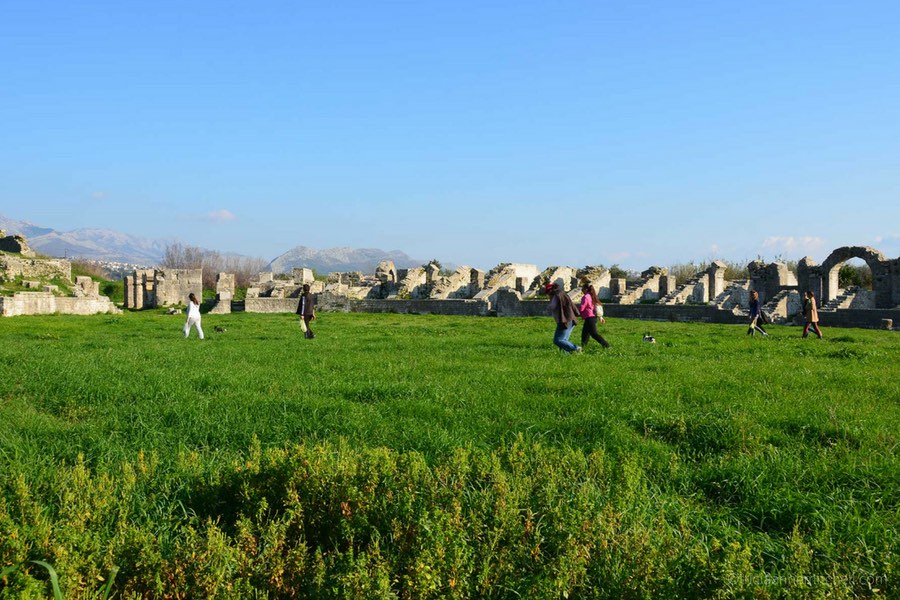
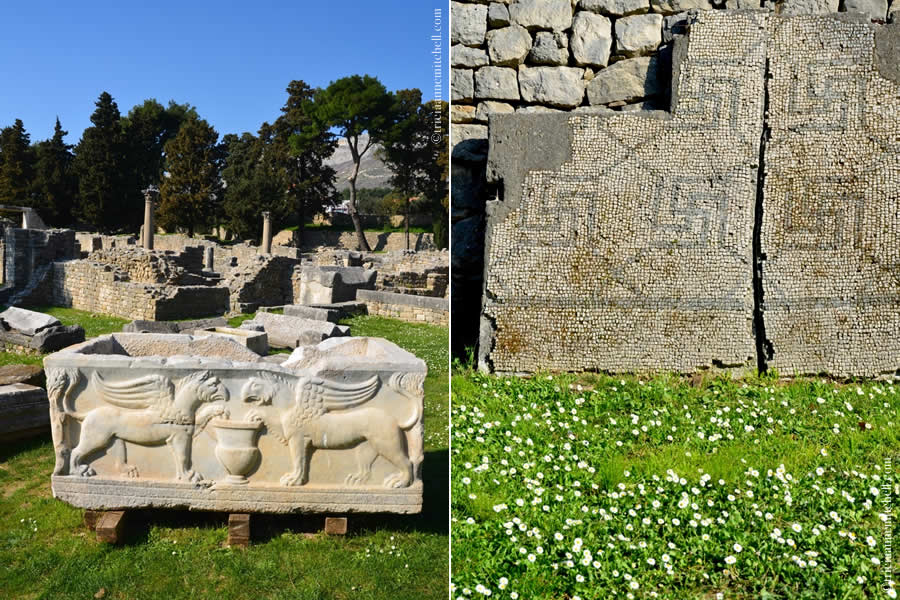
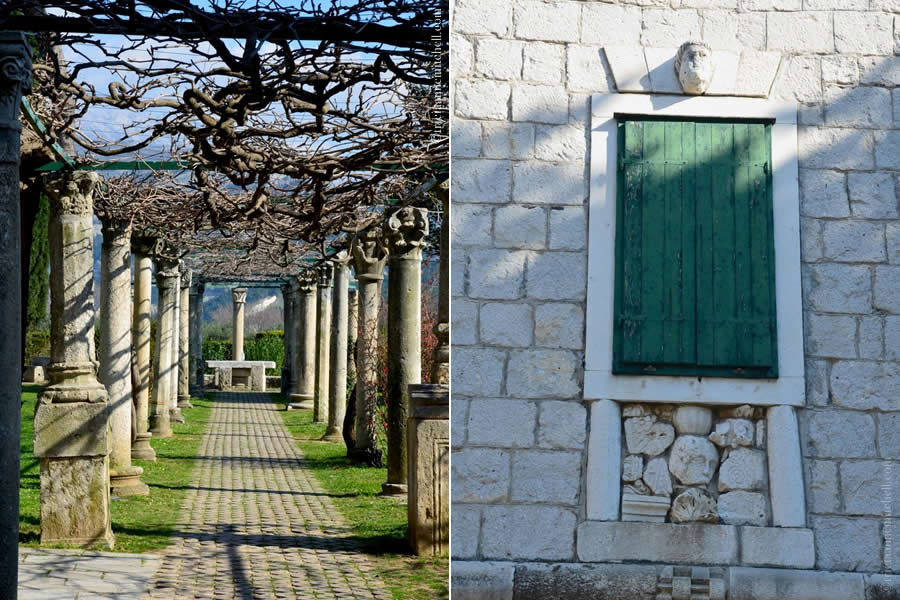
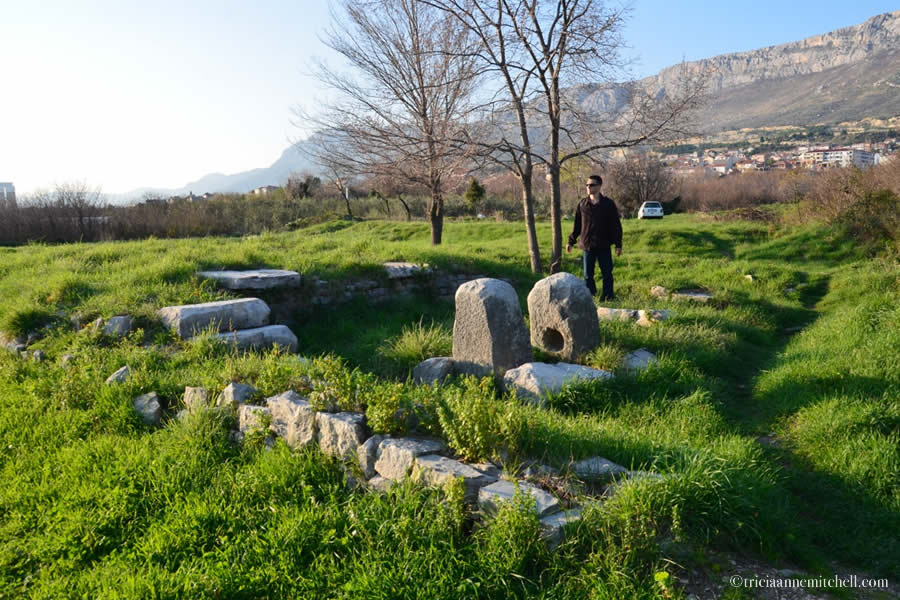
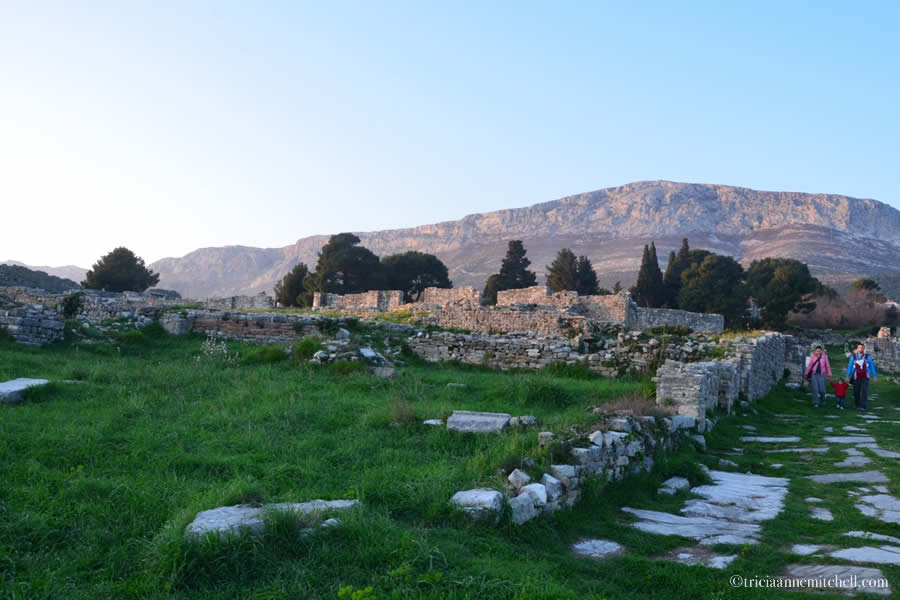
The ancient Roman city of Salona is located near Split, Croatia, in the city of Solin. Today, this landscape is dotted with abstract ruins, leaving much to the imagination. However, about 1,700 years ago, Salona was home to more than 40,000 people, making it one of the largest cities in the Roman Empire.
As we walked through this fascinating archaeological park one early-spring afternoon, Shawn and I felt a bit like archaeologist Howard Carter — or perhaps even fictional Indiana Jones. At times, we pretended that we’d just chanced upon an undiscovered ancient wonder.
Salona is an archaeological treasure, deserving of much more attention. However, on this February day, we were the only travelers there. We did spot a few locals, though.
First, we noticed a couple enjoying a picnic on the bright-green lawn of the Episcopal Center. The city’s weathered, sand-colored walls encircled them. Nearby was a fragment of a broken column. White daisies had emerged alongside it.
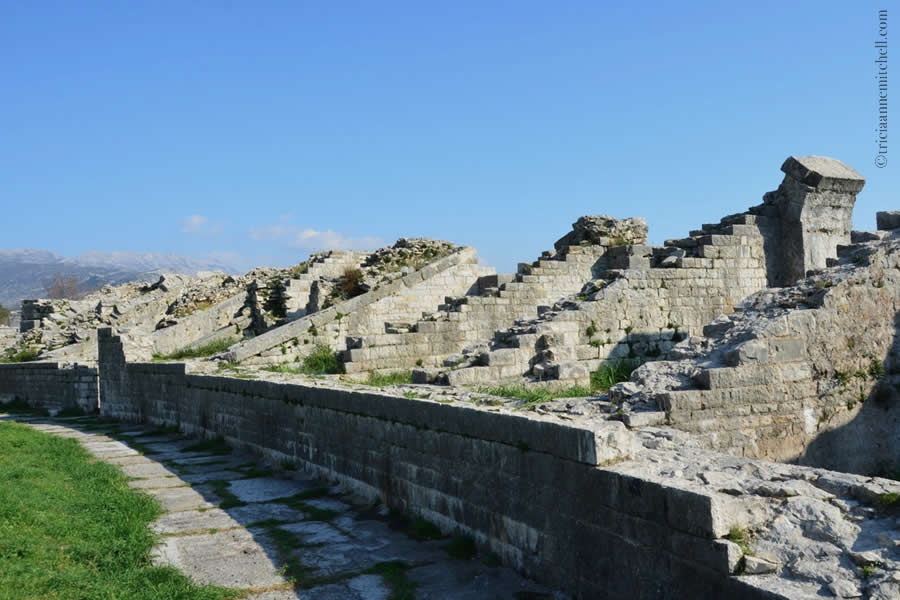
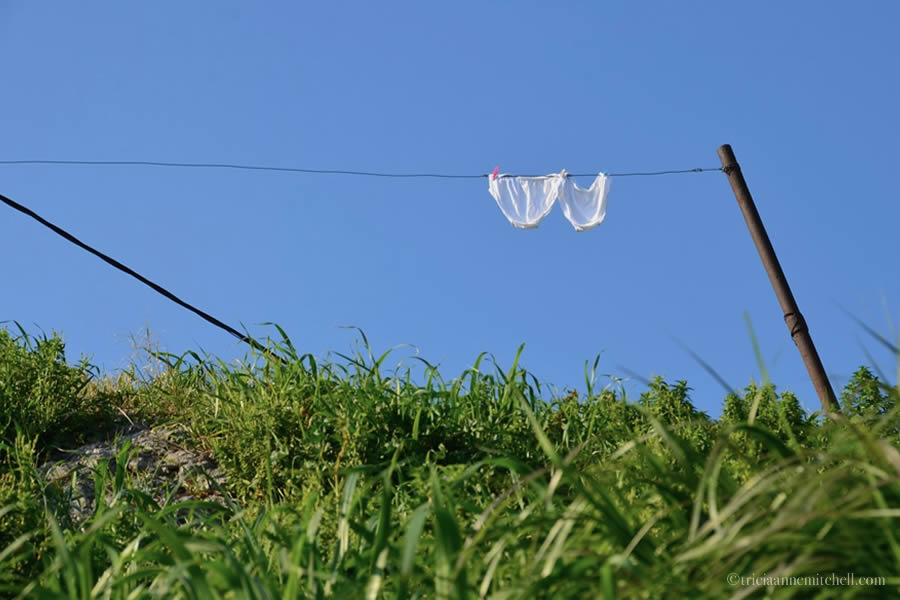
In a backyard overlooking Salona’s ancient amphitheater, a woman hung laundry. We remarked how this sight was decidedly more mundane than the bloody spectacles that would’ve once taken place in that ring.
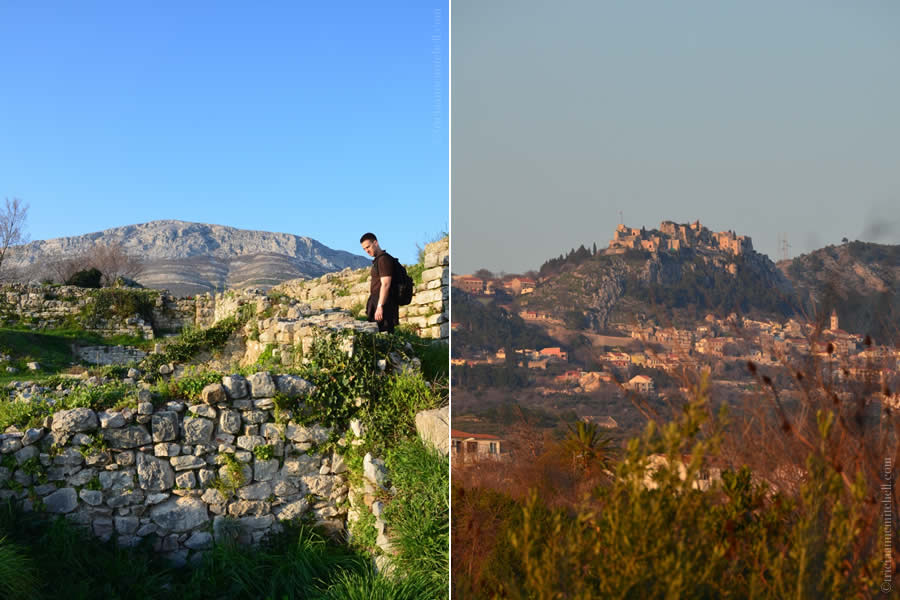
Elsewhere, on a plot of land overlooked by the mighty Klis Fortress, a couple tended to their olive trees. (The Klis Fortress has been around, in some form or another, for thousands of years. However, it’s recently gained notoriety as a Game of Thrones filming location).
We struck up a conversation with this gardening couple. When they heard that we fancied Croatia’s delicious wild asparagus, which was in season at the time, they went looking for some in their garden. Plucking a few stalks of šparoga out of the earth, they generously handed them to us and insisted that we take them as a souvenir to be enjoyed at dinner.
As we explored the ruins a bit more, Shawn and I expressed astonishment that we could have such intimate access to the remnants of this once-prominent city.
Having recently visited the Split Archaeological Museum, which contains many of the portable relics unearthed at Salona, we were better able to piece together what the community must have once looked like. But still, much was left to our imaginations.
Eventually, we found a spot on the seats of the old amphitheater and had a picnic lunch. Afterward, we strolled through the thermal baths. We also walked past remnants of the city walls and the aqueduct.
We also sauntered among ornately carved marble sarcophagi, which are scattered throughout Salona. Many of the tombs had cracked lids, or they were missing lids altogether. Seeing the damaged sarcophagi reminded us of a conversation we’d had earlier with a few Split residents. They told us that some of their friends had found valuable trinkets inside Salona’s ruins decades earlier.
My most memorable moment of our Salona excursion occurred as we walked through the Porta Caesarea (Caesar’s Gate). This portal would have once led to the heart of the ancient city.
Even today, cart ruts are still visible on the road leading to the Porta Caesarea. As we walked on this road, we imagined the Roman carts and the thousands of people who literally left their mark there.
As we tried to visualize these scenes, the last sunbeams of the day cast a warm glow on the tracks. Then, the silhouetted figure of a woman walking a dog appeared. Slowly, this duo came into focus. When I saw the woman’s modern-day clothes and the dog’s leash, my mind shifted forward a few millennia, back to the present.
Skip Ahead:
A Brief History of Salona
Salona was settled by the Illyrians and Greeks, but most extensively developed by the Romans.
During the reign of Emperor Augustus, Salona became the center of the Roman Empire’s province of Dalmatia. The Romans called the city Colonia Martia Iulia Salona.
Later, over the course of several centuries, the city underwent destruction by the Avars, Slavs, and Venetians. In the 6th century, Salona’s inhabitants fled the city, seeking shelter in the Palace of Roman Emperor Diocletian, which today comprises the heart of Split’s Old Town.
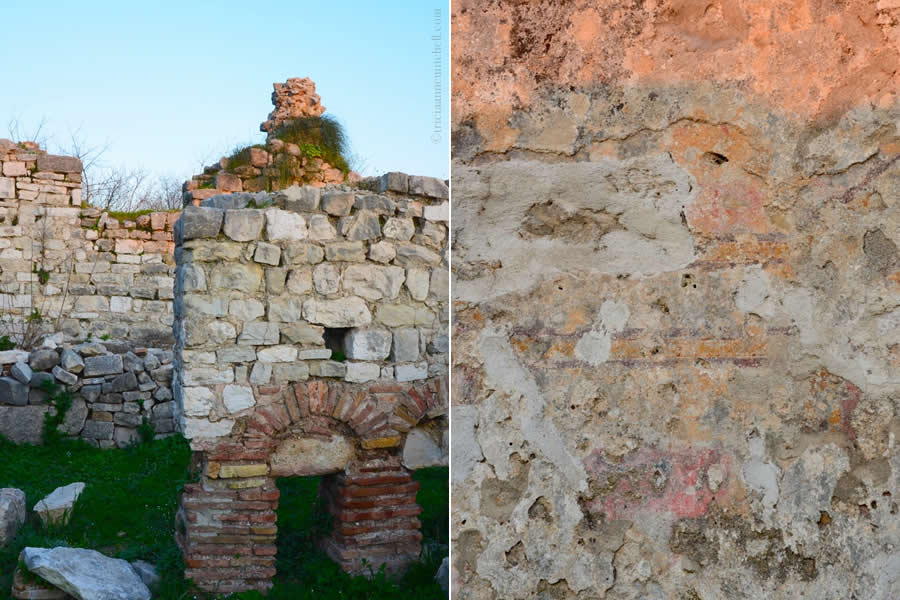
After Salona was abandoned, the ancient city fell into further disrepair. Even today, it has not been extensively excavated.
Today, much of Salona is surrounded by busy highways, industrial buildings, and residential neighborhoods. Even though these modern additions are encroaching on the ancient relics, it’s possible to block them out while you explore.
Our afternoon at Salona awakened my exploratory spirit, satisfied my hunger for history, and left me wanting to learn more about the Roman Empire. It’s my hope that this archaeological treasure will soon be preserved so future generations can savor it, too.
From obscure places to the tourist hot spots, which ancient Roman sites would you recommend visiting? Please share your thoughts in the comments section.
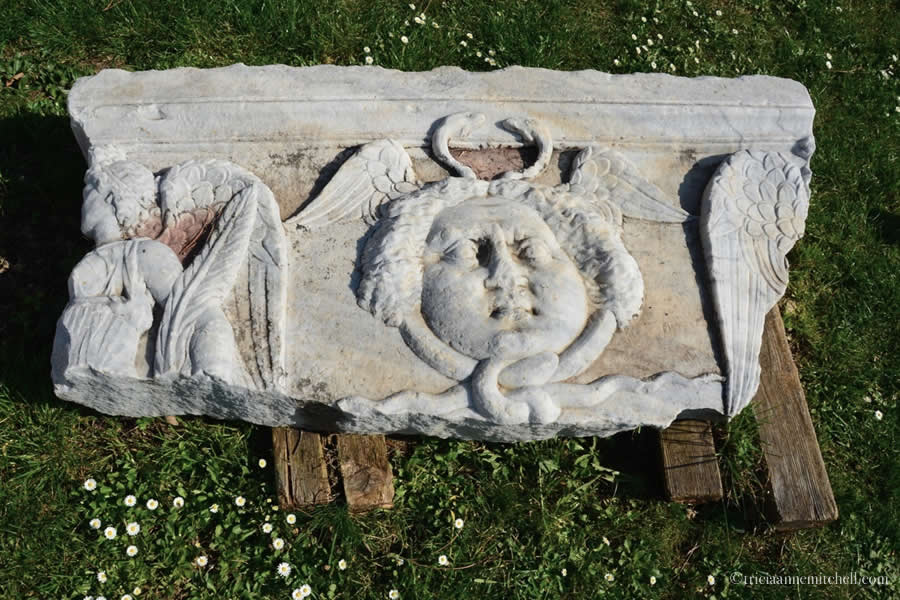




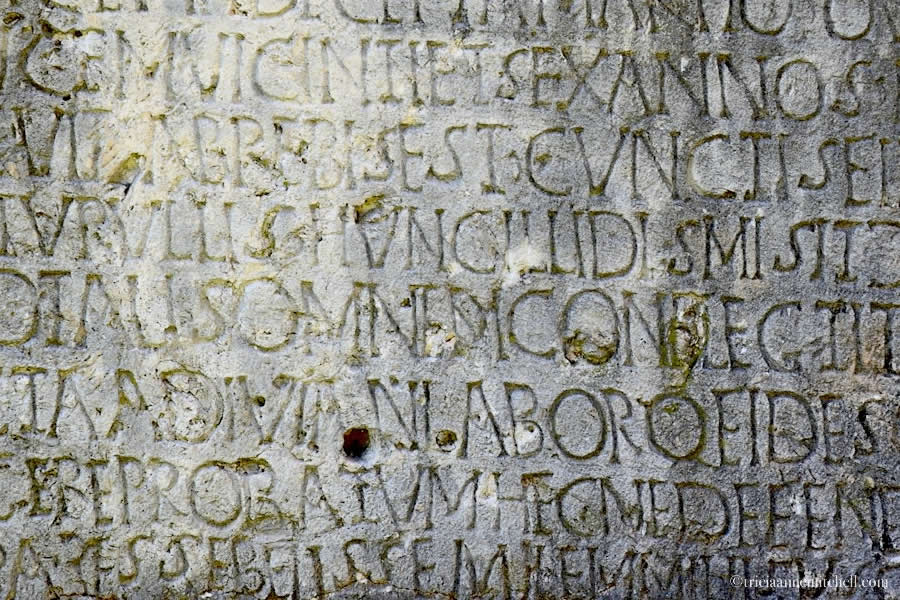
A Latin inscription on a sarcophagus in the Manastirine.


Where in the World?
Planning Pointers:
The Solin Tourist Board website has more information about ancient Salona and modern-day Solin, including this Solin visitor’s map (pdf).
The Split Archaeological Museum has also created a Salona Virtual Tour.
How to get to Salona:
The archaeological site of Salona is located near the modern-day city of Solin, about 6 km (3.5 miles) from Split. There is one official entrance. However, you can access the site from several different sides.
Parking
- If you drive to Salona, there is a small parking lot near the official entrance (just to the west of the Manastirine and Tusculum).
- Near the amphitheater, there’s also an additional parking area close to a small residential area.
Public transportation
- To get to Salona from Split via mass transit, you can take Bus #1 (Starine — HRK) from Gaje Bulata Square (Trg Gaje Bulata). This bus stop is near the Croatian National Theater, just a few minutes’ walk from Diocletian’s Palace.
- On workdays, Bus #1 leaves every 30 minutes. On Saturdays, Sundays, and holidays, the bus doesn’t come as frequently. Here is the Bus #1 timetable.
- We purchased our bus tickets from the agent inside the ticket booth at Trg Gaje Bulata, but it was also possible to buy tickets directly from the bus driver.
- We mentioned that we wanted to stop at Salona, and our bus driver kindly alerted us when we reached our destination.
- Bus #1 dropped us off on the north side of the archaeological park, near the main entrance. This is near the Hotel Salona Palace and the Café Bar Salona.
- Here is a link to Split’s Bus System (available in English and Croatian), as well as an overview of how to use it (in English).
Salona opening hours:
- Salona’s opening hours vary based upon the season.
- To confirm that the site is open when you want to visit, call Salona’s museum: +358 21 212 900 or contact the Solin Tourist Board via their Facebook page.
- You can also check the official Salona website for more information.
1 April – 30 September
- Monday – Saturday: 09:00 – 19:00
- Sunday: 09:00-13:00
1 October – 31 March
- Monday – Saturday: 09:00-15:00
- Sunday: Closed
Salona ticket prices:
- Adults: 40 kuna
- Children & Students: 20 kuna
When we visited in March, there was a billboard at Salona’s main entrance by the Manastirine displaying opening hours and ticket prices. However, there were no employees on site to dispense tickets. We assume that the entry was free because we visited outside of the tourist season. The museum inside the Tusculum was not open at that time either.
Accessibility:
Unfortunately, Salona is not wheelchair-accessible. You won’t find concrete paths or any ramps in the archaeological park.
Semi-flat, gravel pathways link sections of the archaeological park. However, many of the ruins are accessed via old stone stairs and uneven grassy areas.
The Amphitheater and Manastarine/Tusculum are located near gravel parking lots, allowing people with limited mobility to park and then visit parts of these areas.
Signage:
Informational signs, written in Croatian and English, identify the major sites inside ancient Salona.
Despite the presence of these signs near the main sites, we still had to use our detective skills to imagine the functions that many of the ruined structures would’ve originally had. Many ruins remained mysterious, but that was much of the fun!
What to bring:
Ancient Salona was a large city, and it still covers a sizable area today. For example, popular attractions like the Manastirine and Amphitheater are approximately 1 km (about 0.6 miles) apart.
Depending on how much of ancient Salona you choose to explore, your visit to the site might last a couple of hours. Between strolling, picnicking, and pondering, we easily spent an entire afternoon there.
Salona’s infrastructure is largely undeveloped. So, to make your visit as enjoyable as possible, you might want to bring the following:
- Sun protection: The archaeological park is mostly unshaded, so be sure to bring sun protection (hat, sunscreen, etc.).
- Sturdy shoes: You’ll encounter uneven ground and broken rubble in many spots, so it’s a good idea to wear supportive shoes. Also, while we didn’t encounter any snakes at Salona, our Croatian friends have long warned us about them. Be especially cautious if you walk through areas with tall vegetation.
- Water & snacks: There are no places to buy refreshments inside Salona, so pack your own beverages and snacks. Likewise, there are no garbage receptacles, so please take your trash with you.
More information about ancient Salona:
- OmnesViae: Roman Routeplanner and Vici: If you’re interested in old Roman routes and history, be sure to explore these two websites, which allow you to plot out a route and glimpse what Roman sites are along the way.
- Excavations at Salona, Yugoslavia, 1969-1972 (book)
- Picturesque and Historic Voyage in Istria and Dalmatia (book): Published in 1802, this book features beautiful engravings from the region, including some of Salona and Split (referred to by its Italian name, Spalatro). The text is in French, and the engravings are interspersed with the text. Use your keyboard’s arrows to scroll through the pages more quickly.
- Roman Cities in Italy and Dalmatia (book): Published in 1910, this book is available on Internet Archive. See pages 264-283 for information about Salona.
- Online collection of antique Salona postcards (website in Croatian)
- Study of the Aqueduct of Salona 2014-2015 (academic paper)
Accommodation in the Split area:
Shawn and I have spent a total of five winters and one summer in and around the city of Split, using it as a base to explore Croatia’s popular Central Dalmatia region. We’ve made it a habit to create new memories by staying in a different property each year. Over the years, we’ve had long-term stays in Split, Trogir, Solin, and Makarska.
We would happily revisit all of the following apartments. (Please note that some are affiliate links.)
- Kaleta Apartments (Split) – These lovely apartments are located within Diocletian’s Palace (well, technically just a few meters from the Iron Gate). Our elegant studio apartment, called the “Diocletian’s Suite,” had lots of character — including Roman brickwork embedded into the wall. We had overhead views of life on Split’s Old Town streets, and we enjoyed chatting with the friendly owners, Novica and Negri. We spent about 2.5 months here.
- Guesthouse F (Split) – This cozy studio apartment is located in Split’s Varoš neighborhood, just a few minutes’ walk from Diocletian’s Palace. With its quirky narrow streets and stone homes decorated with hunter-green shutters and flower boxes, Varoš is charming. One of Guesthouse F’s apartments was originally a horseshoe maker’s workshop, owned by Anja’s grandfather. Shawn and I dubbed it the “horseshoe cottage.” Aside from our central location, we loved having a tiny terrace. We also appreciated the kindness of our hosts, Anja and Miro. In total, we spent about 2 months here.
- Viola Apartment (Split) – We spent roughly 3 months in this wonderful 2-bedroom apartment, which is also in the Varoš neighborhood of Split. The apartment also has a lovely sun porch and garden. It is in an old stone home, but the interior has recently been remodeled. We were in a perfect location for accessing Diocletian’s Palace and Marjan Forest Park, too. On foot, it takes about six minutes to reach Split’s most famous lookout point near the Caffe Bar Vidilica. The owner, Ljubica, lives upstairs. She is easygoing and helpful.
- Apartments Mirkec (Trogir) – We spent 7 wonderful weeks in this studio apartment, which is located in the heart of the town of Trogir. The apartment had good Wifi and a kitchen with all the basics. It was also perfectly situated in the heart of Trogir’s gorgeous Old Town, just a minute’s walk from the seaside walkway, the Riva. Trogir’s bus station was about a 5-minute walk from the Apartments Mirkec, making day trips using mass transportation easy. Note: As of 2025, I think this apartment has permanently closed. However, the owner’s popular restaurant (Pizzeria Mirkec), which is located underneath the apartment, is still cooking up delicious pizzas in their wood-fired pizza oven.
- Apartments Vesna (Makarska) – This 1-bedroom apartment was our home for about 12 months. The apartment is on the top floor and features skylights. A small balcony on the back of the apartment overlooks Makarska’s harbor — the views of Makarska’s dramatic mountains are wonderful! It takes about 8 minutes to reach Makarska’s bus station on foot. In a matter of minutes, you can also walk to Makarska’s Riva (seaside promenade), several grocery stores, restaurants, and cafés. The owners, Mise and Anna, are exceptionally friendly and helpful.
Looking for more Croatia trip-planning inspiration?
See my Croatia guide.
Save to Pinterest
Photography & text © Tricia A. Mitchell. All Rights Reserved.


Leave a reply to Tricia A. Mitchell Cancel reply