
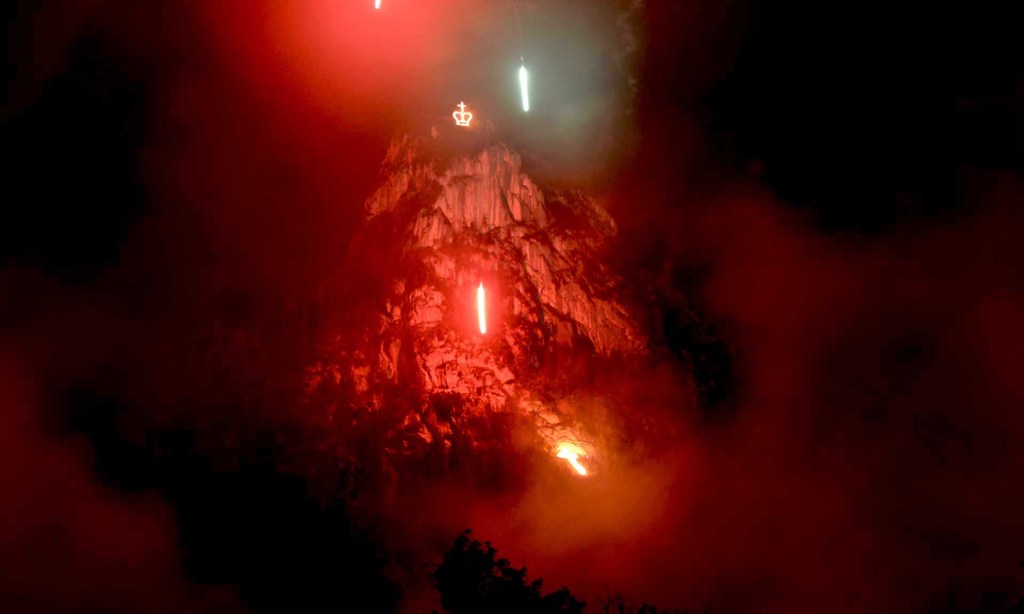
Since 1888, residents in the German town of Oberammergau have celebrated the eve of the birth of the Bavarian king, Ludwig II, with a dramatic bonfire display. Germans call this 24 August event the König-Ludwig-Feuer or Ludwigsfeuer. In the Bavarian dialect, that name translates to Luggi-Feier.
The Annual King Ludwig Bonfire (König-Ludwig-Feuer)
The focal point of the Ludwigsfeuer is the Kofel, Oberammergau’s distinctive mountain. (Often depicted on souvenirs and postcards, the Kofel bears a slight resemblance to Switzerland’s Matterhorn.)

On top of the Kofel, male “fire-makers” (Feuermachers) construct a wooden crown that’s about 14 meters (46 feet) tall. Farther below, on the Kofel’s slopes, the men craft a cross out of timber. And on other neighboring mountaintops in the Ammergau Alps, the fire-makers erect a wooden “L” and a “II” — short for “King Ludwig II.”
The 90 or so Feuermachers are all locals, and many of them are descendants of past fire-makers.
Preparation for the Ludwigsfeuer begins months in advance. First, the fire-makers cut timber and set it out to dry. Later, they carry the wood up to several mountains in the valley, including the Kofel. The Kofel’s peak is 1,342 meters high (about 4,402 feet).
On August 24th, around nine in the evening, shots from a gun salute echo through the valley. This signifies the beginning of the event. Shortly thereafter, the fire-makers set the crown, cross, and initials ablaze. Occasionally, you can hear the fire-makers yodeling and singing — even if you’re down in the valley, far below.
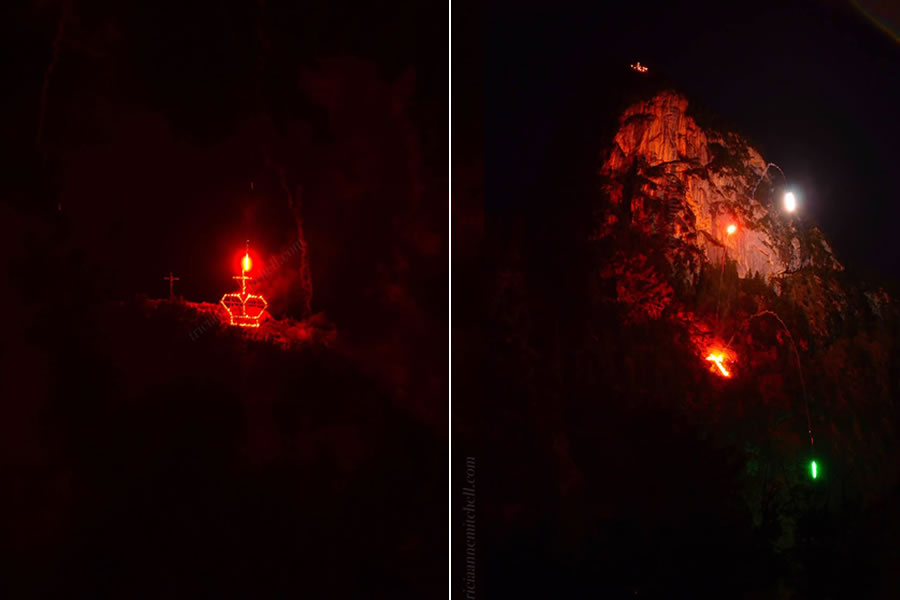

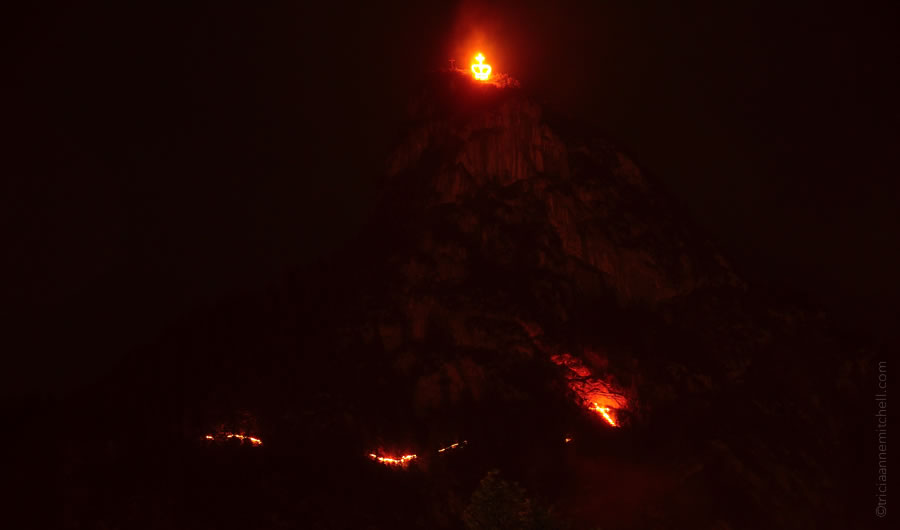
As the fire devours the wooden symbols visible throughout the valley, a traditional brass band plays Bavarian music. The band eventually wraps up by playing the Bavarian anthem.
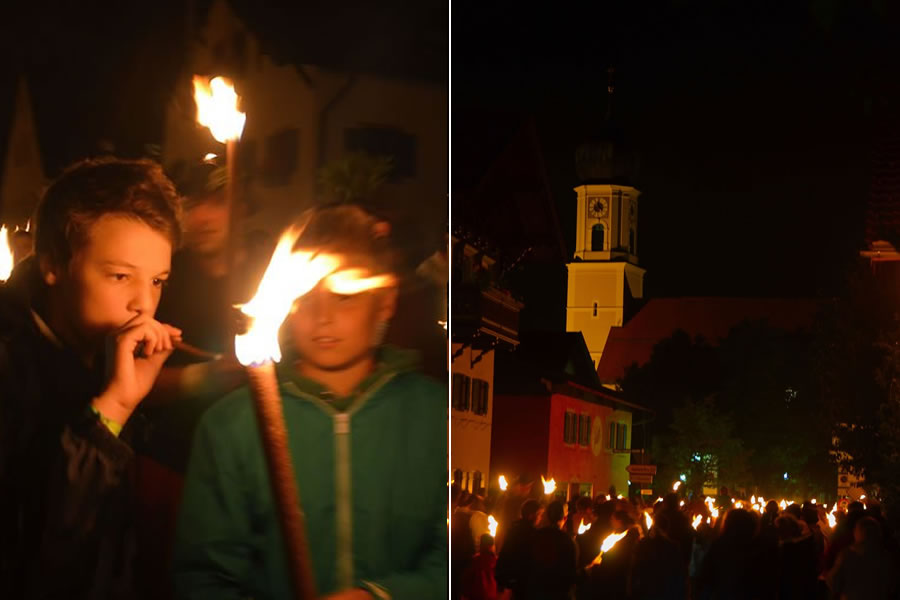
When the fires die out, the fire-makers begin to make their way down from the Kofel, using torches to light the way through the forest. From the ground, this string of men looks like a glowing snake. (I’ve climbed to the top of rugged Mount Kofel by day, and I imagine the trails must feel rather treacherous when it’s dark!)
Once the fire-makers are back in town, they join Oberammergau residents and walk in a procession through the main streets. Brass band musicians and drummers provide a soundtrack for this spectacle. Eventually, the fire-makers and musicians arrive at the Gasthof Rose, a traditional inn. There, with hearty food and much beer, they celebrate until the wee hours of the morning.
My parents live in Oberammergau, and my father’s birthday is the same day as Bavaria’s much-loved king. Since my parents’ home has a great view of the Kofel, my mom and dad often hold get-togethers during the King Ludwig Bonfire. They kick off their celebration with a late-afternoon cookout, and the evening culminates with the fiery bonfire.
The year Shawn and I were able to attend my parents’ shindig, my mom incorporated Bavarian flair into the otherwise American cookout. She set the tables with blue-and-white linens reminiscent of the Bavarian flag. She also used a crown-shaped cookie cutter to make appetizers befitting a royal.
The Bonfire’s Origins and King Ludwig’s Connection with Oberammergau
To international visitors, King Ludwig is perhaps best known as the “fairy-tale king” who commissioned several of Germany’s most famous castles. They include Neuschwanstein (after which the Disney Castle was modeled), Linderhof, and Herrenchiemsee.
King Ludwig had close ties with Oberammergau, likely because his smallest palace (Linderhof) is only a few kilometers away.
In 1871, King Ludwig also attended a special performance of Oberammergau’s world-famous Passion Play. This event inspired the king to donate a marble crucifixion monument to the people of Oberammergau.

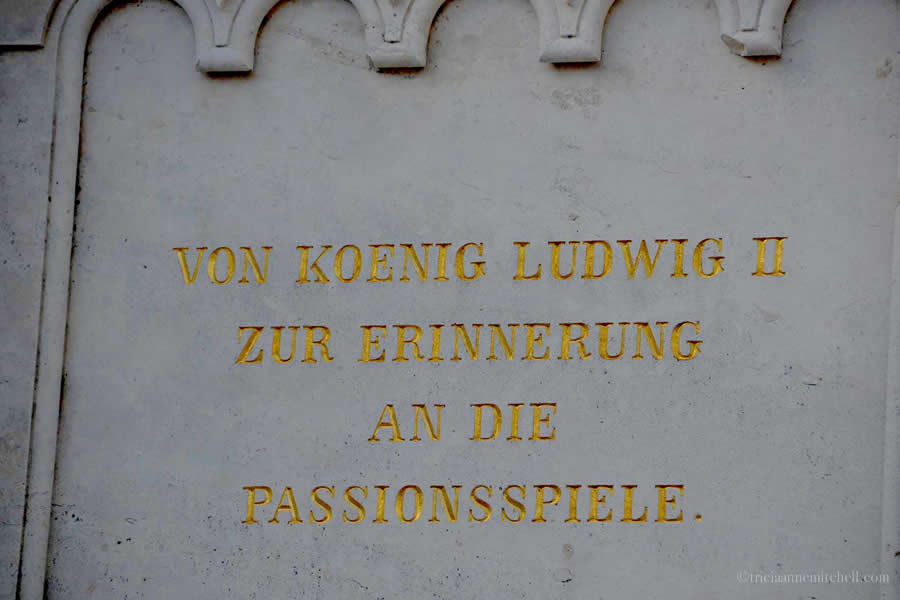
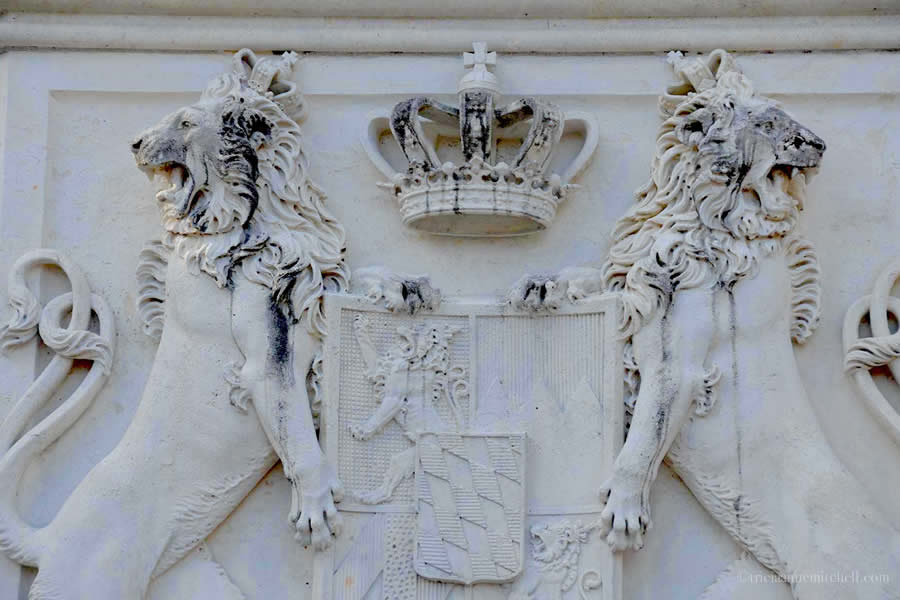
The Crucifixion Monument (Kreuzigungsgruppe), as it’s called, was initially the tallest stone monument of its kind. Weighing 58 tons, the sculpture’s transport presented logistical challenges. Sadly, several laborers were killed while moving it through the rugged mountains. In October 1875, the Crucifixion Monument was inaugurated with a fiery unveiling. It’s believed that the King Ludwig Bonfire that continues to this day has its origins in that event.
After King Ludwig’s mysterious death in 1888, several Oberammergau residents lit a fiery memorial on the Kofel to honor the dead king. A bonfire has taken place annually ever since, come rain or shine. The event has been cancelled a few times, however, when dry-weather conditions would’ve made it dangerous to hold such a spectacle.
The royal crown symbol that you see at the bonfire today was not added to the Ludwigsfeuer event until 1946.
More Information:
- Feuer und Flame – Ludwigsfeuer in Oberammergau, a YouTube video showing the “fire-makers” lugging timber up steep mountain trails. It also shows the bonfire, process, and pub celebrations that follow afterwards. The video is in German, but the imagery is worth a peek!
- The Life of King Ludwig II – An Eternal Mystery, a page about King Ludwig on the website of the Ammergau Alps Tourism Office.
- King Ludwig II of Bavaria, a short biography about King Ludwig on the website of the Bavarian Palace Administration.
Where in the World?
Planning Pointers:
- Oberammergau is located 90 km (55 miles) southwest of Munich.
- The König-Ludwig-Feuer, or Ludwigsfeuer for short, is held in Oberammergau annually on 24 August, the eve of King Ludwig’s birthday. The celebration usually starts around 09:00 pm. and continues to approximately 11:00 pm. For details about the upcoming bonfire, refer to the Ammergau Alps website or the Ammergau Alps Facebook page.
- Are you looking for accommodation in Oberammergau? Here is my round-up of hotels organized by theme.
- I’ve heard that many visitors to Munich embark on organized tours for the spectacle — perhaps even staying overnight in Oberammergau.
- If you’ll be traveling throughout the region of Bavaria via public transport, consider getting a Bavaria Ticket (German: “Bayern Ticket”). As of 2025, these tickets start at €32. You can use the Bayern Ticket for most trains, trams, and city buses, making it a good deal if you’ll be doing a lot of exploring in one day. You can purchase tickets online, via a ticket machine, or in person.
- The following page indexes all my posts from Germany, including visits to King Ludwig’s Neuschwanstein Castle and Schloss Linderhof.
Photography & text © Tricia A. Mitchell. All Rights Reserved.


Join the conversation.