
When spring returns to Croatia, residents do what they’ve done for centuries: take to the fields and forests in search of wild asparagus, known in Croatian as šparoga.
The asparagus-hunting season has just begun here in central Dalmatia, and last weekend, we were lucky enough to be invited by Croatian friends to go foraging for it in the countryside, about a 40-minute drive from the historic town of Trogir.
Skip Ahead:

Before we left to go on our hunting mission, several locals explained how difficult it is to find asparagus. Everyone kept telling us that you “must have a good eye.” But when they marveled at how delicious the asparagus was – in risotto, soup, or with hard-boiled eggs – we concluded that it was a challenge worth undertaking


We piled into our friend’s car, heading first to the home of her brother and her mother, an accomplished asparagus huntress. Though there was a chill in the air, it was a beautiful, sunny Sunday, and we sat on Božana’s mother’s terrace enjoying splendid Turkish coffee, which is rich, sweet, and has a thick sludge of sediment swirling at the bottom.
We also sipped homemade Višnia, a local version of a cherry brandy. When Božana’s mother recognized our amazement that her garden had so much life in March, she generously snipped a bunch of hyacinths and rosemary for us, as well as a handful of lemons from a small tree. Božana’s young son also brought his mother a bouquet of wild hyacinths – something that can be found in the countryside.
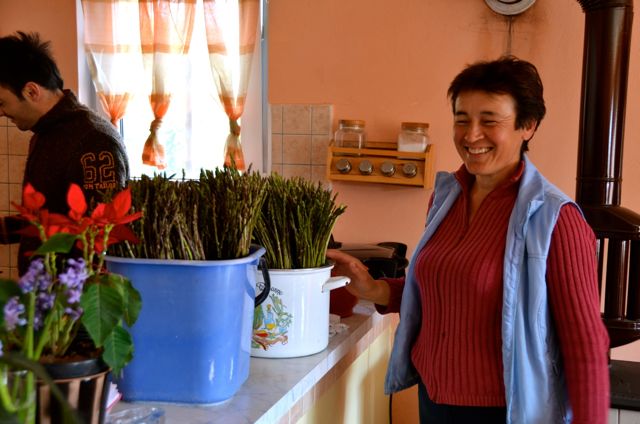

Božana’s brother explained that he’d once lived in Zagreb, Croatia’s capital city, but that when he was there during the grey winters, he found he missed the warmth of the coast.
“I need this daily dose of happiness,” he said, pointing to the rays of sunshine.
After a short drive to the rugged countryside, which looks otherworldly given the rocks and boulders that are strewn everywhere, we arrived at Božana’s charming country home.
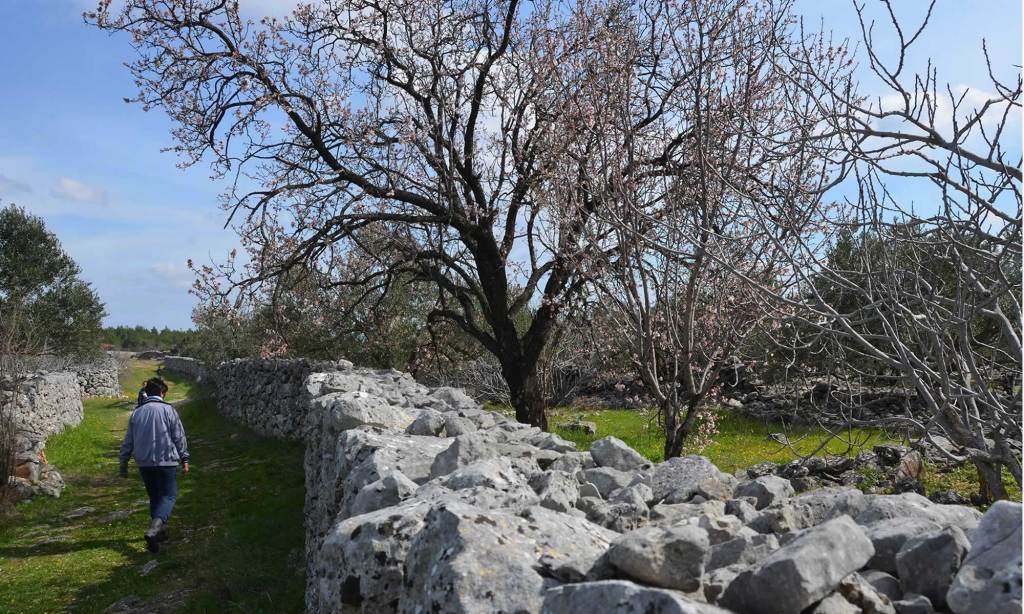
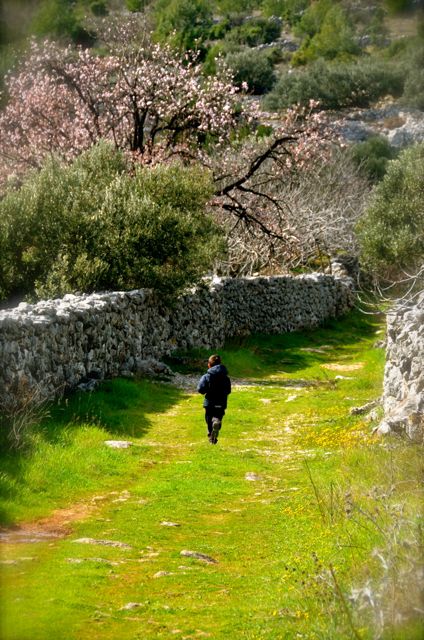
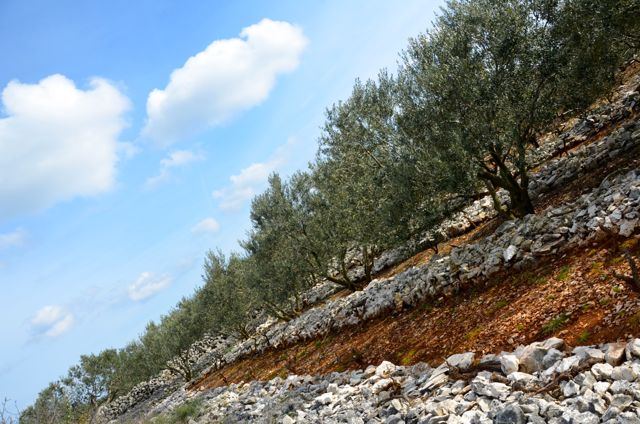
Dry stone walls delineated different owners’ plots of land. However, there were no other homes in sight, just modern windmills in the distance. Small fruit trees lining the inside of the walls bore delicate pink blossoms.
Božana and her mother told us that the atmospheric stone walls crisscrossing the land were probably constructed a hundred years ago. Farmers would have cleared the rocks from the landscape so that they could engage in agriculture. Croatians call these stone walls gromače or suhozid. As with drystack walls in other parts of the world, they’re made without using any mortar.

The duo wasted no time in schooling us how to properly forage for wild asparagus. The instructions were short, but the mission proved to be challenging: scan the ground for the prickly, dead growth of years past, because stalks of asparagus often emerge in its vicinity.

Quickly, the ladies had found their first prize. For about 40 minutes, I wandered the area, unable to spot any asparagus among the dead growth that I now easily recognized. When Božana found asparagus, she sometimes waited to harvest it, allowing me the pleasure of plucking it from the earth. As I tugged at the stubborn plant, I was glad that I’d worn gloves, since the bush’s dead growth is sharp and needle-like.
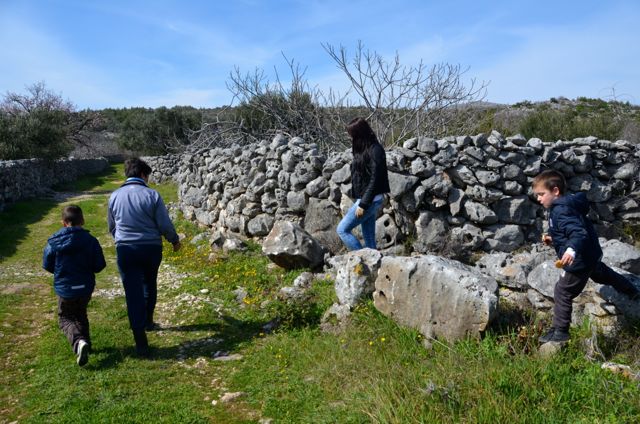
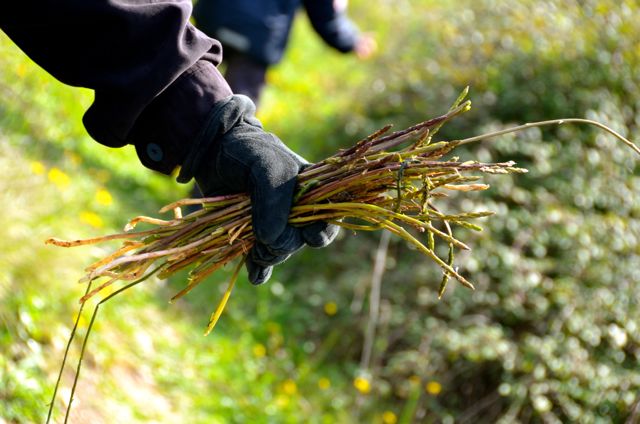

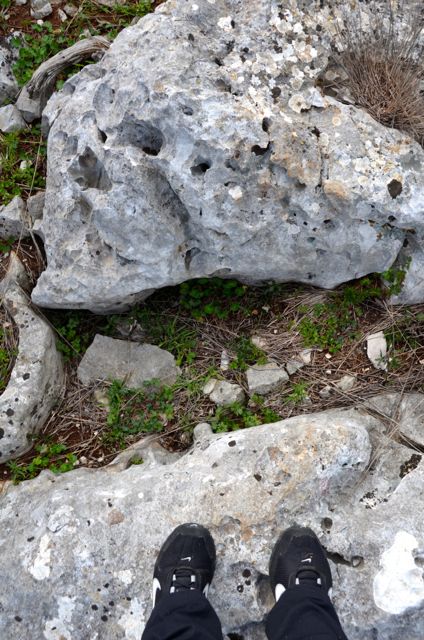
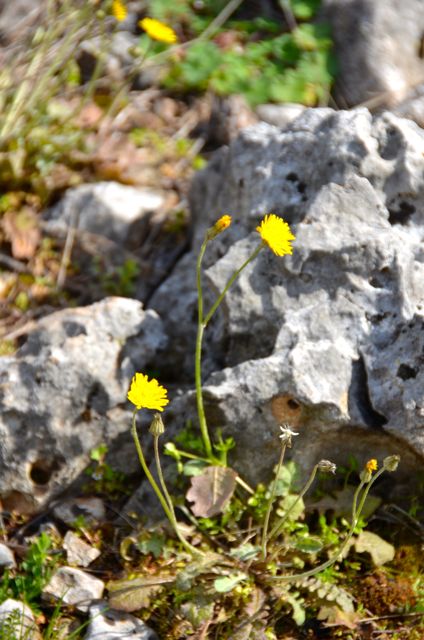
We foraged for asparagus among groves of olive trees and twisty grape vines, stopping briefly at a pond with small frogs. Božana’s sons and mother gathered branches to fill the wood-burning stove we’d be using to cook the meat we’d picked up at a butcher shop earlier in the day.


Among the bushes and rocky landscape, we happened upon a stone structure that resembled an igloo. We asked Božana what it was and she explained that it was probably built 100 years before and that it was used as a shelter for shepherds and their flock during unpleasant weather.
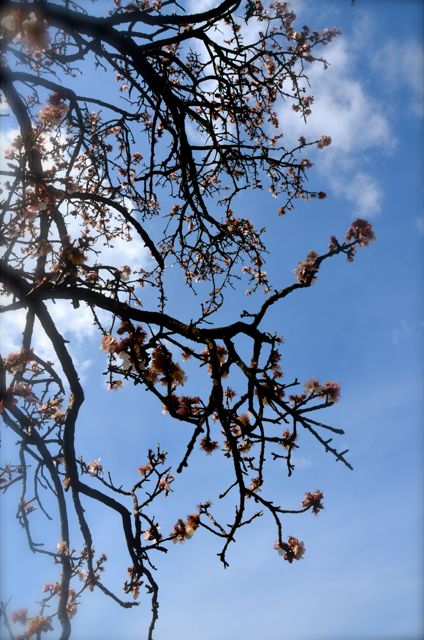

Božana and I would continue hunting for asparagus for a while longer, while Shawn went off to play basketball with Božana’s two sons. Božana’s mother also went to get the fire started in the wood-burning barbecue. Unfortunately, Božana’s husband had developed a cold, so he’d been unable to join us.
Finally, I hit the asparagus jackpot – a tangled area in a corner, hugging a stone wall! I was happy to contribute to the meal that the ladies were working so hard to create.
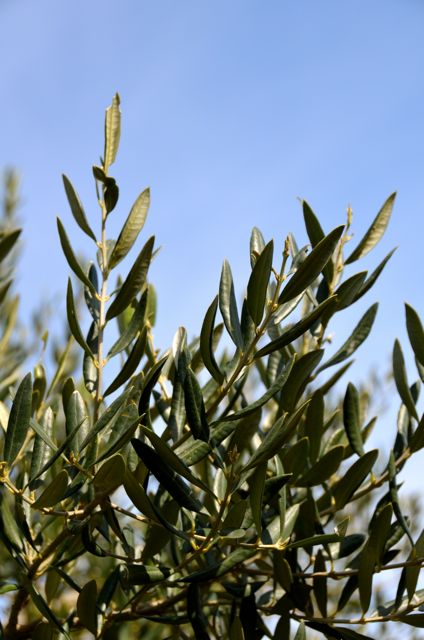
Thirty minutes later, with small bunches of asparagus in hand, Božana and I headed back to her home. To get there, we wove through the family’s hundred or so olive trees whose fruit they harvest to make their own olive oil in the autumn months. Our quitting time couldn’t have been better timed, for just when we returned home the weather started to get dramatically cold. The brisk bura wind that we’d experienced the day before while sailing on the Adriatic, had returned.


Inside the home, the ladies taught me how to make the traditional Dalmatian dish that we’d be enjoying shortly:
Croatian Wild Asparagus and Hard-Boiled Eggs Recipe
A traditional Dalmatian dish.
Ingredients:
- bunch of wild asparagus
- sea salt
- olive oil
- 6 to 8 hard-boiled eggs
- vinegar
- salt and pepper to taste
Preparation:
- Wash the asparagus. Break off the woody ends (the bottom portion of the stalk) by gently snapping the stalk just at the point where it easily bends. Discard the woody ends of the asparagus stalks. (Note that you can use the bottom of the stalk for making stock; I haven’t tried this yet.)
- Boil the top portions of the asparagus in a pot of lightly salted water. Add a bit of olive oil to the water. Cook until tender — about 6 minutes.
- Combine the asparagus with 6 to 8 hardboiled eggs. Toss them with a blend of olive oil and a splash of vinegar. Add salt and pepper to taste.
Dobar tek! (Enjoy your meal.)
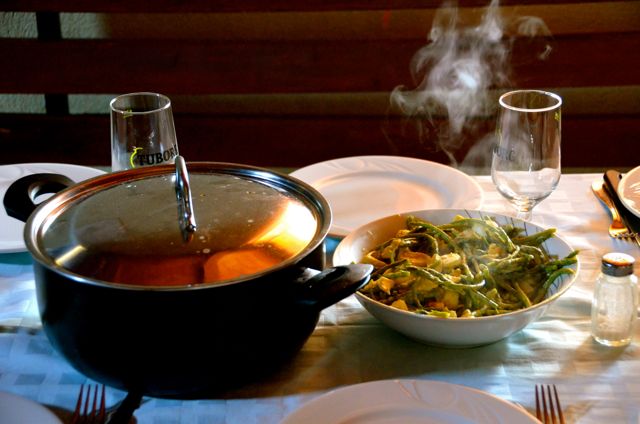
When we set the hot bowl of the celebrated Dalmatian dish on the table, steam danced up into the chilled air.
Everyone quickly dove in. With many children averse to eating vegetables, I was impressed that the boys devoured them with such gusto. I guess their fervor illustrates how delicious the dish really was.
The wild asparagus had a more intense flavor than its farmed counterparts.
Simply put, it was delicate and divine.
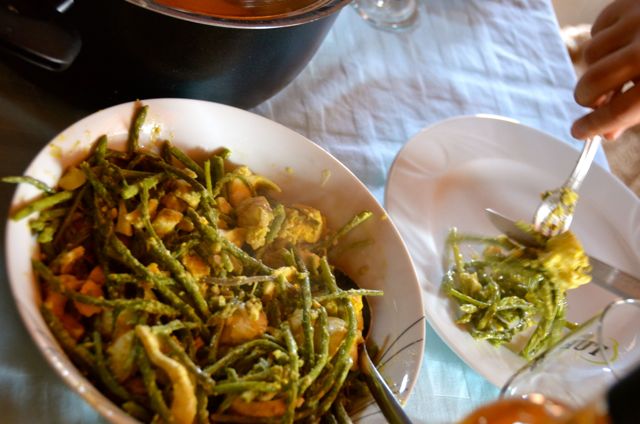
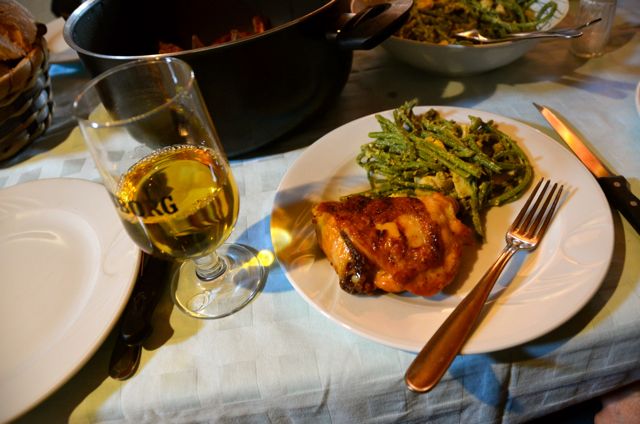
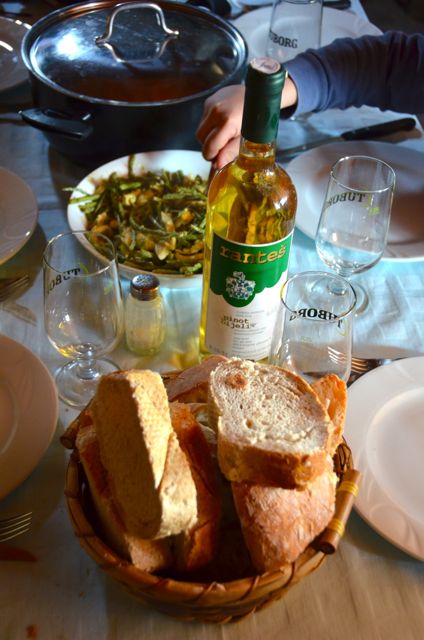
Our lunch was rounded off with a 2008 Pinot Bijeli (a semi-sweet white wine), roasted chicken and pork, crusty, fresh bread; and strong Croatian coffee.


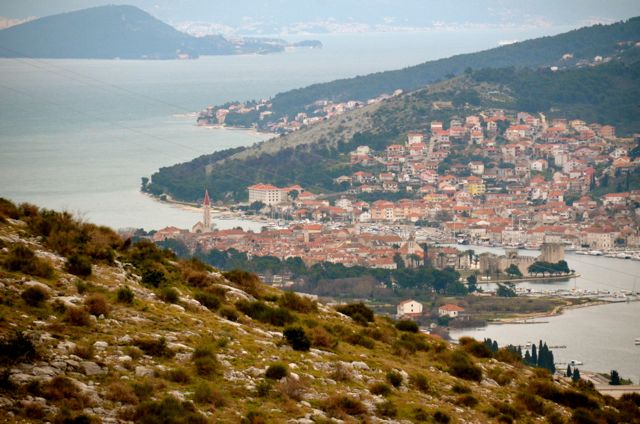
On the ride back to our home away from home in Trogir, we encountered a flock of sheep crossing the road. We briefly stopped at an overlook point to glimpse the dwarfed Trogir far below.
After a weekend of sailing and asparagus hunting — with such extraordinary food swirling in our bellies — we returned home utterly relaxed.
We felt grateful that our friends shared such a marvelous part of Croatian springtime culture with us.
Where in the World?
Planning Pointers:
Wild asparagus grows in Croatia’s Dalmatia and Istria regions. It also grows in other parts of the Mediterranean. After this experience, we encountered wild asparagus in Montenegro and Malta, too.
It’s possible to buy a bunch of asparagus at one of Croatia’s local “green markets.” However, if you get the chance, it’s much more fun harvesting your own.
Tips for harvesting wild asparagus in Croatia
When is Croatia’s wild asparagus harvest season?
Croatia’s wild asparagus can emerge at different times, depending upon how cold the winter was and how much rain there’s been. In general, you’ll find it in Dalmatia between March and mid-April.
The only certainty is that once it appears in the landscape, it’s quickly harvested by locals with eagle eyes!
How can you identify wild asparagus and harvest it?
Several different types of asparagus grow in Croatia. Oštrolisna šparoga or thorny-leaved asparagus — the type we harvested on our friends’ property — is common in coastal areas. Its Latin name is Asparagus acutifolius.
Oštrolisna šparoga isn’t a protected species. However, Croatia does protect other species of wild asparagus, so be certain you’re picking the unprotected variety. If in doubt, ask a local with expertise.
To find wild asparagus, scan the ground for the prickly, dead growth of past years, since stalks of asparagus often emerge in its vicinity. The asparagus bush can be thorny, so you might prefer to wear gloves when harvesting it. Often, you’ll find asparagus shoots emerging from rock walls.
Instead of pulling the asparagus shoot out with its root, simply find the point where the stalk naturally snaps. Gently break it there.
The upper part of the stalk is tender, whereas the bottom portion tends to be woody in texture. You can discard the bottom part, but I’ve also read that you can also use it for making stock.
Be wary of snakes and ticks, too.
Here’s a video showing how to find wild asparagus.
Looking for more Croatia trip-planning inspiration?
See all my posts from Croatia.
Photography & text © Tricia A. Mitchell. All Rights Reserved.


Leave a reply to rigmover Cancel reply